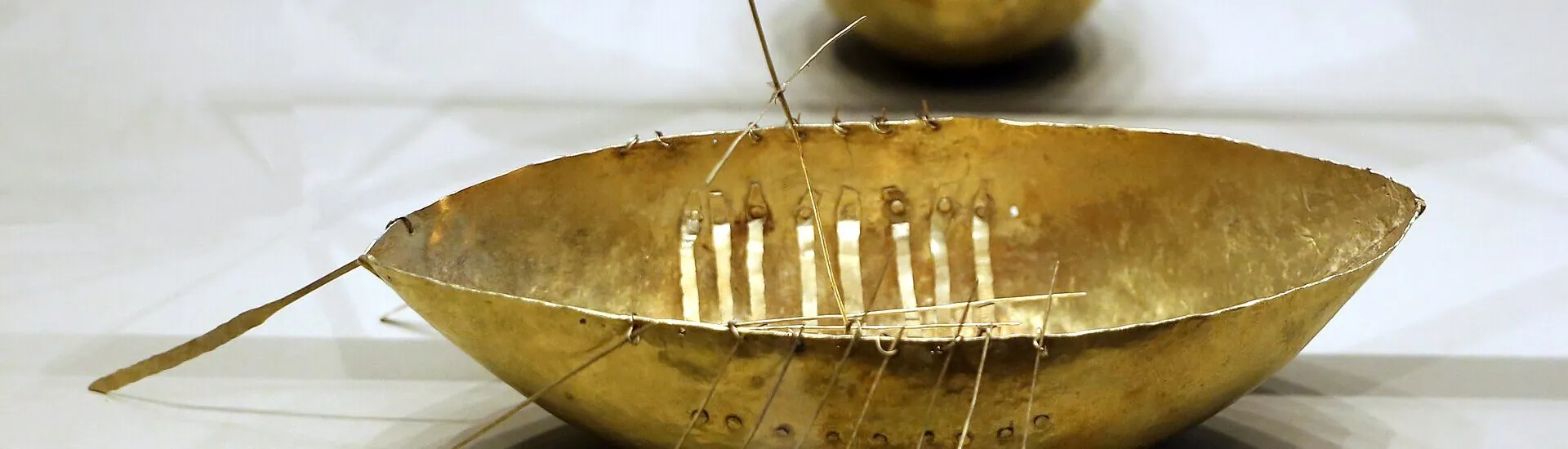
It measures barely 20 centimetres, yet it has a mast, rowing benches and tiny oars. The Broighter Gold Boat depicts a vessel with remarkable precision for an object around two thousand years old. Discovered in 1896 near Lough Foyle in County Derry, it forms part of an Iron Age hoard now held in Dublin. Its appearance immediately catches the eye. Its purpose, however, remains open to interpretation.
The Broighter Boat is a gold model generally dated, like the rest of the hoard to which it belongs, to the 1st century BC. It comes from Broighter, near Limavady, in the low-lying land beside Lough Foyle. Its discovery connects today’s agricultural landscape with an ancient coastal environment.
The boat is one of seven gold objects found together. The hoard also includes a small vessel resembling a cauldron and several neck ornaments, including a large decorated tubular collar. The group is known as the Broighter Hoard, Broighter Hoard or Broighter Gold. The boat and jewellery are best understood as elements of the same deposit.
This association raises several questions. Who could have assembled such a quantity of gold? Why place a representation of a boat alongside personal ornaments? And why leave these objects in the ground? Archaeology provides elements of context, but no contemporary text explains the act that led to their burial.
In 1896, Tom Nicholl and James Morrow were ploughing land then owned by Joseph Gibson. They unearthed the gold pieces that would make Broighter famous. The farm now operating this land preserves the story of the discovery and its connection with the two ploughmen.
The circumstances were very different from an excavation conducted using modern methods. The objects were uncovered during agricultural work, then passed through several hands before being studied. The observations published after their discovery are therefore essential to understanding their original condition and arrangement.
The boat was damaged and reshaped. Early studies do not all describe its condition in the same way. The object displayed in the museum should therefore be viewed with its history of discovery and restoration in mind. Its small accessories are among the reasons researchers took an early interest in this group.
The hull is fashioned from a thin sheet of hammered gold. The model is around 18.4 centimetres long. Crosspieces occupy the interior, representing the rowers’ seats. At its centre stands a mast, together with a yard, the transverse spar designed to carry a sail.
The oars are particularly delicate. A long steering oar would have been used to guide the vessel depicted. Other fittings also suggest poles and a grappling hook. Visitors can follow the outline of the hull, then examine the seats and finally the movable elements. A close-up photograph helps reveal details that are easy to miss behind the display case.
The model offers an insight into ancient maritime culture, but it must be interpreted with caution. A goldsmith depicted a boat on a reduced scale, subject to the constraints of the material and its assembly. The model does not necessarily reproduce every feature of a full-sized vessel.
The National Museum of Ireland presents the deposit as a possible offering to Manannán mac Lir, a divine figure associated with the sea in Irish tradition. Lough Foyle itself has a mythological connection with Manannán. The presence of a gold boat near an ancient shoreline lends particular meaning to this interpretation.
Under this hypothesis, the hoard would have been deliberately dedicated. The gold may have been used to honour a protective power in a world where sea travel exposed travellers to dangers that were difficult to predict. The object’s maritime form makes this proposition appealing, without allowing its recipient to be identified with certainty.
It is important to distinguish between the age of the boat and the mythological accounts preserved in later sources. The connection with Manannán is an interpretation of the deposit. No deity’s name is engraved on the hull to confirm it. This uncertainty is part of the hoard’s fascination.
The great Broighter collar provides another perspective. Its decoration includes stylised bird and horse motifs. The museum notes that precious collars are associated with kings and gods in the Celtic world. The wealth of the deposit may therefore be linked to local authority and its ritual practices.
Some ornaments in the group also point to connections with the Roman world. The hoard invites us to view Iron Age Ireland as a territory engaged in the movement of objects and styles. The miniature boat takes on a particular resonance amid this evidence of exchange.
After its discovery, the hoard passed through the antiquities market and was acquired by the British Museum. Where it should be kept then became the subject of legal proceedings, which concluded in 1903. The debate concerned, in particular, the intention of the people who had deposited the gold.
An offering deliberately abandoned and a hoard concealed in the hope of later recovery did not carry the same legal interpretation. The court ruled that it was treasure trove, awarding the objects to the Crown. The deposit subsequently joined the national collection in Dublin.
The boat’s history therefore involves two successive mysteries. The first concerns its ancient purpose. The second, far better documented, concerns the status of objects found in a field and which became a heritage claim contested by institutions.
The original boat is held at the National Museum of Ireland – Archaeology in Dublin. It is displayed with the Broighter Hoard in The Treasury gallery. The official presentation of the Broighter collar offers an initial overview of the deposit’s context.
At the display case, look first at the model, then at the great collar and the other pieces. The comparison reveals several ways of working gold, from the almost unadorned hull to the raised decoration of the ornaments. For children, looking for the mast, oars and benches offers a very tangible introduction to the visit.
The Tara Brooch, displayed in the same museum’s collections, then offers a chance to discover another period of Irish goldsmithing. Before travelling to see a particular object, check the museum’s information and any changes to the display.