
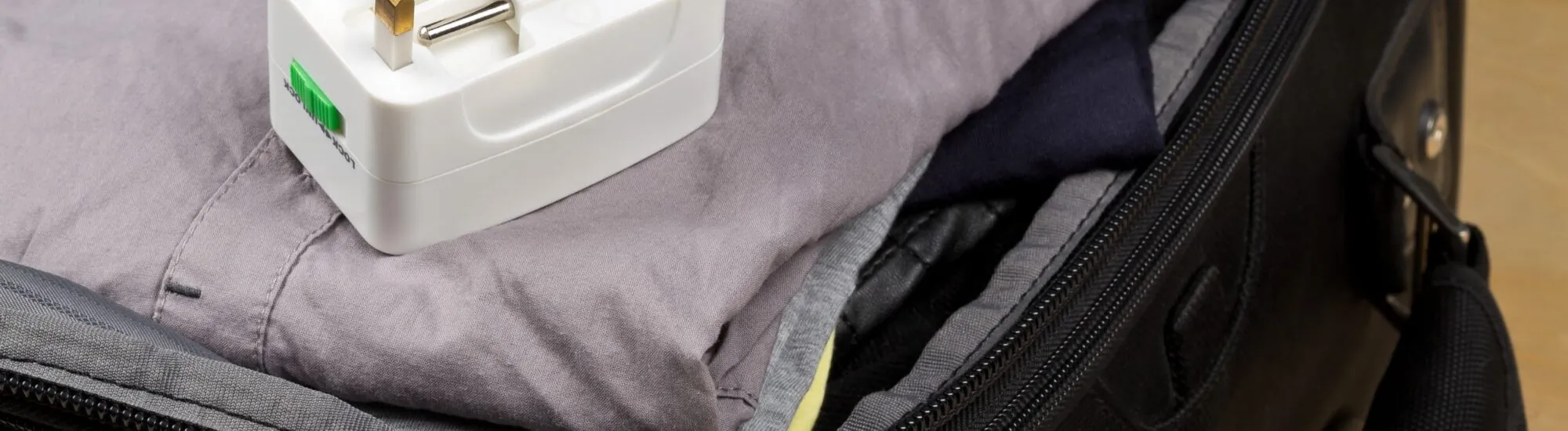
Planning a trip to Ireland? Remember to pack a Type G electrical adapter. Irish sockets have three rectangular pins, so they are not compatible with French plugs, which have two round pins.
However, you will not normally need a voltage converter. As in France, Ireland’s electricity supply operates at 230 volts and 50 hertz. In the vast majority of cases, a simple adapter is all you need to charge a phone, camera or laptop.
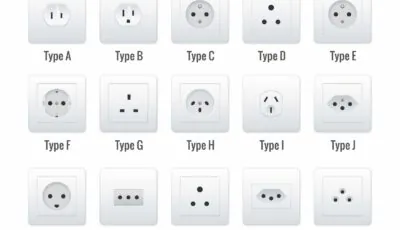
Irish electrical sockets are Type G – © Golden Sikorka
The Republic of Ireland uses Type G electrical sockets. This format is recognisable by its three rectangular openings arranged in a triangle: two are for the electrical supply and the third is for the earth connection.
French plugs are generally Type C and E. Their round pins cannot be inserted directly into an Irish socket, so you will need an adapter compatible with Type G.
This format is also used in the United Kingdom. An adapter advertised as compatible with British sockets is therefore perfectly suitable for a stay in Ireland.
Yes, travellers from France should bring an Europe-to-Ireland and UK adapter. This accessory allows you to connect a French plug to an Irish socket without altering how the appliance operates.
Simply plug your charger into the adapter, then insert it into the wall socket. Some models offer several USB or USB-C ports, allowing you to charge several small devices from a single socket.
The same adapter works throughout the island, in both the Republic of Ireland and Northern Ireland. You can therefore use it in Dublin, Galway, Cork, Belfast or Derry.
Ireland’s electricity supply operates at a voltage of 230 V and a frequency of 50 Hz. These values are identical to those of the French network.
The difference between the two countries is therefore not the electrical current, but chiefly the shape of the plugs. Phones, laptops, cameras and other equipment bought in France can generally be used without a converter.
The claim that Ireland has a specific voltage compared with the rest of Europe is therefore incorrect. When travelling from France, electrical compatibility does not usually present any difficulty.
A plug adapter changes only the shape of the connection. It allows a French plug to fit into an Irish socket, but does not alter the voltage.
A voltage converter changes the electricity received by the appliance. For example, it may be needed to use equipment designed exclusively for 110 or 120 V on a 230 V supply.
As French appliances are normally designed for 230 V, they require only an adapter in Ireland. The question of a converter mainly concerns certain items bought in the United States, Canada, Japan or other countries that use a different voltage.
Before plugging in any equipment, look for the word Input or Entrée on its charger, power supply or rating plate.
If it states 100–240 V, 50/60 Hz, the appliance can be used in Ireland. This applies to most chargers for recent phones, tablets, e-readers, cameras and laptops.
An appliance marked 220–240 V, 50 Hz is also compatible with the Irish electricity supply.
However, equipment marked solely 110 V or 120 V must not be plugged in using a simple adapter. It could overheat, be damaged or cause a fire.
Recent smartphone chargers generally accept voltages between 100 and 240 V. You can therefore use your French charger in Ireland by adding a Type G adapter.
Some hotels, airports, ferries and trains offer USB ports. However, their availability and power output are not guaranteed. An older port may also charge your phone much more slowly than a recent USB-C charger.
The most reliable option is to bring your own charger along with a good-quality adapter.
Laptop power supplies are almost always designed to accept voltages between 100 and 240 V. Nevertheless, check the information shown on the charger before you leave.
A Type G adapter is sufficient if the power supply is compatible. However, it must be able to support the charger’s wattage, particularly for gaming laptops or workstations with high-power supplies.
Where the mains cable can be detached from the power supply, you can also use a cable fitted directly with a British plug. This can sometimes be more stable than having a heavy power supply hanging from a small adapter.
Hairdryers, straighteners, curling irons and other heated appliances use far more electricity than a phone. You should therefore check their voltage, wattage and the adapter’s maximum capacity.
A French appliance operating at 220–240 V can be used in Ireland with a sufficiently robust adapter. A model designed exclusively for 110 or 120 V, however, must never be plugged directly into an Irish socket.
Small travel converters are not always capable of powering heated appliances. If in doubt, use the hairdryer provided by the hotel or choose an appliance designed to operate at 230 V.
Both the Republic of Ireland and Northern Ireland use Type G sockets supplied at 230 V and 50 Hz.
This uniformity makes cross-border itineraries easier. One adapter is enough to visit the entire island, even though Northern Ireland is part of the United Kingdom.
Many Irish wall sockets have a small switch. It allows you to turn the power on or off without removing the plug.
If your device does not charge after being plugged in, check that the switch is in the on position. A socket that appears faulty is sometimes simply switched off.
It is best to switch off the power before removing the adapter, particularly when a high-power appliance is connected.
British and Irish plugs meeting the Type G standard normally incorporate a fuse. Some travel adapters have one too, but this is not necessarily the case for every product sold online or at low prices.
The presence of a fuse does not guarantee absolute safety. A poor-quality, overloaded or damaged adapter can still heat up and create a poor connection.
Choose an accessory from an identifiable manufacturer that clearly states its maximum voltage, current and wattage. Avoid models that are cracked, warped or hold plugs loosely.
A French extension lead can be connected to a Type G adapter to charge several small devices. This arrangement is useful in accommodation with few sockets.
However, the combined wattage of the appliances must not exceed the capacity of either the extension lead or the adapter. This solution is better suited to phones, cameras and smartwatches than to several heated appliances.
Avoid linking several adapters or extension leads together. Such setups increase the risk of poor connections, overloading and overheating.
Type G adapters are available from electronics shops, DIY retailers, some supermarkets and specialist travel shops. They are also easy to order online.
You can buy them at airports, ferry ports and in many Irish shops. Prices may be higher there, and the choice more limited, than before departure.
Prices vary according to quality and features. Rather than always looking for the cheapest model, choose an adapter that is sturdy, clearly identified and suited to the wattage of your equipment.
For a stay solely in Ireland or the United Kingdom, a dedicated Type G adapter is generally the best choice. It is compact, easy to use and often fits more securely in the socket than a bulky universal model.
A universal adapter becomes useful if you regularly travel to countries using several plug formats. Some models also have USB and USB-C outputs that allow several devices to be charged at once.
Check the total power delivered by the USB ports, especially if you want to use fast charging or power a computer via USB-C.
Some hotels and guesthouses lend adapters to their guests. The number available is often limited, particularly during busy periods.
More recent establishments may also offer European sockets or built-in USB ports. However, this equipment is not standard, particularly in older buildings.
It is therefore better to bring your own adapter than rely on one from your accommodation.
In bathrooms, some sockets are intended exclusively for electric shavers. Their power is limited: they must not be used to run a hairdryer or other power-hungry equipment.
For a standard stay, bring a good-quality Type G plug adapter. You will then be able to charge your phone, computer, camera and most of your French equipment.
A voltage converter is unnecessary for appliances marked 220–240 V or 100–240 V. Only equipment designed exclusively for another voltage requires a specific solution.
If you are travelling with several devices, a multi-port USB charger used with a single adapter can simplify your connections and lighten your luggage.