
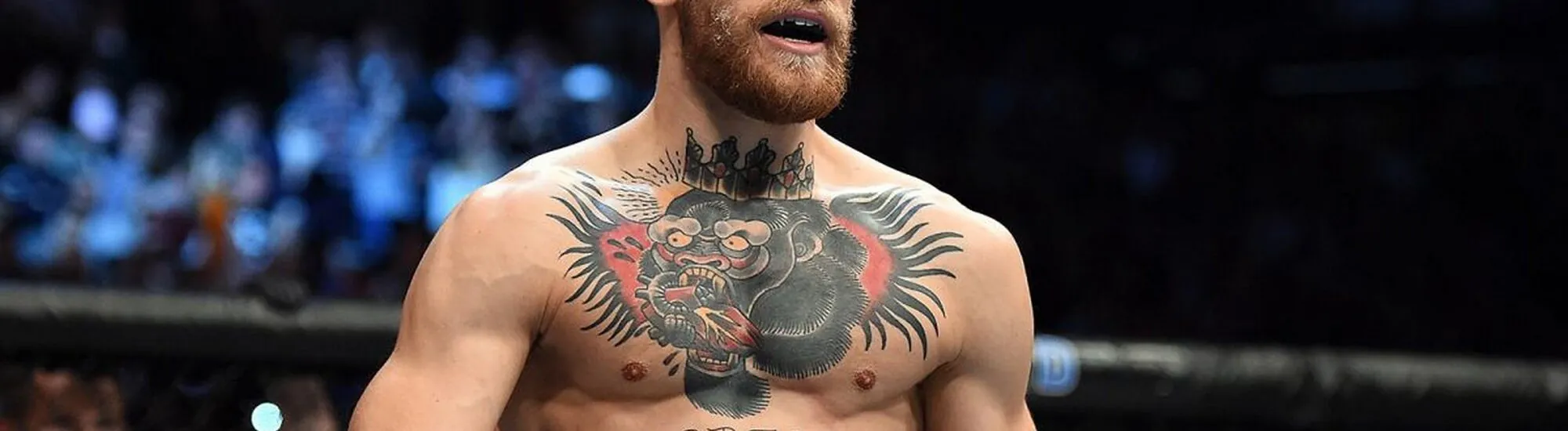
He was the first fighter in UFC history to hold two world titles simultaneously. On the journey from the boxing gyms of Crumlin to the arenas of Las Vegas, Conor McGregor turned his striking precision, flair for provocation and Dublin accent into a global brand.
But the story of a champion who rose from almost nothing is no longer enough to define him. Behind the victories that transformed MMA lie a lengthy absence from the sport, several convictions and a major ruling in the Irish civil courts. Idolised at the height of his career, McGregor has become a deeply controversial figure whose influence now extends far beyond the octagon.
Conor McGregor – Andrius Petrucenia – cc
Conor Anthony McGregor was born in Dublin on 14 July 1988. He grew up in Crumlin, a working-class district in the south of the Irish capital, with his parents, Tony and Margaret McGregor, and his two sisters.
A keen sportsman, he began by playing football. At the age of 12, he joined Crumlin Boxing Club, where he learned the fundamentals of boxing from Phil Sutcliffe, a former Irish Olympic boxer. This early work on footwork, range and left-hand power would play a central role in his future fighting style.
In his late teens, his family moved to Lucan, west of Dublin. There, McGregor met Tom Egan, through whom he discovered wrestling, grappling and mixed martial arts more seriously. At the same time, he began an apprenticeship as a plumber, a trade he quickly left behind to devote himself to training.
This period has greatly shaped the narrative surrounding his rise. Without stable employment, McGregor received Irish jobseeker’s allowance for a time and trained with limited means. His partner, Dee Devlin, whom he met in 2008, supported him through those difficult years. The couple have since started a family.
McGregor joined Straight Blast Gym Ireland, run by John Kavanagh in Dublin. There, he developed a style combining boxing, kickboxing, wrestling and Brazilian jiu-jitsu. His relaxed guard, changes of range and ability to strike while moving backwards quickly set him apart.
He had his first amateur MMA bout in 2007 before turning professional in 2008. His early career was uneven: he won several fights by stoppage, but also suffered two submission defeats, exposing weaknesses in his ground game.
From 2011, he put together a run of victories that drew the attention of Cage Warriors, one of Europe’s leading MMA organisations.
In June 2012, Conor McGregor beat Dave Hill to become Cage Warriors Fighting Championship featherweight champion. A few months later, in December, he defeated Ivan Buchinger to claim the lightweight title.
He therefore held the Cage Warriors featherweight and lightweight titles simultaneously. That achievement, coupled with a run of eight consecutive wins, persuaded the UFC to offer him a contract in 2013.
Contrary to a frequently repeated claim, Conor McGregor was not the first Irishman to fight in the UFC. That distinction belongs to Tom Egan, who appeared at UFC 93 in Dublin in January 2009. McGregor would, however, become the first Irish fighter to win a title in the organisation.
Conor McGregor – https://vimeo.com/237593610
Conor McGregor made his UFC debut against Marcus Brimage on 6 April 2013. He won by technical knockout in the first round and received a bonus for the best performance of the night.
His personality immediately commanded as much attention as his results. McGregor predicted his victories in advance, provoked opponents at press conferences and brought with him a particularly fervent Irish following. In Boston, Dublin and Las Vegas, the stands were filled with tricolour flags.
After wins over Max Holloway, Diego Brandão, Dustin Poirier and Dennis Siver, he faced Chad Mendes in July 2015 for the interim featherweight title. Despite several difficult spells on the ground, McGregor won by technical knockout in the second round.
On 12 December 2015, Conor McGregor faced José Aldo, the undisputed featherweight champion for several years. After months of taunts and a particularly tense promotional tour, the fight lasted just 13 seconds.
Aldo surged forwards, McGregor stepped back and landed a left hook that immediately sent the Brazilian to the canvas. It remains the fastest finish ever recorded in a UFC title fight.
The victory made McGregor the undisputed featherweight champion and one of the biggest stars in combat sports history. His ability to predict and then deliver on some of his forecasts earned him another nickname: “Mystic Mac”.
In March 2016, McGregor moved up a weight class to face Nate Diaz. After a strong start, he tired and lost by submission in the second round. The defeat ended a run of 15 consecutive victories.
The two men met again in August 2016. McGregor adopted a more measured strategy and won by majority decision after five punishing rounds. The rematch became one of the most lucrative events in UFC history.
On 12 November 2016, McGregor faced Eddie Alvarez for the lightweight title at UFC 205, the first UFC event held at Madison Square Garden in New York. The Irishman dominated the champion and won by technical knockout in the second round.
Already the holder of the featherweight belt, he became the first fighter in UFC history to hold titles in two divisions at the same time. Others had been champions in more than one division, but none had previously retained both belts simultaneously.
That night marked the sporting peak of his career. McGregor would not defend either belt, however. He was stripped of the featherweight title at the end of 2016 and the lightweight title in April 2018, following a long period of inactivity.
On 26 August 2017, Conor McGregor temporarily left MMA to face Floyd Mayweather Jr under boxing rules. The American, unbeaten in 49 professional fights, came out of retirement for the occasion.
McGregor started well and won several of the early rounds according to some judges. Mayweather nevertheless allowed his opponent to tire, gradually increased the pressure and won by referee stoppage in the tenth round.
The contest was therefore not a lasting move into boxing for McGregor. Above all, it remains an extraordinary commercial event, watched around the world and generating considerable revenues for both fighters.
McGregor returned to the UFC in October 2018 in an attempt to reclaim the lightweight title from Khabib Nurmagomedov. The rivalry quickly went beyond the usual limits of sports promotion. A few months before the fight, McGregor was notably involved in an attack on a bus carrying UFC fighters in New York.
In the octagon, Nurmagomedov imposed his wrestling and submitted the Irishman in the fourth round. A brawl then broke out around the cage involving several members of both teams. Sporting commissions imposed suspensions and fines following the incident.
In January 2020, McGregor returned to winning ways by stopping Donald Cerrone after just 40 seconds. However, it remains his most recent victory to date.
In 2021, he faced Dustin Poirier twice. The American won the first fight by technical knockout in January. In their third meeting, in July, McGregor fractured his left tibia at the end of the first round. The doctor stopped the fight and the victory went to Poirier.
The seriousness of the injury led to surgery followed by a very long rehabilitation period. A return against Michael Chandler was announced for June 2024, but McGregor withdrew because of a broken toe sustained in training.
After five years away from the octagon, Conor McGregor finally returned on 11 July 2026 at UFC 329 in Las Vegas. He faced Max Holloway, whom he had beaten by decision in 2013, in a welterweight bout.
The comeback was short-lived. Attempting a jumping kick early in the fight, McGregor injured his knee and could no longer put weight properly on his leg. The referee stopped the contest after just 69 seconds and awarded Max Holloway a technical knockout victory.
Tests revealed a torn anterior cruciate ligament and a meniscus injury. McGregor announced that he would need further surgery. The UFC estimates that he could be sidelined for around a year, while the Irishman now suggests a possible return in summer 2027.
In August 2026, his professional MMA record stood at 22 wins and 7 losses. He has not won since his fight against Donald Cerrone in January 2020.
Conor McGregor profoundly changed the way MMA is promoted. His tailored suits, predictions, provocative language and staged press conferences drew audiences far beyond combat sports fans.
His effectiveness was not based on spectacle alone, however. At the height of his career, McGregor had an excellent sense of range, great precision and formidable left-hand power. His victory over José Aldo and his performance against Eddie Alvarez attest to genuine technical talent.
His ability to unsettle opponents psychologically was nevertheless accompanied by remarks that were at times insulting or outrageous. Over time, the boundary between sporting promotion and personal behaviour became increasingly difficult to distinguish.
McGregor’s career has been marked by several legal cases. In 2018, following the attack on a bus carrying UFC fighters in New York, he pleaded guilty to a reduced charge of disorderly conduct.
In 2019, he pleaded guilty to assaulting a customer at Dublin’s Marble Arch Pub who had refused a glass of his whiskey. The court fined him €1,000 after he apologised and paid compensation to the victim.
He has also received convictions relating to road traffic offences. These episodes have lastingly damaged the athlete’s image and contradict the sometimes romanticised narrative of a Dublin fighter driven solely by the will to succeed.
In November 2024, a Dublin High Court jury found, in civil proceedings, that Conor McGregor had raped Nikita Hand in a Dublin hotel in December 2018. The plaintiff was awarded just under €250,000 in damages.
McGregor denies the allegation and maintains that the relationship was consensual. He appealed the decision, but the Irish Court of Appeal dismissed his appeal in its entirety on 31 July 2025.
It is important to note that this was a civil action rather than a criminal trial. The ruling is therefore not a criminal conviction, but it is a judicial finding upheld on appeal. The case led to the termination of several commercial partnerships and the withdrawal of products associated with him from many Irish retailers.
In 2018, McGregor helped launch Proper No. Twelve, a whiskey whose name refers to the Dublin 12 postal district, where Crumlin is located.
In 2021, Proximo Spirits acquired full control of the brand in a deal whose potential value could reach $600 million. This figure did not represent what McGregor personally received: it related to the entire transaction, included earlier payments and was to be shared among co-founders and partners.
Since 2021, Proximo Spirits has owned 100% of Proper No. Twelve. Following the 2024 civil verdict, the company announced that it would no longer use Conor McGregor’s name or image to promote the brand.
The Dubliner has also moved into hospitality with the Black Forge Inn, a pub in Crumlin, and into beer with Forged Irish Stout. Since 2024, he has also been a co-owner of the Bare Knuckle Fighting Championship, a bare-knuckle boxing organisation.
The documentary film Conor McGregor: Notorious, released in 2017, follows several years of his rise in the sport. It is not a Netflix original production, although the documentary was available on the platform in some countries.
In 2023, Netflix devoted another documentary series to him, McGregor Forever, focusing on his fights against Donald Cerrone and Dustin Poirier, as well as his serious injury in 2021.
In 2024, McGregor made his acting debut in Road House, alongside Jake Gyllenhaal. He plays Knox, a henchman as violent as he is flamboyant.
In recent years, McGregor has made an increasing number of political statements, notably against the Irish government’s migration policy. In March 2025, he was received at the White House by US President Donald Trump for St Patrick’s Day.
His remarks were immediately disowned by Taoiseach Micheál Martin and Tánaiste Simon Harris, who stressed that he was speaking in a personal capacity and represented neither the government nor the Irish people.
McGregor then announced his intention to stand in the 2025 Irish presidential election. To appear on the ballot paper, he would have needed the backing of 20 members of parliament or four local authorities. He ultimately withdrew his candidacy on 15 September 2025, before securing the required nominations.
These episodes show how sharply his image now divides public opinion. While his sporting success was once presented as an embodiment of the “fighting Irish spirit”, a large part of Ireland’s political establishment and public now refuse to see him as a spokesperson for the country.
Full name: Conor Anthony McGregor.
Nickname: “The Notorious”.
Date of birth: 14 July 1988.
Place of birth: Dublin, Ireland.
Long-standing gym: Straight Blast Gym Ireland.
Weight divisions in which he was champion: featherweight and lightweight.
Professional record as of August 2026: 22 wins and 7 losses.
Most recent fight: defeat to Max Holloway by injury stoppage after 69 seconds, on 11 July 2026 at UFC 329.
Sporting status: sidelined with an anterior cruciate ligament and meniscus injury; a possible return has been suggested for 2027.