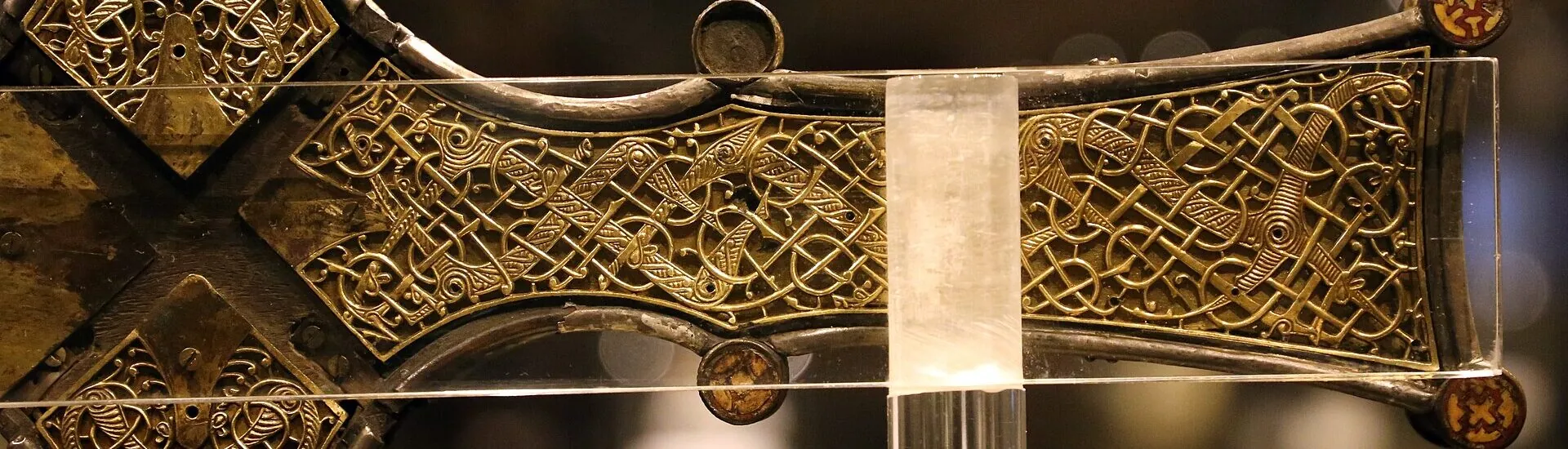
At the centre of the Cross of Cong, a polished rock crystal stands out against a surface of interlace and small animals with elongated bodies. This stone protected a relic believed in the Middle Ages to be a fragment of Christ’s cross. Made in 1123 at the request of an Irish king, the reliquary combines devotion, prestige and masterful craftsmanship. Now held in Dublin, it also bears inscriptions naming its patron and the man who made it.
The Cross of Cong is a work of religious metalwork. A reliquary is used to preserve and venerate a relic. In this case, the precious cross formed a casing around a small fragment of wood to which the faithful attributed a sacred origin.
It was designed to be carried in procession, although the National Museum of Ireland indicates that it was probably used chiefly as an altar cross. Its purpose meant that it needed to be seen, approached and recognised during celebrations. The decorated surfaces and central crystal contributed to the presentation of the relic.
The fragment of wood no longer survives. Its identification as part of the True Cross belongs to the religious tradition associated with the object. Historical research can document the commission for the reliquary and the beliefs surrounding it, without authenticating the origin of the relic itself.
The patron was Turlough O’Connor, also known as Toirrdelbach Ua Conchobair, King of Connacht and High King of Ireland. The sources presented by the museum date the acquisition of the relic to 1122 and the making of the cross to the following year.
Such a commission required more than the resources of a craftsman. It associated the ruler with a venerated object and important ecclesiastical figures. The cross therefore offers an insight into the links between royal patronage and religious institutions through a work intended for public worship.
According to a presentation by National Museum of Ireland specialist Griffin Murray, it was made at Roscommon, probably for Tuam, then kept at Cong Abbey. Its current name therefore recalls a major stage in its history. It does not necessarily indicate where the goldsmith worked.
Beneath its precious outer covering, the cross has an oak structure. Metal plates clad this wooden core. The object draws its impact from the combination of materials, relief and light, with particularly intricate decoration around the centre.
The metalwork combines several techniques. Openwork metal creates openings in the plates, while filigree forms patterns from fine gold wires. Coloured ornaments and dark details make the surfaces easier to read. Even in a photograph, several levels of craftsmanship can be seen within a few centimetres of decoration.
Research on the cross examines the materials and techniques used by Irish goldsmiths in the 11th and 12th centuries. It also reveals the limits of our knowledge of their workshops and sources of supply. The richness of a surviving object is not always enough to reconstruct the organisation of the craftspeople who produced it.
The large transparent stone draws the eye to the point where the arms meet. It held an essential place in the presentation of the relic. Its setting forms a sequence of circles and ornaments that naturally leads the eye towards the centre.
To examine it, begin by looking at the cross as a whole, then focus more closely on this central area. Look for the differences between smooth metal, wires and openwork plates. The composition becomes easier to understand when you distinguish its materials before trying to follow every pattern.
The decoration of the cross gives considerable prominence to interlaced animals in the Scandinavian Urnes style. Elongated bodies coil, cross and fit into compartments. At first glance, they may resemble ribbons. Follow a line to its end and you will discover a head or limb.
The museum’s educational material highlights the highly controlled organisation of these motifs in their Irish adaptation. Symmetry and repeated forms structure the decoration. It can take several looks at a panel to understand the path of an animal.
This Scandinavian presence in an Irish Christian commission recalls the circulation of artistic models. The cross belongs to a period when craftspeople adapted forms from several traditions. Seeing them solely as signs of separate groups would overlook this process of appropriation.
The inscriptions are among the most valuable aspects of the cross for historians. They are written in Irish and Latin and run along its sides. They request prayers for several people associated with its making.
King Toirrdelbach Ua Conchobair appears alongside two churchmen, Muiredach Ua Dubthaig and Domnall mac Flannacáin Uí Dubthaig. The goldsmith is also named: Máel Ísu mac Bratáin Uí Echach. For a work of such age, being able to connect the work to an identified person adds a particular depth to a visit.
The Latin phrase recalls that this cross contains another: the one on which Christ is said to have suffered. The text therefore makes clear the function of the reliquary. The inscriptions connect the material to individuals, a commission and a religious intention.
The cross takes its name from the centuries it spent at the Augustinian abbey of Cong, in County Mayo. Its link with the O’Connors is also part of the history of the site. The 12th-century abbey was founded by Turlough O’Connor on the site of an older establishment.
For travellers, a visit to Cong Abbey reveals the monastic setting associated with the object. The remains include elements of the church and cloister. Nearby, the monks’ small fishing house, built over the river, offers a glimpse of a more everyday side of the community.
The cross’s story continued in the 19th century, when it was acquired by the mathematician James MacCullagh, who gave it to the Royal Irish Academy. It subsequently joined the collections of the national museum. The ruins at Cong and the object displayed in Dublin now form two distinct stops for exploring this history.
The original cross is held at the National Museum of Ireland – Archaeology in Dublin. The museum displays it among the treasures of medieval metalwork. Consult its official record and visitor information before making a trip specifically to see this work.
On site, spend a few minutes taking in its outline, then the crystal, animals and inscriptions. Close-up views available in the documentation help to supplement what can be seen through the display case. Comparing it with the Tara Brooch helps trace the evolution of forms and techniques over several centuries.
Replicas of the cross exist in other collections. Check the caption when viewing a photograph or planning a visit, particularly to distinguish a modern copy from the original 12th-century cross held in Dublin.