
A large upturned bronze basin protected a chalice, a paten and ceremonial instruments. On 17 February 1980, these objects re-emerged from the ground at Derrynaflan, on a former monastic site in County Tipperary. Their discovery revealed one of the most remarkable collections of Irish religious metalwork. The Derrynaflan Hoard tells the story of medieval liturgy, the skills of craftspeople and a legal battle over ownership of heritage.
Known in English as the Derrynaflan Hoard, the collection comprises a silver chalice, a silver paten, its stand, a gilt-bronze strainer and a bronze basin. The chalice is the piece most often reproduced, but the significance of the discovery lies in the presence of several objects used in the celebration of Mass.
Each item had a particular function. The chalice held the Eucharistic wine. The paten was used to present the consecrated bread. The strainer played a role in preparing the wine. Found overturned above the other pieces, the basin had served as a cover for the deposit.
Viewed together, the objects recreate a set of equipment that goes beyond the beauty of each individual piece. Their differing materials, sizes and decoration recall how a ceremony combined precious vessels with more discreet instruments.
Derrynaflan lies near Killenaule in Tipperary. The former monastic settlement stood on a rise of dry ground amid a boggy landscape. The ruins of its church still bore witness to the site’s religious past when the hoard was discovered.
On 17 February 1980, Michael Webb and his son, also named Michael, were exploring the site with a metal detector. They uncovered the buried objects near the remains. After seeking advice from the archaeologist Elizabeth Shee Twohig, they handed them over to the National Museum of Ireland.
Archaeologists subsequently worked at the site. Excavations recovered detached elements of the decoration, including panels and fittings. This work complemented the objects removed at the time of the discovery and placed the deposit within the history of the site.
The care taken in grouping the pieces beneath the basin suggests an intention to protect them. The date and reason for this act nevertheless remain open to debate. The objects may have been kept for a long time before being buried. Their manufacture and deposition in the ground belong to distinct periods.
The 1986 excavation report highlights the difficulty of precisely dating the hoard pit from the relationships between the layers of soil. Explanations attributing the burial to a particular attack must therefore remain cautious. No contemporary account describes the person who hid these pieces or the circumstances of their departure.
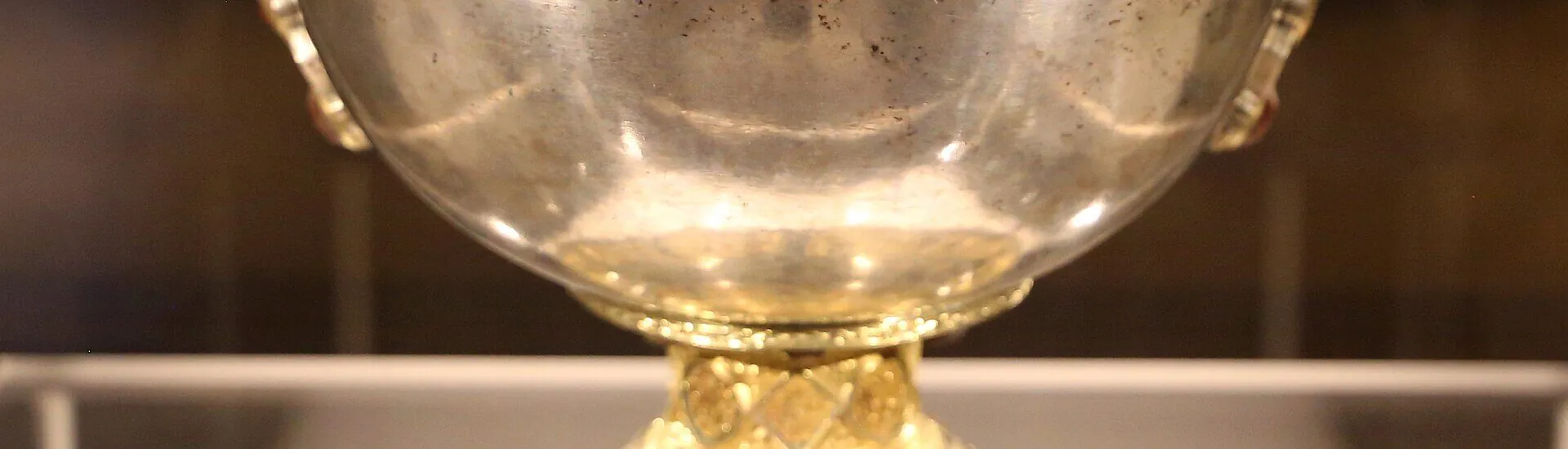
The National Museum of Ireland dates the chalice to the early 9th century. Its hammered silver bowl stands on a foot and has two handles. A decorative band encircles the upper section, while amber ornaments punctuate the composition.
The handles feature panels of gold filigree. The metal wires form dense patterns, which close-up photographs make easier to distinguish. A system of stem and fittings connects the bowl, central section and foot. The underside of the object also deserves attention.
Comparison with the Ardagh Chalice is particularly revealing. The museum considers the Derrynaflan example to be slightly later, with simpler decoration. Looking at the two cups makes it possible to compare their proportions, handles and distribution of materials, rather than simply deciding which appears more sumptuous.
The Derrynaflan Paten dates from the 8th century. Its construction combines more than three hundred pieces. The hammered silver plate is attached to a bronze rim, clad in gilt frames and filigree panels. The decoration conceals some of the joins required to make it.
Abstract motifs sit alongside human and animal figures. Some panels show kneeling men arranged back to back. These details are minute on the scale of the plate. They invite the eye to slow down and move from one compartment to the next.
The museum compares the techniques used for this paten with those of the Ardagh Chalice, even suggesting that they may have been made in the same workshop. This proposal is based on similarities in wirework, filigree and enamel. It remains a hypothesis of attribution, offering a lead for comparing the works.
The strainer takes the form of a long gilt-bronze ladle. Its perforated section and decorated handle associate it with the preparation of Eucharistic wine. It is a reminder that altar service required several instruments whose uses are less immediately apparent to today’s visitor.
The basin appears more understated, but its position at the time of discovery gives it particular importance. Overturned above the deposit, it helped to protect the other pieces. Together, the objects allow visitors to observe both the ceremonial equipment and the way it was placed in safekeeping.
After the objects were handed over to the museum, a dispute arose between the finders and the State. The case of Webb v Ireland concerned ownership of the hoard and the terms under which the discovery was recognised. The University of Galway archives hold a body of documents relating to it.
The litigation went through several stages. In December 1987, the Supreme Court recognised State ownership of the hoard. The finders subsequently received a reward. The case occupies an important place in the Irish history of archaeological heritage protection.
It extends the objects’ medieval history into a modern question. How can the collective interest in a discovery whose value exceeds that of precious metal be preserved? At Derrynaflan, the pieces, the site and the information gathered by archaeologists form different parts of the same case.
The hoard is held at the National Museum of Ireland – Archaeology in Dublin. The chalice and paten are among the works displayed in The Treasury. Check the museum’s information before planning a visit centred on a particular piece, as displays may change.
Start by looking at the collection as a whole to understand the differences in scale, then examine the chalice and the paten’s rim. The official paten record helps identify details of its construction. With children, identifying the cup, plate and strainer offers a tangible way into this story.
The Tara Brooch, also held in the museum’s collections, offers a way to continue exploring filigree and small-scale decoration. The motifs take on a different meaning when they move from a piece of religious tableware to an item of personal adornment.