

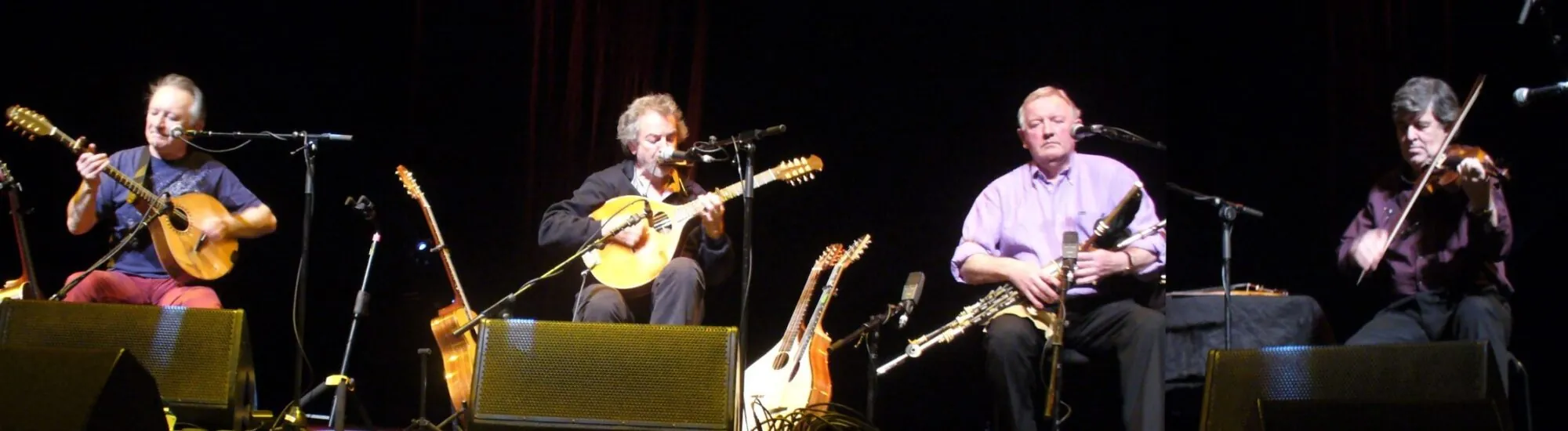
In an Irish music ensemble, the ear naturally follows the fiddle, flute or voice. Dónal Lunny also invited listeners to hear what supports them: the strings that propel a dance forwards, the chord that opens up a new perspective, the rhythm that allows a melody to breathe. A musician, arranger and producer, he helped turn accompaniment into a language in its own right. From Planxty to Moving Hearts, his career tells the story of a tradition vibrant enough to change without losing its memory.
Born in 1947 in Tullamore, County Offaly, Dónal Lunny later grew up in Newbridge, County Kildare. The Arts Council has highlighted the role that his family environment and summers in Donegal played in his discovery of Irish music. By the age of 15, he was already accompanying traditional musicians from the local area.
His education was not confined to music, however. Between 1965 and 1968, he studied at the National College of Art and Design, where he received two scholarships. Visual art and ensemble playing went hand in hand during these formative years: before becoming a leading figure in the folk revival, Lunny belonged to a generation for whom the boundaries between disciplines remained open.
The trio Emmet Spiceland brought him national recognition. The RTÉ Archives note that the group’s version of Mary of Dungloe reached number one in the charts in 1968. This first success on record came before the role that would make him distinctive: shaping bands through their collective sound as much as through the individual musicians within them.
In the early 1970s, Lunny co-founded Planxty with Christy Moore, Andy Irvine and Liam O’Flynn. The group brought together distinct musical worlds: folk song, traditional repertoires, stringed instruments and uilleann pipes. Their strength lay precisely in the dialogue between them.
To explore this legacy, listen to the relationships between the individual parts. Who states the theme? Who supports it? At what point does a chord change alter the colour of the ensemble? These questions make Planxty’s music more approachable than the daunting idea of a monument that must be known by heart.
Lunny then became part of The Bothy Band, formed in 1975. The group offered another way of hearing traditional tunes: through the density, speed and energy of ensemble playing. The bouzouki can be heard as a hinge between rhythmic drive and melodic shape.
His progression from one group to another was more than a succession of prestigious names. It reveals a musician experimenting with balance: accompanying a singer calls for a different approach from supporting a set of dance tunes. Lunny’s identity can be heard in this attention to context.
With Moving Hearts, which also featured Christy Moore, the dialogue between traditional music and rock became central. Coolfin and Mozaik later extended the diversity of his projects. His official website highlights the international tours and encounters with musicians from different cultures that marked his career.
This constant movement makes his career a valuable antidote to a fixed view of folklore. Irish music does not appear here as a museum piece preserved behind glass, but as a living practice: it travels, encounters new listeners and returns enriched by those exchanges.
The Presidency of Ireland paid tribute to his role in introducing the bouzouki into Irish music. It would be reductive, however, to associate Lunny with a single instrument: he also played guitar, bodhrán, mandolin and keyboards.
Above all, the Irish Traditional Music Archive places his contribution in the harmonic and rhythmic possibilities he opened up within a strongly melodic tradition. In other words, his importance lies not only in the notes he played, but in the paths he traced around those played by others.
Lunny was also a co-founder of the Mulligan Records label. According to his official biography, he produced 17 albums there. His studio work and collaborations brought him together with artists including Clannad, Kate Bush, Mark Knopfler and Baaba Maal. He also produced Common Ground, a project featuring Bono, Elvis Costello, and Neil and Tim Finn, among others.
This work shifts the focus: a musical career cannot be measured solely by how often a name appears at the top of the bill. Arranging and production also determine how a piece will be heard, preserved and passed on. For Lunny, they were an extension of the same curiosity about creative encounters.
A member of Aosdána, he received an honorary doctorate from Trinity College Dublin in 2008. In 2025, the RTÉ Radio 1 Folk Awards recognised his entire career with a Lifetime Achievement Award. These honours reflect the place he held beyond traditional music audiences alone.
Dónal Lunny died on 23 October 2026, aged 79. In her tribute issued that same day, President Catherine Connolly recalled his long-standing collaborations and his contribution to the country’s musical life.
Start by comparing a Planxty song, an instrumental set by The Bothy Band and a track by Moving Hearts. The exercise requires no specialist vocabulary: first follow the melody, then listen again, focusing only on the strings and rhythmic accents. The landscape changes.
The material available from RTÉ Archives and the Irish Traditional Music Archive then helps place these sounds in their respective eras. Before an evening of music in Ireland, this kind of listening offers a subtle but valuable point of reference: pay attention to the accompanying musicians too. Sometimes, they are the ones who give the ensemble its direction.
Sources: Arts Council, tribute of 23 October 2026; Irish Traditional Music Archive, 23 October 2026; Presidency of Ireland, 23 October 2026; RTÉ Archives and Dónal Lunny’s official biography, accessed 29 October 2026.