

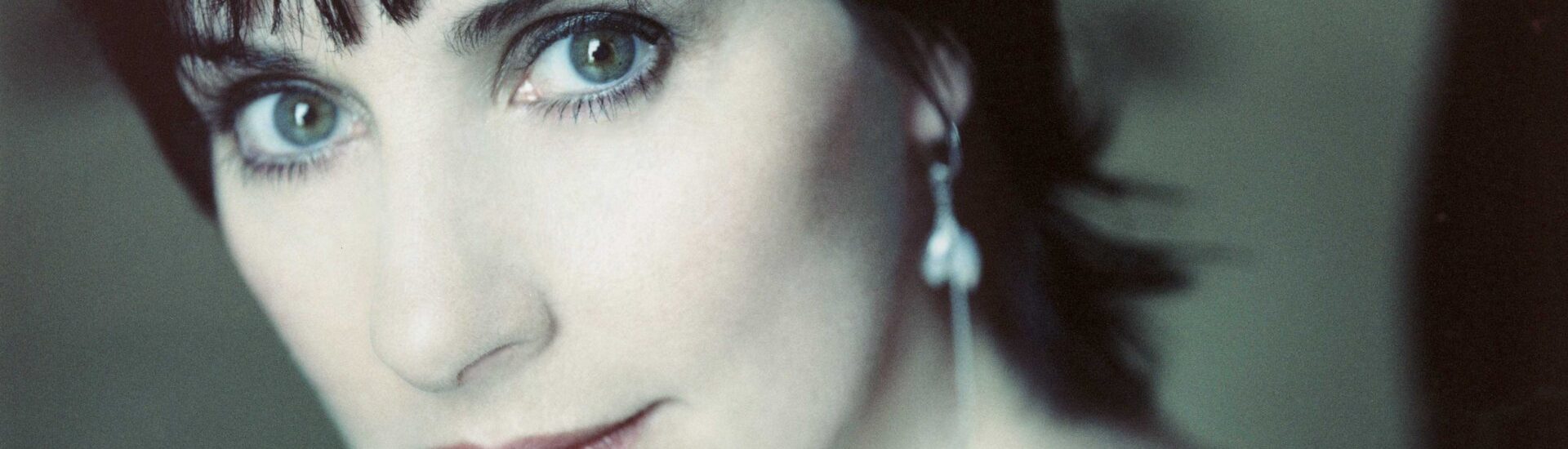
The voice seems to come from several places at once. It doubles, rises, then gives way to a few piano notes: in Enya’s work, a song can take on the dimensions of a landscape. Since the success of Orinoco Flow in 1988, the Irish musician has built a body of work that is instantly recognisable, blending limpid melodies, vocal harmonies and electronic textures. Behind this apparent lightness lies patient studio work, sustained for decades by an essential collaboration with Nicky and Roma Ryan.
Born on 17 May 1961, Eithne Pádraigín Ní Bhraonáin grew up in Gaoth Dobhair, or Gweedore, in County Donegal. This north-western region is part of the Gaeltacht, the areas where the Irish language retains an important place in everyday life. Her stage name, Enya, makes her given name, Eithne, more accessible to an international audience.
Music was a family pursuit. Her father, Leo, was a musician; her mother, Máire, taught music. Several of her siblings also became performers. Her eldest sister, known as Moya Brennan, is notably the voice of Clannad. Piano lessons and classical training complemented an environment steeped in songs and traditions.
These roots help to explain her world, without confining her music to a simple evocation of Ireland. Donegal was a starting point: her career would also be shaped by sonic explorations, foreign languages and imagined landscapes.
In 1980, Enya joined Clannad, the family group that included her sister, brothers and two uncles. She played keyboards and contributed vocals. The experience introduced her to recording and performing live, but she wanted to develop her own musical voice.
She left the group in 1982. Nicky Ryan, who had already worked with Clannad, then became a decisive partner in her solo career. Together with his wife Roma, he helped bring forth a project whose singularity would become clearer over the years.
The name Enya refers to one artist, but her recorded work rests on close collaboration. Enya composes the music and performs most of the vocals and keyboards; Nicky Ryan develops the production and sonic arrangements; Roma Ryan writes the lyrics. This complementary partnership brings melody, language and studio architecture into dialogue.
A musical idea does not therefore immediately become a finished song. Form, harmonies and words take shape together. Depending on the track, a vocal line may remain highly exposed or merge into a dense whole, as though one person occupied every place in a choir.
Nicky Ryan died in September 2025. In its official tribute, the Irish presidency highlighted the importance of his production work to the identity and reach of this body of work. His role is fully part of Enya’s artistic story.
One of her most striking signatures is the layering of vocal takes. Enya records different parts, which the production work assembles, balances and allows to resonate. Keyboards and spatial effects extend this human material. The result may seem ethereal, but its construction requires great precision.
Often placed in the ‘new age’ category, her music also draws on pop, classical composition, singing and electronic worlds. To hear it as something other than soothing background music, listen closely to the movement of the voices, chord changes and small pulses that structure the tracks. Its gentleness does not always erase tension: some pieces are dark, solemn or shot through with unease.
Among her first solo projects was the score for the film The Frog Prince, released in 1985. This was followed by the BBC documentary series The Celts, broadcast in 1987. The music from the series formed the basis of her first album, titled Enya, released that same year.
The record includes Boadicea, in which the wordless voice establishes a presence that is both spare and mysterious. It was reissued in 1992 under the title The Celts. This distinction matters when understanding her discography: these are not two entirely different studio albums.
In 1988, Watermark transformed the scale of her career. Its single Orinoco Flow, often recognised by its ‘Sail away’ refrain, reached number one in the UK charts and remained there for three weeks, according to Official Charts.
The track combines a lively momentum, moving voices and lyrics that evoke departure and distant horizons. But the album is not limited to that hit: the instrumental Watermark reveals a more intimate restraint, while Storms in Africa unfolds a different energy. This variety gives the record more depth than its reputation as calming music might suggest.
Shepherd Moons, released in 1991, confirmed the strength of her musical world. Caribbean Blue is one of its emblematic tracks: its swirling motion and harmonies give the song a sense of suspension. The record won the Grammy Award for Best New Age Album in 1993.
With The Memory of Trees, released in 1995, Enya continued exploring the contrasts between instrumental pieces, luminous songs and more reflective passages. Anywhere Is particularly demonstrates her taste for rhythmic, catchy writing. The album earned her a second Grammy in 1997, rather than in the year of its release.
In 2000, A Day Without Rain was released, notably featuring Only Time and Wild Child. The first track took on a particular resonance in the United States after the attacks of 11 September 2001, when its broadcast accompanied images and tributes. It had, however, been released before the events.
The song leaves ample room for the listener’s interpretation: anticipation, separation, uncertainty or hope may all meet within it. This ability to accommodate very different experiences contributes to its longevity. A Day Without Rain in turn won the Grammy Award for Best New Age Album in 2002.
Enya contributed to The Fellowship of the Ring, the first instalment of Peter Jackson’s trilogy, released in 2001. She provided May It Be and Aníron. The film’s main score was composed by Howard Shore, so attributing the entire soundtrack to Enya would be inaccurate.
May It Be extends the world of the film through a song in which hope and the sense of a journey find a natural echo. The composition was nominated for the Academy Award for Best Original Song in 2002. The Academy credits Enya, Nicky Ryan and Roma Ryan; that year, the award went to Randy Newman for If I Didn’t Have You, from Monsters, Inc..
With Amarantine, released in 2005, the trio introduced Loxian, a language created by Roma Ryan. In this world, words are also chosen for the way their sounds inhabit the melody. English, Irish and Latin had already shown how a language can alter the colour of the same voice. Amarantine won a Grammy in 2007, bringing Enya’s total number of awards to four.
And Winter Came…, in 2008, explores winter and Christmas atmospheres. Then Dark Sky Island, released in 2015, returns to themes of travel and distance. Its title is connected to Roma Ryan’s writings about islands, notably Sark in the Channel Islands, and its preserved night sky. It does not, therefore, refer to an island in Donegal.
Echoes in Rain is a particularly accessible way into this record. To follow the artist’s announcements, Enya’s official website remains the best place to start, rather than rumours of a return or tour.
Here are the eight studio albums that form the heart of her catalogue, along with a few listening suggestions to help you choose according to your taste.
| Year | Album | Where to start |
|---|---|---|
| 1987 | Enya | The early explorations, including Boadicea and The Celts. |
| 1988 | Watermark | Orinoco Flow, Watermark and Storms in Africa. |
| 1991 | Shepherd Moons | Caribbean Blue and Shepherd Moons. |
| 1995 | The Memory of Trees | Anywhere Is and the album’s title track. |
| 2000 | A Day Without Rain | Only Time, Wild Child and the piano on the title track. |
| 2005 | Amarantine | Amarantine and the sounds of Loxian in The River Sings. |
| 2008 | And Winter Came… | Trains and Winter Rains and Oíche Chiúin (Chorale). |
| 2015 | Dark Sky Island | Echoes in Rain, The Humming… and So I Could Find My Way. |
The Celts (1992) is the reworked reissue of the first album, while Paint the Sky with Stars: The Best of Enya (1997) and The Very Best of Enya (2009) are compilations. The expanded editions of Amarantine do not constitute a separate new studio album.
Her work is not limited to listeners of contemplative music. Boadicea was notably sampled in the Fugees’ Ready or Not, then in Mario Winans’ I Don’t Wanna Know. Her way of layering voices and turning them into harmonic material has also caught the attention of artists from R&B and experimental pop.
This circulation reveals another side of Enya: a studio musician whose innovations can be relocated, cut up and reinterpreted. The same vocal phrase changes meaning according to the rhythm surrounding it. To appreciate this, listening to Boadicea before the tracks that use it is a particularly revealing experience.
For travellers, the most tangible link with her origins leads to Leo’s Tavern, or Tábhairne Leo, in Crolly, in the Gweedore area. Founded by her father, this family pub is associated with the beginnings of Clannad and Enya. Discover Ireland presents it as a key place in this musical history.
The appeal of a visit goes beyond celebrity: it allows an international career to be set within a region where language, song and sociability remain closely connected. Check the pub’s programme before travelling there for a musical evening. Enya’s appearance is not a performance advertised to visitors, and the venue should not be regarded as an opportunity to meet the artist.
To extend your discovery, explore the surroundings of Gweedore and listen to Clannad too. The comparison is rewarding: a shared heritage emerges, alongside choices in songwriting, production and performance that give each project its own character.