
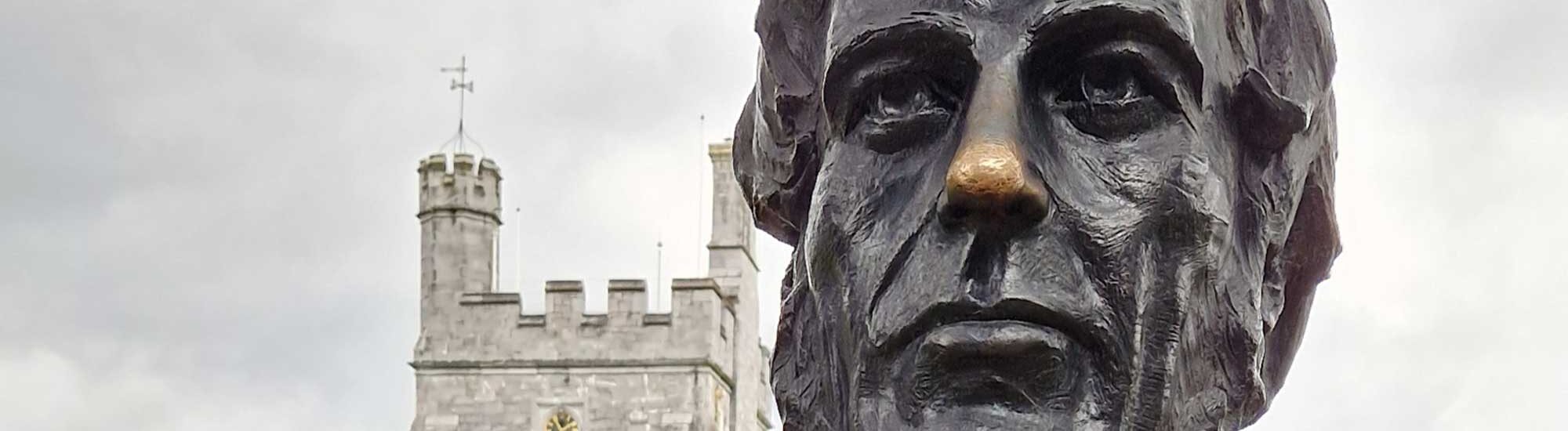
George Boole (November 2, 1815 – December 8, 1864) was an English mathematician, logician, and philosopher whose work laid the foundations of modern computing and probability theory. Considered the father of Boolean algebra, his major contribution was applying algebraic methods to logic, paving the way for the development of digital circuits and computers. His connection to Ireland is special: it was on the Emerald Isle that he revealed his full genius, from his role as a professor at Queen’s College Cork to his scientific publications produced on the green Erin.
George Boole was born in Lincoln, England, the son of John Boole, a self-taught shoemaker passionate about mathematics and science. From a young age, George showed an interest in languages and mathematics. Although his family was not wealthy, his father passed on his passion for learning. By age 12, George was already proficient in Latin and Greek, and he taught himself French, German, and Italian.
Without the means to attend university, Boole continued his education independently. He studied the works of mathematicians such as Isaac Newton, Pierre-Simon Laplace, and Joseph-Louis Lagrange, deepening his knowledge of advanced mathematics.
At 16, Boole began working as an assistant teacher to support his family. In 1834, at 19, he opened his own school in Lincoln. Despite his professional responsibilities, he continued studying mathematics and published his first articles in renowned mathematical journals such as the Cambridge Mathematical Journal.
His early work focused on differential and integral calculus, differential equations, and invariant theory. His contributions were quickly recognized by the mathematical community, leading to his 1844 nomination for the Royal Medal from the Royal Society for his paper on operator calculus.
In 1849, thanks to his academic achievements, Boole was appointed the first professor of mathematics at Queen’s College, Cork (now University College Cork) in Ireland. This position marked the start of his formal academic career. In Cork, he continued teaching and conducting research while publishing works that would revolutionize logic and mathematics.
Boole’s most significant contribution is undoubtedly the development of Boolean algebra, presented in his 1854 work “An Investigation of the Laws of Thought on Which are Founded the Mathematical Theories of Logic and Probabilities”. In this book, Boole introduced a new approach to logic using algebraic symbols to represent logical propositions. He demonstrated that logical operations could be treated similarly to classical algebraic operations.
Boolean algebra is based on two values, typically 0 and 1, representing false and true, respectively. The fundamental operations include AND (conjunction), OR (disjunction), and NOT (negation). This formalization allowed for the simplification and systematic solving of complex logical problems.
Although Boole did not live to see the rise of computing, his work profoundly influenced the development of computers and electronic circuits. Boolean algebra is essential in designing logic circuits, processors, and programming languages. It is also fundamental in set theory, probability, and artificial intelligence.
Besides his work in logic, Boole made significant contributions to differential equations and mathematical analysis. In 1859, he published “A Treatise on Differential Equations”, followed in 1860 by “Treatise on the Calculus of Finite Differences”. These works were widely used and influenced mathematicians for many years.
Philosophy and Teaching Approach
Boole was also a philosopher who believed in the interconnectedness of mathematics, logic, and human thought. He saw mathematics not only as a tool for solving numerical problems but also as a means to explore the fundamental structures of reality and knowledge.
As a teacher, Boole was respected for his clarity and ability to inspire students. He encouraged a rigorous and methodical approach to learning while emphasizing the importance of intuition and creativity.
In 1855, George Boole married Mary Everest, niece of Sir George Everest, the man after whom Mount Everest is named. Mary was herself an accomplished intellectual, and their union was described as a meeting of minds. They had five daughters, several of whom became notable figures:
On December 8, 1864, George Boole died prematurely at age 49 in Cork, Ireland. His death followed pneumonia. A frequently told anecdote recounts that Boole walked in heavy rain to reach the university, and once ill, his wife followed a medical belief of the time by treating him with cold water, which worsened his condition. While this story is hard to verify, it highlights the limitations of medical knowledge at the time.
George Boole’s work left a legacy that transcends disciplinary boundaries. His contributions have been recognized and celebrated in various ways: