

At Islandmagee, the sea outlines the contours of an Antrim peninsula. Yet behind this coastal landscape, north of Belfast, lies a story rarely told on postcards. In spring 1711, eight women were accused of tormenting a young woman through witchcraft. Their names moved from neighbourhood conversations to depositions, then to the court in Carrickfergus. Fear became a legal process. Reputation became evidence.
The Islandmagee witch trial is generally regarded as Ireland’s last witch trial. Yet the phrase encompasses two separate hearings and nine convictions: those of eight women in March, followed by that of a man in September. To understand this case, one must look beyond images of cauldrons and examine a community, its beliefs and the way it identified its culprits.
The events unfolded in what is now Northern Ireland, on the east coast of County Antrim. The Islandmagee Witches 1711 history project, led by researchers Andrew Sneddon and Victoria McCollum, describes a small Presbyterian community of Scottish descent. This context matters: those involved in the case had a religious language through which to interpret misfortune, illness and behaviour that perplexed them.
This was therefore neither a judicial remnant of Samhain nor a Celtic ceremony that became a trial. Its connection with Halloween in Ireland today lies in memory and storytelling. The main hearings of 1711 took place in spring and late summer, not on the night of 31 October.
The case took shape around a house in Islandmagee known as Knowehead House. Ann Haltridge, the widow of a Presbyterian minister, died in February 1711. Accounts link her final months to supposedly supernatural disturbances. After her funeral came her niece, Mary Dunbar, an educated young woman of eighteen.
What followed reaches us through testimony written in a world that believed in the actions of spirits. The fact that these texts report extraordinary phenomena does not, of course, establish their reality: above all, they document what their authors said they had seen and what they believed they understood.
Witnesses referred to convulsions, trances, words or gestures considered disturbing, and the supposed expulsion of objects from the mouth. Mary claimed to be attacked by women appearing before her as apparitions. Under this logic, an accused woman could be held responsible without being physically present with the young woman.
This is one of the case’s most troubling mechanisms: how can one disprove an act that the prosecution places in the invisible world? Distance was no longer enough to establish innocence. The depositions reveal less an investigation into material facts than an attempt to make a narrative of possession legally actionable.
In a presentation of his research published by Ulster University, Andrew Sneddon argues that the possession was feigned, enabling Mary to transgress the limits imposed on her behaviour and acquire a new place in the community. This is a reasoned historical interpretation, not a recovered confession by Mary Dunbar.
The distinction is essential. At a distance of three centuries, turning these accounts into a certain medical diagnosis would be equally precarious. It is possible to analyse the credibility afforded to a young woman from a good family and the interests of the various actors; it is not possible to confidently attribute a specific illness to her on the basis of these descriptions alone.
The edition of the trial documents prepared by Andrew Sneddon and Shannon Devlin gives the following names: Catherine McCalmond, Janet Liston, Elizabeth Sellor, Janet Carson, Janet Main, Janet Millar, Janet Latimer and Margaret Mitchell. Spellings vary in early sources; this variation accounts for some of the differences in modern accounts.
Janet Liston and Elizabeth Sellor were mother and daughter. The accused women did not all come from the same village: the case concerned Islandmagee and the surrounding area. Using their names rather than subsuming them into an anonymous group recalls what a tourist-friendly formula can erase: people had to defend themselves, with their family ties and their place in society.
Sneddon’s work highlights poor women, some living with disabilities, as well as behaviour that did not conform to the female norms of the period. Drinking, swearing, an appearance considered unattractive or an unfavourable reputation could all feed suspicion. These elements were not evidence of witchcraft; they help explain why some names became more readily accusatory targets than others.
The new edition of Possessed by the Devil, published in 2024, places the trial within a community in crisis. The issue goes beyond the convenient opposition between a credulous crowd and a few victims: it also concerns the distribution of trust. Who deserves to be believed? Who must first overcome the poor opinion held of them?
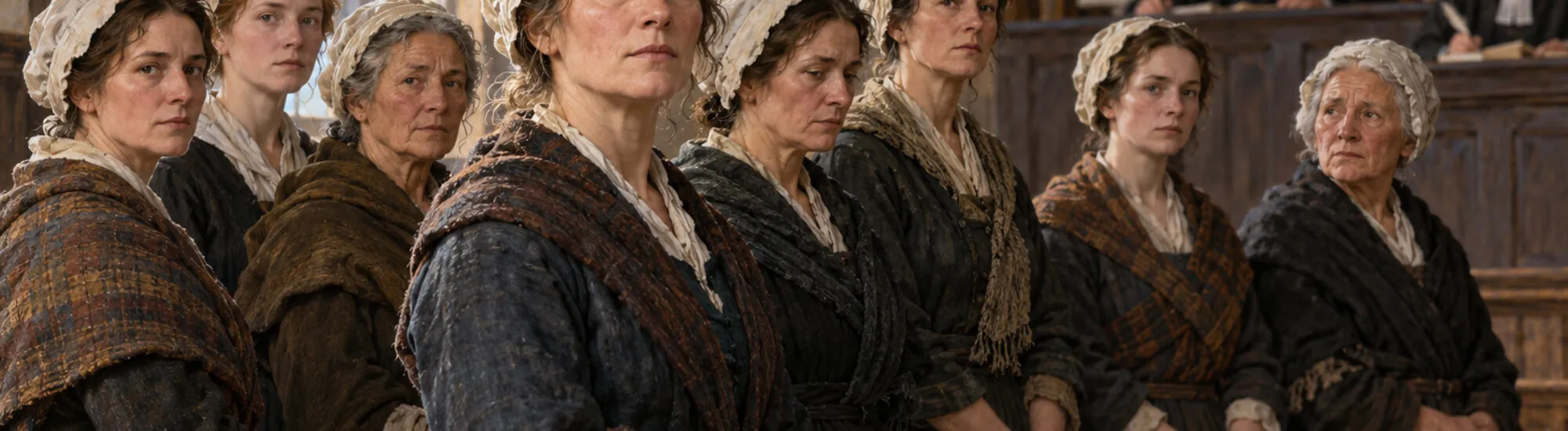
The eight women appeared at the Carrickfergus assizes on 31 March 1711, under the Irish Witchcraft Act of 1586. They denied the charges. The documents show that the judges did not assess the case uniformly: Anthony Upton pressed for acquittal, while James MacCartney supported conviction.
This disagreement cracks the image of a past in which no one doubted. Believing that the devil could act did not necessarily mean considering those accused to be guilty. The question also concerned the connection between the manifestations attributed to Mary and the responsibility of the women she named.
The jury nevertheless found them guilty. Their sentence included one year’s imprisonment and four appearances in the pillory. This instrument of public punishment immobilised the body and exposed the convicted person to the gaze of the community. Humiliation was part of the penalty; it should not be presented as a mere formality simply because it was not a death sentence.
The eight women were therefore not sentenced to be burned at the stake in this case. Depicting them as burned alive would replace the documented verdict with a generic image of witch hunts.
The women’s imprisonment did not end the accusations. Mary subsequently named William Sellor, Janet Liston’s husband and Elizabeth Sellor’s father. She died a few weeks after the first trial. William was in turn convicted on 11 September 1711: the young woman’s death gave the accusation capital significance.
Publications do not all describe his fate with the same degree of certainty. The history project website and the recent edition of the documents refer to a probable execution. This caution should be maintained rather than inventing a date or the circumstances of his death. The later fate of the eight women is also poorly documented.
One anecdote recurs frequently: one of the convicted women is said to have lost an eye after projectiles were thrown at the pillory. In his analysis published by the Social History Society, Sneddon identifies this detail as a late addition circulated in the 19th century, notably repeated by W. B. Yeats. It should therefore not be presented as a fact established by trial testimony.
Local memory has also linked the accused women to the Rocking Stone, a rock around which stories developed of nocturnal dancing and marks left in the stone. These traditions say something about the story’s long afterlife; they do not prove that the women performed the acts attributed to them.
Islandmagee refers to the last known Irish prosecutions under this specific legislation. That does not mean either that Ireland experienced witch hunts comparable in scale to those in certain parts of Europe, or that it was untouched by accusations of magic.
In his academic study Witchcraft belief and trials in early modern Ireland, Sneddon emphasises the rarity of prosecutions while showing that accusations were more widespread than long believed. Distinguishing between belief, denunciation and conviction prevents a judicial anomaly from becoming a simplistic portrait of an entire country.
The Carrickfergus Museum, housed in the Museum and Civic Centre at 11 Antrim Street, is a fitting starting point. The Islandmagee Witches project has a permanent space there, developed from the 2023 and 2024 exhibitions, including digitised documents and interactive storytelling materials.
The research team’s website clearly distinguishes these former temporary exhibitions from the permanent display. It is also important to distinguish the archive from interpretation works: animation, graphic novels and video games are creations that stage the story, not visual testimony from 1711. Before visiting, check access arrangements and available facilities with the museum.
To continue on to Islandmagee, bear in mind a recent change. In an announcement of 28 April 2026, Mid and East Antrim Borough Council stated that the memorial stone now stands in the Islandmagee community garden on Ballystruder Road, beneath a sculpture called Willow. Older directions pointing only to the Gobbins Visitor Centre are therefore no longer sufficient.
The garden is a community space maintained by volunteers. It is a place to come to understand and reflect, while respecting how the site is used. The memory of the nine convicted people is inscribed here in a lived-in landscape, not in a setting abandoned to visitors.
The documentary Dr Marie Cassidy Investigates Ireland’s Last Witch Trial, announced by RTÉ for 29 October 2026, brings the case back into the spotlight. The former forensic pathologist meets historians and specialists to examine the accusations and interpretations of the reported phenomena. Its broadcast provides an opportunity to revisit the case; it is not the discovery of a previously unknown trial.
In their presentation of the film published by RTÉ, director Edel O’Mahony and screenwriter Andrea McCartney emphasise the accused women and their resistance to the accusations. This is also what makes the story feel so close: behind the apparitions and accounts of possession, voices tried to make themselves heard.
The collection Documents from the Trial of the “Islandmagee Witches” at Carrickfergus Assizes, County Antrim, Ireland, 1711, edited by Andrew Sneddon and Shannon Devlin, brings together depositions, correspondence, an early account and newspaper articles, accompanied by reproductions. The testimony remains situated source material: it provides access to the accusations and reasoning of the period, not a neutral observation of events.
For an in-depth study, Andrew Sneddon published Possessed by the Devil in 2013, followed by a revised and expanded edition in 2024. The scholarly Witches of Islandmagee project, the 2019 Social History Society article and Ulster University publications make it possible to follow the development of this research. Visitor information was checked against official resources available on 29 October 2026.