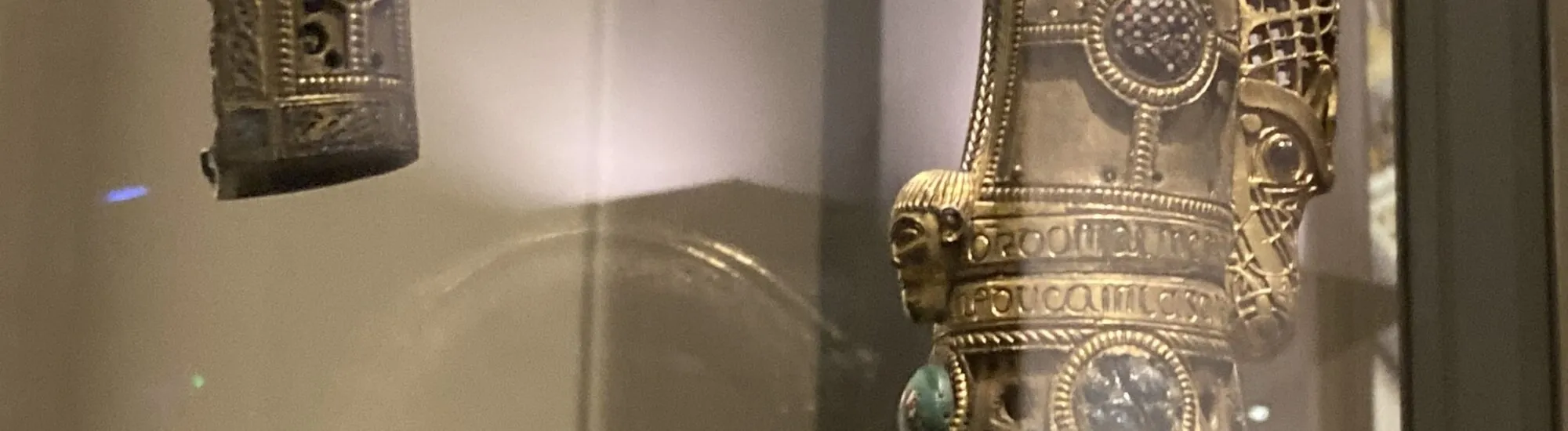
Open-mouthed animals follow the curve of the metal, set among cabochons of blue glass. Made around 1100, the Lismore Crozier is one of the precious examples of medieval Irish religious art preserved in Dublin. This emblem of authority has a moving distinction: an inscription gives us the name of its patron and that of the craftsman who made it. Found at Lismore Castle in 1814, it traces a story in which artistic creation, ecclesiastical power and heritage conservation intersect.
A crozier is a pastoral staff with a curved upper section. In the Christian world, it accompanies the spiritual authority of religious leaders. The Lismore example belongs to the tradition of Insular croziers: a distinctive silhouette, enhanced with metalwork that gives the staff a presence far removed from that of a simple practical object.
The museum dates it to around 1100. This places the work at the turn of the 11th and 12th centuries; it does not correspond to a precisely documented year of manufacture. Its name links it to Lismore in County Waterford, while its present location takes visitors to the National Museum of Ireland – Archaeology, in Dublin.
The object combines a wooden shaft, bronze casing and several bosses that punctuate its height. At its summit, the curved section was cast in a copper alloy. Its overall form invites the viewer to look from afar; the richness of its workmanship then calls for a closer look, within the limits of the display case.
This change of scale is one of the most rewarding aspects of the visit. The eye moves from the long staff to the miniature architecture of its summit: reliefs, borders, coloured elements and animal figures echo one another. To understand the object, take the time to distinguish between its structure and its decoration.
Three open-mouthed animals form the crest of the crozier. This sequence ends in an animal head with blue-glass eyes. On both sides of the curved section, further blue-glass ornaments hold red and white inlays made using the millefiori technique: small coloured patterns formed in glass.
The National Museum of Ireland guide cites the Lismore Crozier among the religious works of the 11th and 12th centuries marked by Viking artistic styles. These borrowings show how Irish workshops could incorporate decorative repertoires from elsewhere. Here, the animals become elements of a Christian object commissioned for a bishop.
During your visit, follow the outer line of the curve to spot the creatures, then look for the blue details. With children, this small observation game offers a way into the work without beginning with dates or technical vocabulary.
At the base of the curved section, an inscription asks for prayers for Niall mac Meic Aeducain, for whom the object was made, and for Neachtain, the craftsman who made it. The spelling of the names varies between modern transcriptions. Niall is identified as Bishop of Lismore, who died in 1113.
This inscription provides more than a chronological reference point. It preserves two distinct roles: that of the man who commissioned the work and that of its maker. Before a medieval work whose many details remain anonymous, being able to name the craftsman brings visitors remarkably close to its making.
Richly decorated croziers also belong to the history of power. The early 12th century saw the Irish Church reorganise, while its major monastic centres defended their place in the new diocesan landscape. The museum places these prestigious commissions within this context of reform and rivalry.
The crozier made religious authority visible. Its richness must therefore be understood alongside its function and institutional setting. To explore this period, The Treasury at the National Museum of Ireland offers a particularly illuminating setting: it brings together works that allow visitors to compare the forms, materials and uses of Irish religious art.
The crozier was found in 1814 in a walled-up opening at Lismore Castle, along with the manuscript now known as the Book of Lismore. Their discovery together does not mean that they were made together: the book is a 15th-century compilation, much later than the crozier.
The earlier circumstances of their concealment call for greater caution. Finding them within masonry is not enough to identify the person who placed them there or their motives. Above all, it marks a documented stage in the reappearance of these works.
To admire the original, visit the National Museum of Ireland – Archaeology on Kildare Street in Dublin. Remember its English name, Lismore Crozier, which is useful when reading labels or asking for information. Check the museum’s information before travelling for any changes to the visitor route.
Allow time to study the summit closely rather than simply glancing at its silhouette. Look for the animals, the glass inlays and then the inscription. The Ardagh Chalice offers a way to continue exploring Irish religious metalwork through another type of object from an earlier period.