
A small iron bell and its ornate shrine tell two very different chapters in Irish history. The first is striking in its simplicity. The second encases its form in gold, silver and interlaced animals. Held at Dublin’s archaeological museum, St Patrick’s bell and its shrine show how an object associated with a saint could become a religious treasure, a symbol of authority and an heirloom passed down through generations of custodians.
Known as St Patrick’s bell, this small handbell is made of iron covered in bronze. Its body consists of two riveted sheets of metal. Its handle and flared shape recall its original purpose: an object that could be held and rung.
In tradition, it is known as the “Bell of the Testament”, or Cloc ind Aidechta. The name reflects the belief that Patrick bequeathed it to his successors. The bell thus became one of the objects associated with his memory and with the authority of those who claimed his legacy.
In the Middle Ages, it formed, alongside the Book of Armagh and the Bachall Ísu, the “Staff of Jesus”, a group of prestigious emblems in the cult of Patrick. The Dictionary of Irish Biography notes that the bell was mentioned by name in the Annals of Ulster in 1044. Its renown therefore predated the making of its precious casing.
Its attribution to the saint belongs to tradition. The National Museum of Ireland dates the bell to the 8th–9th centuries, several centuries after Patrick’s lifetime. The object’s name testifies to its enduring association with the saint, rather than to proven personal ownership.
The shrine is later still. It was made around the year 1100 to house a bell that was already ancient and venerated. The dating of the instrument and that of its protective casing must therefore be distinguished. Seen together, they reveal how a community transformed the way an object was preserved and displayed over the centuries.
This difference between material history and religious tradition is part of the story. The study of the bell tells us as much about the beliefs of its custodians as it does about the instrument itself. Its medieval fame did not rest on archaeological analysis, but on the place it held in Patrick’s memory.
The shrine follows the bell’s trapezoidal outline. Its rounded upper section covers the handle. It forms a casing fitted to the object, whose contours remain recognisable beneath the decoration. A series of bronze plates, joined at their edges, forms its structure.
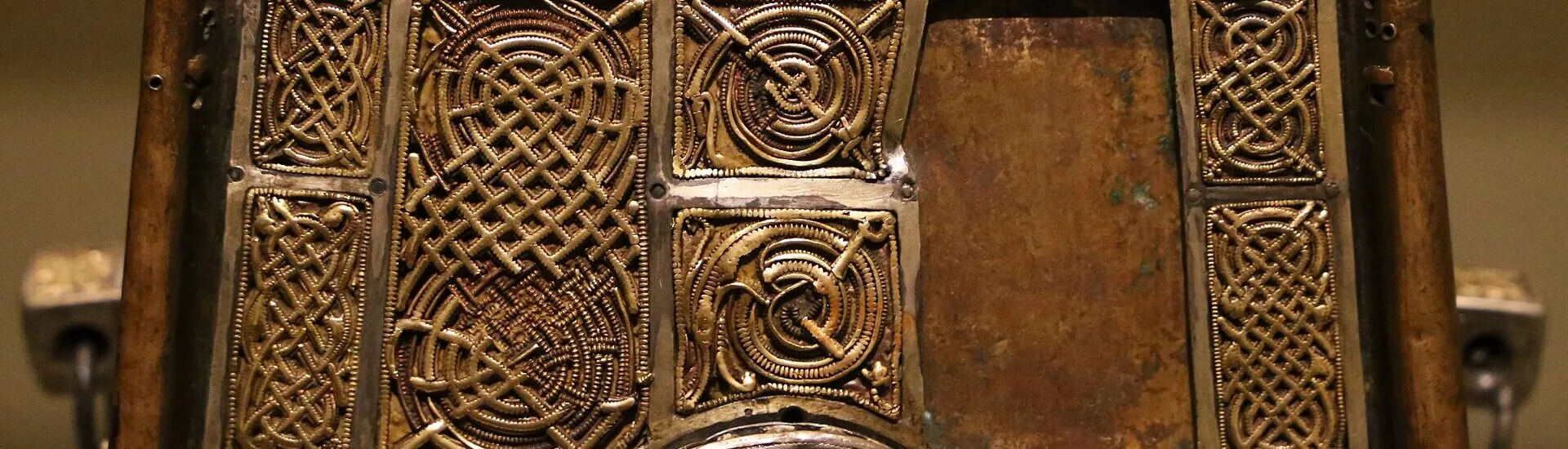
The main face has a gilt-silver frame that originally held thirty gold filigree panels. The decoration is arranged around a ringed cross. The metalwork gives this small, familiar form a solemn presence commensurate with the importance attached to its contents.
The filigree reveals itself when you take the time to study the details. Metal threads form dense patterns arranged in small compartments. Their delicacy becomes easier to make out in close-up photographs. At the display case, begin with the silhouette, then look at how the panels are arranged.
The museum highlights the bell’s political role. Its association with Patrick helped to legitimise Armagh’s position as a major Christian centre in Ireland. Keeping a relic of the saint made a link with the origins of the religious community visible.
Art historian Rachel Moss notes that the staff, the Book of Armagh and the bell were gradually added to the insignia of office of Armagh’s leaders. The objects carried a memory that people and institutions could invoke. Their preservation and display contributed to the continuity claimed with Patrick.
A bell could therefore transcend its sounding function. Its importance also came from its name, the stories that accompanied it and those entrusted with its care. The richness of its casing makes this transformation from instrument to object of devotion tangible.
The shrine bears an inscription documenting its making. It mentions Domhnall Ua Lochlainn, the ruler who commissioned it, as well as the maker and his sons. The bell’s custodian, Cathalan Ua Maelchallain, is also named.
These names reveal several complementary roles. The patron made the work possible, the craftsmen produced the casing, and the custodian looked after the relic. The inscription is a reminder that such an object depended on a network of people, skills and responsibilities.
Custodianship passed down through the Ua Maelchallain family, whose name is known in its anglicised form, Mulholland. This hereditary care continued for several centuries. Research into ancient Irish bells makes it possible to trace some episodes in this succession of custody as far as the early 19th century.
The survival of the bell and its shrine therefore also rests on successive custodians. It invites us to consider the history of collections through the people who preserved objects long before they entered a museum.
The sides feature openwork panels in which elongated animals mingle with serpentine forms. To read these motifs, follow a single line until it reaches a head or a paw. The bodies cross and fill the surfaces while retaining an ordered design.
The reverse has a more restrained composition, with an openwork silver plate decorated with interlocking crosses. Comparing the faces shows that the object was conceived as a three-dimensional piece. Its interest is not limited to its most ornate façade.
The Tara Brooch offers another point of comparison for the finesse of the metalwork. Their functions differ, but studying the threads, frames and small decorated surfaces helps to recognise the scale of Irish craftsmen’s skill.
The bell and its shrine are displayed in The Treasury gallery at the National Museum of Ireland – Archaeology in Dublin. The museum’s official entry can help you prepare to encounter these two objects.
On site, look at them separately before comparing them. The shrine’s outline becomes easier to understand once you have observed that of the bell. With children, look for the handle, the cross and the animals. These details offer a practical way into an object whose religious and political significance requires further explanation.
Check the institution’s information before your visit if these pieces are your main reason for travelling there. Older documents and reproductions can also help you study faces that are difficult to see. Check their captions to distinguish the originals held in Dublin from modern copies in other collections.