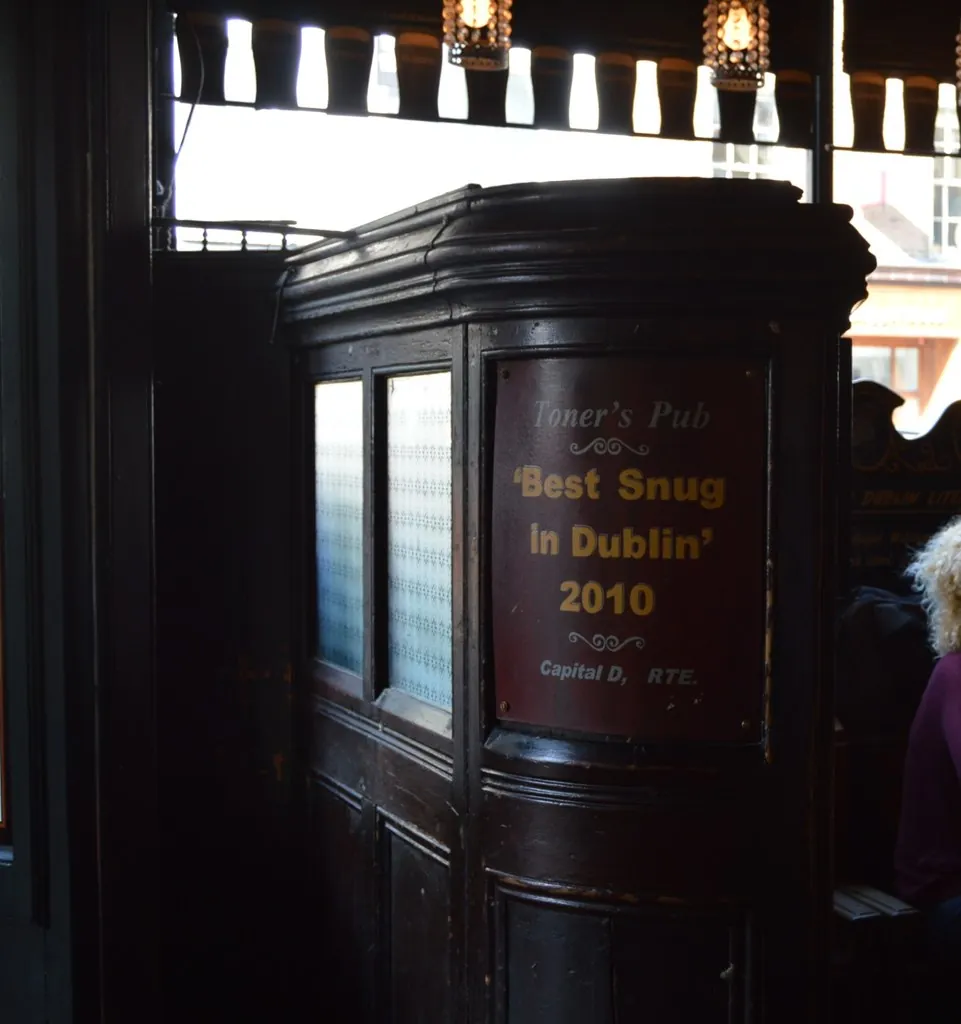
At Toners in Dublin, the small room is marked out by a dark wooden partition and frosted glass. You could easily walk past it while looking for a space at the bar. Yet this dividing wall tells part of the story of Irish pubs all by itself. It allowed people to be served at the bar while remaining out of sight. This little corner is known as a snug. Today, it is often seen as the best table in the pub. In the past, though, sitting there could answer a far more delicate question: who was allowed, or simply free, to drink in public?
The English word snug suggests somewhere cosy and sheltered. In a pub, it refers to an area physically separated from the main room, often by wood panelling and sometimes with a door or glass panels. Its size and degree of privacy vary from one establishment to another. What identifies it is the division between those seated in the compartment and those standing at the bar.
Some snugs communicated with the bar through a small window known as a serving hatch. Staff could take orders and pass drinks through it. At Kehoe’s in Dublin, the hatch has been preserved, along with the snug’s bell. These two tiny objects explain better than a commemorative plaque how the room worked. Customers could order from their seats and remain apart from the main room.
In some Irish pubs, particularly in cities and towns, the bar was long a space for male sociability. Women could enter certain establishments, but customs varied and their presence at the bar was not always taken for granted. The snug allowed them to drink on the premises in a separate space. Depending on the pub’s layout, staff would come to take their order or serve them through an opening in the partition.
This detail matters. In her study of the changing spaces of the Irish pub, researcher Gwendolyn Scarbrough describes practices that differed from one establishment to another. Far from every pub had a snug. Their history chiefly reveals how a venue’s layout could reflect the social expectations of its time. The partition gave some female customers privacy while preserving a separation from the bar’s regulars.
The need for discretion could also be entirely commonplace. At Kehoe’s, the pub notes that part of the establishment once operated as a grocery shop. Customers could sit in the small room for a drink while the shopkeeper prepared their order. The mahogany drawers behind the bar, once used for provisions, still reveal this dual purpose. Buying tea and sitting down for a few minutes for a drink were part of the same errand.
To see what remains of this architecture in Dublin, start at Kehoe’s on South Anne Street. Look for the hatch and the bell, then notice how the partitions divide up the room around the bar. Much of the appeal lies in these details. If the compartment is occupied, the arrangement of the wood panelling alone is enough to understand how customers and staff moved about. Guide-Irlande has also covered Niall Horan and Lewis Capaldi’s visit to Kehoe’s, offering another perspective on the life of this address.
At Toners on Lower Baggot Street, the snug can be recognised by its sign and frosted glass. A photograph from 2018 clearly shows what these materials achieve: light comes through, while the view is blurred. If you would like to sit there, the pub states that its main bar welcomes customers without reservations. Availability in the small room will therefore depend on when you visit.
As you move from one to the other, compare what can be seen from the room with what might be visible from the bench seat. Kehoe’s hatch tells the story of how orders travelled. Toners’ frosted glass tells that of glances. These two details offer visitors a very simple way to read an old interior, even when the pub is full.
When choosing a seat, look first towards the bar. A corner with a bench seat may be comfortable, but it is the partition that tells the story of the snug. Look for the angle that blocks the view from the room, the small opening through which a drink could be passed, the frosted glass that filters the light. In a busy pub, these are easy details to miss. Once you have spotted them, you understand why a few square metres were enough to transform an entire evening’s experience.
Alcohol abuse is dangerous for your health. Drink in moderation.