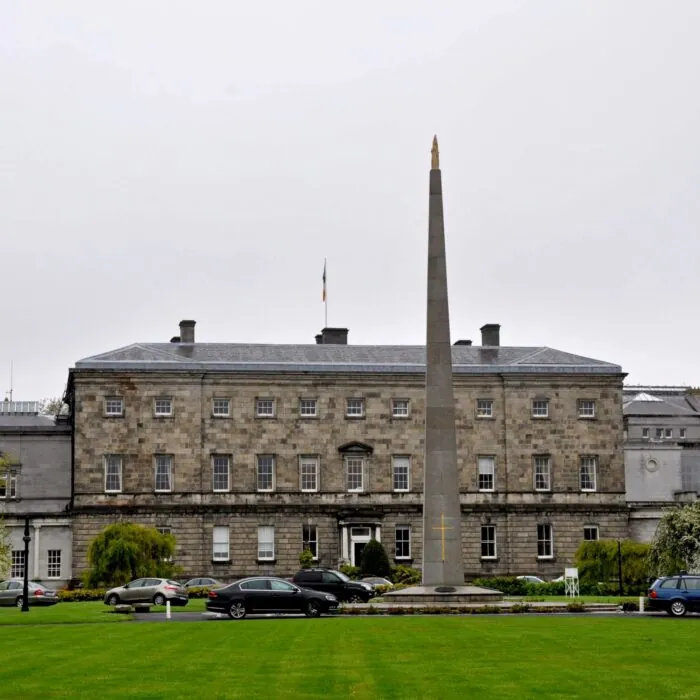
Ireland is a modern parliamentary democracy, inheriting both ancient traditions and its recent history marked by independence. Its government is based on the 1937 Constitution (Bunreacht na hÉireann), which defines institutions, the separation of powers, and the fundamental rights of citizens. Understanding the functioning of the Irish government means delving into a political system where the parliament, the executive, the president, and the judiciary each play a decisive role.
The Irish Constitution
The founding text since 1937
The 1937 Constitution, drafted under the impetus of Éamon de Valera, is the fundamental text organizing the political life of the Republic of Ireland. It affirms national sovereignty, defines institutions, and enshrines the rights and freedoms of citizens.
This text, regularly amended by referendum, has allowed the country to adapt to its social and political evolution: European integration, recognition of same-sex marriage, legalization of abortion, and institutional reforms.
The President of Ireland
A representative and symbolic role
The President of Ireland (Uachtarán na hÉireann) is elected by direct universal suffrage for a seven-year term, renewable once. His role is essentially representative and honorary.
The president promulgates laws, represents the country abroad, and embodies national unity. He also has the power to refer laws to the Supreme Court to verify their constitutionality before promulgation. However, he does not intervene in the daily management of the state, which is entrusted to the government.
The Irish Parliament
The Oireachtas and its two chambers
Legislative power is exercised by the Oireachtas, which comprises two chambers:
- The Dáil Éireann (lower house), composed of deputies elected by proportional universal suffrage. It is the central organ of political life, where governments are formed and laws are passed.
- The Seanad Éireann (upper house), or Senate, whose members are partly appointed by the Taoiseach (Prime Minister), universities, and various colleges. Its role is consultative and it can delay, but not block, laws adopted by the Dáil.
This bicameral system ensures balance, although the Dáil holds political predominance.
The Taoiseach and the Government
The executive at the heart of the system
The head of government is the Taoiseach, equivalent to the Prime Minister. Appointed by the president but chosen from within the Dáil, he is generally the leader of the majority party or coalition.
The Taoiseach leads the government (cabinet), sets major political directions, and represents Ireland in international affairs. He is assisted by the Tánaiste (deputy prime minister) and a team of ministers accountable to the Dáil.
The Irish executive thus originates from parliament, making it a system close to the British parliamentary model but with strong popular legitimacy thanks to proportional suffrage.
The Judiciary
An independent judiciary
The Irish Constitution guarantees the independence of the judiciary. The Supreme Court, High Court, and lower courts ensure the application of the law and the protection of fundamental rights.
The Supreme Court, in particular, plays a crucial role in constitutional review of laws. It can invalidate a text deemed contrary to the Constitution, thereby reinforcing the balance of powers.
Political Parties in Ireland
A landscape dominated by Fianna Fáil and Fine Gael
Irish political life is marked by a multiparty system. The two major historic parties are:
- Fianna Fáil, founded in the 1920s by Éamon de Valera, long the dominant party in the country.
- Fine Gael, heir to the movement favorable to the Anglo-Irish Treaty, anchored in the center-right camp.
Alongside these two forces, parties such as the Labour Party, Sinn Féin, and the Greens play a growing role. Sinn Féin, long associated with the Northern Irish republican struggle, is now a central political actor, notably since the 2020 general elections.
Elections in Ireland
A proportional representative system
Elections to the Dáil Éireann use a system of single transferable vote (STV). This voting method allows for more balanced representation of political forces and encourages coalitions.
The president, for his part, is elected by direct universal suffrage. Local and European elections also follow a proportional system, reflecting the desire for broad democratic representation.
The Role of the European Union
A determining influence
A member of the European Union since 1973, Ireland has seen part of its public policies framed within a European context. Community law takes precedence over certain national laws, and numerous European funds have contributed to the country’s economic development.
The Irish Constitution has had to be amended several times to ratify European treaties (Maastricht, Lisbon). The link with Europe is thus now a structural component of governmental functioning.
Local Government
Territorial communities
Ireland is divided into counties and municipalities with local councils. These manage competencies such as urban planning, local infrastructure, culture, or certain social services.
Local power remains limited compared to central power but plays a key role in citizens’ daily lives and reflects the importance of local communities in Irish identity.
Recent Developments
Reforms and a changing society
The functioning of the Irish government evolves with reforms and social changes. Referendums on social issues (same-sex marriage, abortion) have demonstrated the strength of direct democracy.
Unprecedented coalitions, such as that between Fine Gael, Fianna Fáil, and the Greens since 2020, also testify to adaptation to a fragmented political landscape. The growing role of Sinn Féin could further reshape government functioning in the coming years.
A Balance Between Tradition and Modernity
The Irish democratic model
The Irish government is the product of a long journey: from ancient Gaelic law to modern institutions, through British domination and the conquest of independence.
Its functioning, based on a balance of powers and strong democratic legitimacy, embodies the will of a nation to govern its own affairs while opening up to the world.

 +
+