Matt Molloy
Matt Molloy is one of Ireland’s most famous traditional musicians. A member of the Chieftains, but also of the Planxty, Matt Molloy…


Matt Molloy is one of Ireland’s most famous traditional musicians. A member of the Chieftains, but also of the Planxty, Matt Molloy…
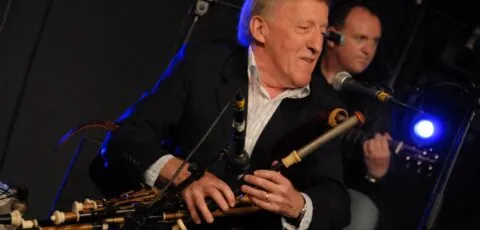
He is a leading figure in traditional Irish music. Paddy Moloney (1938 – 2021) is undoubtedly one of the world’s most famous…

Tonight, Ireland loses one of its monuments: Paddy Moloney, famous Irish musician with the Chieftains, died on Tuesday. He was 83 years…
If there is one Irish group to know, it is indeed The Chieftains! This trad band is undoubtedly one of the most famous and most heard groups in Irish Pubs! This group brings together all the traditional Irish instruments to create true standards of Irish traditional music! A must listen!
The Chieftains (“the clan”) were formed in 1963 in Milltown. Around Paddy Moloney, formerly of “The Square,” the rest of the group gathered: Martin Fay on violin, Sean Potts on tin whistle, Michael Trudy on flute, and David Fallon on bodhrán, who was replaced from the second album by Peadar Mercier.
Very quickly, the group met with great success, and the lineup expanded to include a harp for the next album (1971) with harpist Derek Bell. It was that year that The Chieftains distinguished themselves from all other Irish groups with a well-defined style.
From then on, the Irish eagerly bought their albums and considered their music a true renewal of traditional Irish music.
The group had now achieved international fame, and in 1975 they composed the music for the film “Barry Lyndon,” and “Women of Ireland” went worldwide. Peadar Mercier stepped down, and Kevin Conneff took over on bodhrán. The Chieftains contributed in 1977 to the soundtrack of Yves Boisset’s film “Le Taxi Mauve.” The following year, the group received a Grammy for “Chieftains 7” in the World Music category.
Then, a new change occurred in the group: Michael Tubridy and Sean Potts left, and Matt Molloy, formerly of Planxty, joined. The Chieftains won their second Grammy for “Boil The Breakfast Early.”
Their music reached as far as China, where they even performed on the Great Wall—a first.
Paddy Moloney’s uilleann pipes were featured in a symphony orchestra for the piece Tristan and Iseult.
In 1986, commissioned by National Geographic Special, the group recorded “Ballad of the Irish Horse.” Two years later, The Chieftains ventured into Breton music.
The 1990s were the decade of their consecration. In 1991, they achieved gold record status with “The Bells of Dublin.” In 1997, the group collaborated many times with Carlos Núñez, a player of the gaita, a Galician bagpipe.
Their two latest albums are “Tears of Stone” in duets, and “Water from the Well,” which reconnects with traditional music from various regions of Ireland.