

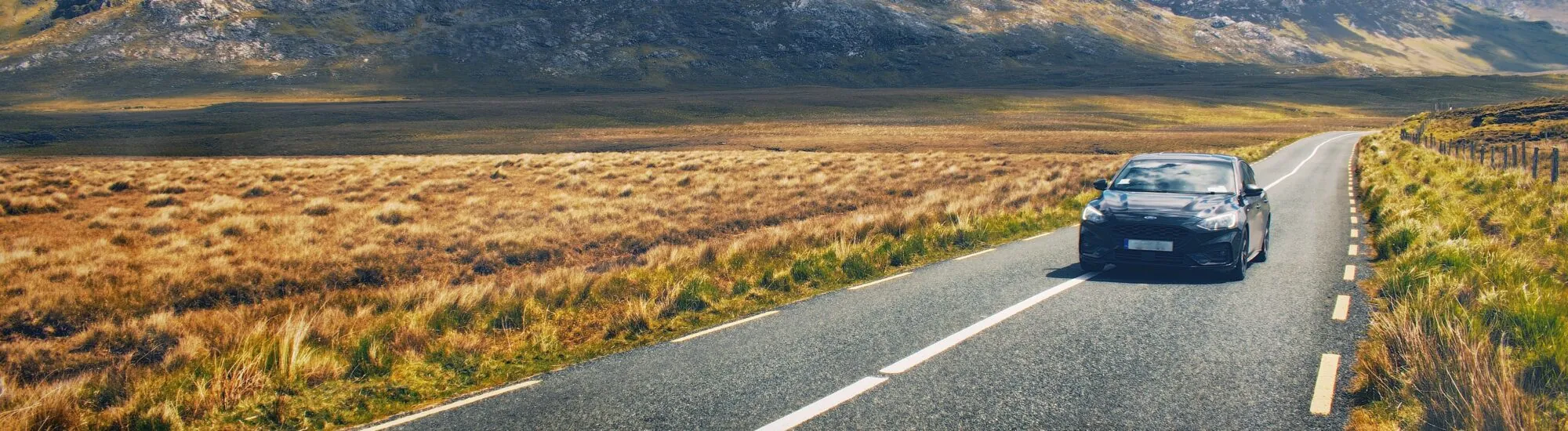
The car coming the other way appears at the end of a narrow road lined with stone walls. As it passes you, the driver barely raises their index finger, their hand still resting on the steering wheel. A second later, the car has vanished in your rear-view mirror. You did see it. On some country roads in Ireland, briefly lifting a finger from the steering wheel is a way of saying hello. If the other driver has just let you pass, a similar gesture can also be used to say thank you.
The gesture takes place in the tiniest of spaces, between the hand resting on the steering wheel and the windscreen. A letter published in The Irish Times describes exactly what a motorist might see on rural Irish roads: the index finger briefly rises as an oncoming car passes. This account offers a useful reference point for travellers wondering whether they have just been greeted. It can happen even when the two cars pass each other without either needing to slow down.
You might compare it to the nod you give someone on a path. It is enough to acknowledge their presence, even when you do not know their name. That is also what makes it easy to miss. While watching the road, you may catch the movement too late and wonder afterwards whether the driver was really signalling to you.
Two cars pass and each carries on? The gesture is likely a greeting. Did you stop to let the oncoming vehicle through a narrow stretch? A raised finger as they draw level may mean thank you. The context says more than the form of the gesture. Depending on the person, it may also be a slight wave or a nod. And if the other driver keeps their eyes on the road and does not respond, they may simply be busy negotiating the passing point.
On a narrow road, drivers sometimes have time to look at one another because they need to slow down to pass. The Road Safety Authority notes that many local roads in the Republic of Ireland remain narrow and have no hard shoulder. In these conditions, making a little room for the other driver can be part of the journey. A wave is then enough to thank the person who waited. On a fast road, where encounters are fleeting and traffic is heavier, the same gesture would easily go unnoticed.
As for its origins, the Irish Times account describes a contemporary custom. It does not make it possible to trace it back to a date or region where it all began. For a traveller, the most interesting part may lie elsewhere: this way of greeting people is discovered while driving, in the succession of small encounters that give a journey off the main roads its particular flavour.
You can simply keep driving. If you are getting used to driving on the left in Ireland, your attention will often already be taken up with the car’s position, the bend and the space between you and the oncoming vehicle. A hand gesture gives no reliable indication of priority or of the room available to pass. The simplest thing is to let the gesture serve its original purpose: a hello or thank you exchanged along the way.
If you are a passenger, you will have plenty of opportunity to spot these exchanges. Watch what happens when two cars meet between the stone walls, when one waits and the other moves on, or when the drivers recognise each other. Before long, you may notice this small movement even before the oncoming car draws level.