

Your trip is booked, Ireland’s rivers are waiting and one question remains: how do you take your fishing rods on a plane to Ireland? Between the tube sticking out of your suitcase, lures fitted with hooks and sporting baggage options, it is best to prepare before heading to the check-in desk.
The most predictable solution is to carry longer rods in a rigid case checked into the hold, after confirming the dimensions and booking the appropriate baggage allowance. A travel rod may be easier to pack, but its compact size does not guarantee that it will be accepted in the cabin. The airline’s rules and those of security screening should be checked separately, both outbound and on the return journey.
There is no single answer that applies to every flight to Dublin, Cork, Shannon or Belfast. Security screening assesses the nature of the items, while the airline sets the dimensions, number of pieces and conditions of carriage, among other requirements. Equipment deemed acceptable at security may therefore still be incompatible with your cabin baggage allowance.
The UK example is instructive: GOV.UK states that fishing rods may be carried in the cabin or hold, while asking travellers to check the carrier’s conditions. This is neither permission for every departure airport nor a guarantee that your airline will let you board with them.
A multi-section rod packed entirely inside baggage within the permitted dimensions is easier to present than a separate long tube. Even so, ask for confirmation, describing the equipment. Do not rely on an airline crew’s discretion or on a successful previous trip: refusal may result in unplanned checked baggage, charges or an inability to transport the item.
Before contacting the airline, measure the complete item, closed and ready to travel: external length, width or diameter, total weight and number of pieces. End caps and protective padding add centimetres; reels and accessories add weight.
A tube attached to a suitcase does not automatically count as a single piece of baggage. If you want to combine several items, have the packing arrangement and number of pieces confirmed. Also check that the same solution will be accepted on every leg if you have a connecting flight.
Ryanair lists long fishing rods among the items unsuitable for the cabin. Its sporting equipment page provides for their carriage in the hold for an additional fee, with a 20 kg weight allowance for the relevant items and charges for excess weight. Have the applicable category and limits for your tube confirmed before paying.
Do not infer from the general rules on an extra seat that your long rod can be placed on a seat. The airline explicitly lists it among items intended for the hold. Full details are available in its sporting equipment help page.
Aer Lingus includes fishing equipment among its sporting equipment. Air France also has a section dedicated to fishing under its special baggage provisions. These classifications do not mean that an additional tube is included with every ticket: check the allowance, cost and dimensions that apply to your booking.
Transavia states that fishing equipment is among the special baggage items that must be declared before the flight. Check the arrangements through your booking, and do not leave this until the day of departure. For each airline, use the official pages: Aer Lingus baggage, Air France special baggage and Transavia special baggage.
If the ticket is sold by one airline but the flight is operated by another, mention this when making your enquiry. If you are connecting, have acceptance confirmed for the entire journey, along with any requirements to collect and re-check your baggage.
A precise request avoids overly general answers: “I would like to carry a rigid tube containing dismantled fishing rods, measuring X cm in length, Y cm in diameter and weighing Z kg. For this flight, which category should I book, how many pieces are permitted, and is prior approval required?” Add the flight reference and details of any connection.
Keep the written reply with your booking. It helps explain what was approved, without overriding security requirements or changes to operational conditions.
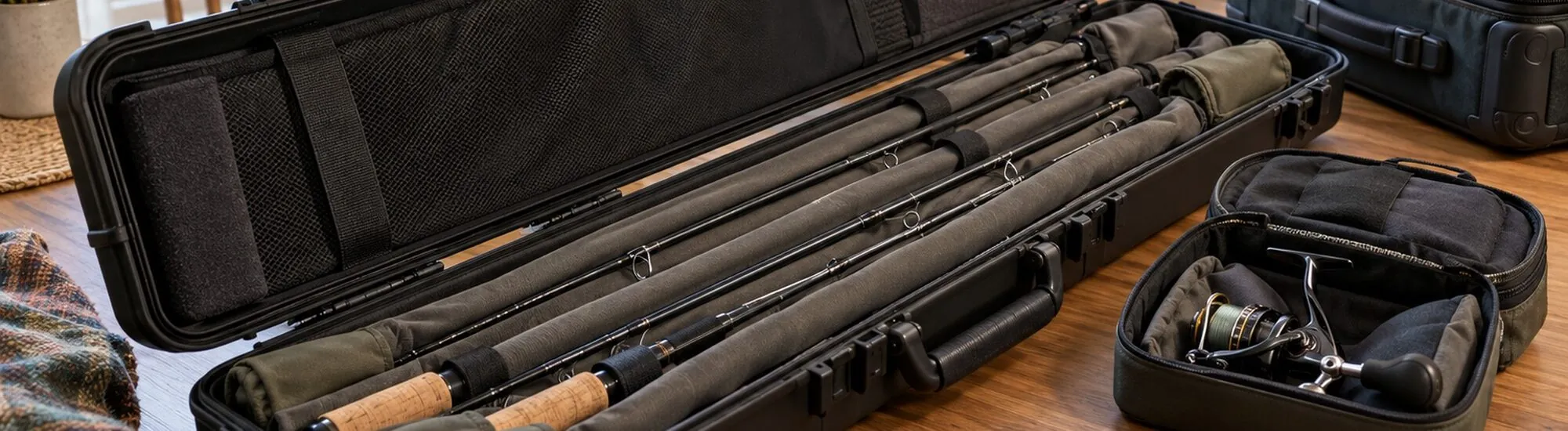
A rigid case suited to the length of the dismantled sections is a sound starting point. Place each section in its sleeve or a soft protective cover, then secure everything without putting pressure on the line guides. Protect the tips in particular: movement inside the tube can be enough to damage them.
Remove the reels from the rods and protect them separately. Check the fastenings and ensure there are no protruding parts. The tube must remain accessible for any potential inspection; use a system that complies with the instructions of the airline and relevant airports.
Add a sturdy label with your contact details, along with a second form of identification inside. Photograph the rods, the packing and the closed case before you leave. Keep proof of value and check your insurance: a “fragile” label does not in itself provide specific cover.
A multi-section rod may fit inside a checked suitcase you already intend to take, sometimes avoiding a separate long item. This depends on its dimensions, protection and your carrier’s conditions. Do not assume that simply closing the suitcase is enough for its contents to be approved.
For a first introduction or a single day’s fishing, also compare the transport cost with the cost of equipment provided locally. Ask the provider about the type of rod, available sizes and included accessories. Travelling with your usual equipment is enjoyable; travelling light can be too when loaned equipment meets your needs.
Prepare a closed box for hooks, hook-fitted flies, lures, knives and sharp tools, and plan to carry them in the hold where this is permitted. Protect the points so that they cannot injure anyone during an inspection. This organisation avoids discovering a forgotten treble hook in a pocket at security.
A reel without sharp accessories may be considered for cabin baggage if the carrier and security authorities allow it and your allowance permits it. Also check the position regarding loaded spools and related accessories. Do not simply declare “fishing equipment”: describe the items to obtain a useful answer.
A sporting baggage booking does not grant permission for every accessory. Inflator cartridges for a life jacket, batteries, aerosols, solvents and flammable products may be subject to specific rules. Declare them separately to the carrier, and do not put a spare battery in the tube out of habit.
For natural bait, also check the health and entry rules that apply to your point of origin and destination, particularly if you are entering Northern Ireland. Buying it locally may be the simplest option. Acceptance of a container on the aircraft does not mean that its contents may be imported.
There is no universal surcharge for a fishing rod. Compare the ticket cost with the cost of transporting the tube, any additional suitcase, potential excess charges and every journey involved. A price shown per item and per flight can add up to considerably more on a return journey with a connection.
Calculation example: if your booking shows €45 per journey for the equipment, allow €90 for a direct return flight, before other baggage. This is a calculation example, not an airline fare. Confirm the amount in your booking when you make the purchase.
At the airport, take the tube to the designated desk and follow the instructions: a specific oversized baggage drop-off may be required. Allow enough time to meet check-in deadlines, without assuming that you will hand it in at the same place as an ordinary suitcase.
On arrival, ask where to collect long items. Inspect the case and equipment as soon as possible. In the event of damage or delay, report it to the baggage service, keep the claim reference numbers and follow both the carrier’s procedure and that of your insurer. Claims deadlines require prompt action.
Clean and dry boots, waders, landing nets and other equipment before travelling, then between sites. Inland Fisheries Ireland recommends the Check, Clean, Dry principle to limit the spread of unwanted species and organisms. Find out about the guidance specific to the waters where you will be fishing.
Finally, carrying your rods does not give you the right to fish. Arrange the necessary licences and permits and ask your fishing guide to confirm what is included. Before closing your bags, keep the tube booking, the carrier’s replies and the contact details for your first meeting by the water close at hand.
Before buying the baggage option, measure and weigh your closed tube. Send its dimensions to the airline, specify its contents and have the category to book confirmed for each flight. Keep the written reply and check the return conditions too. Photograph the equipment and packing before departure.