
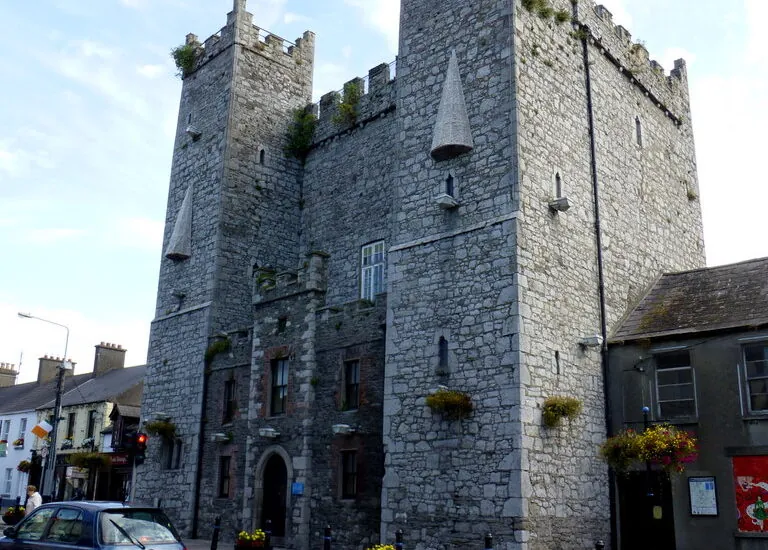
Right in the centre of Ardee, County Louth, Ardee Castle stands on Castle Street. This imposing medieval fortified house occupies an unusual position for a castle: it is part of the streetscape. Also known as St Leger’s Castle and Pipard’s Castle, it is regarded as Ireland’s largest surviving medieval fortified house.
According to local tourism sources, Ardee Castle dates from the 15th century and is attributed to John St Leger. At the time, Ardee lay on the edge of the Pale, the part of Ireland controlled by the English administration. The castle served both as a fortified residence and a defensive stronghold for the town.
Its setting is one of its most intriguing features. Ardee Castle does not command an isolated hilltop; instead, it is woven into the fabric of a medieval town. Pause on Castle Street to take in the space occupied by its tall stone façade among the neighbouring buildings.
The castle has a rectangular plan and rises over four storeys. Turrets project from its north-west and south-west corners. Its original entrance was protected by several defensive features, including an external machicolation. These elements are a reminder that an urban house could also be designed to withstand attack.
Ardee Castle was caught up in the conflicts of the 17th century. In 1641, Phelim O’Neill’s forces took the town before it was recaptured by troops under Henry Tichborne. According to local heritage accounts, James II and William of Orange also stayed at the castle at different times before the Battle of the Boyne.
In 1805, the building was handed over to the Louth Grand Jury and adapted for use as a courthouse and prison. This long period of use explains why the castle now bears traces of several eras: the medieval building continued to evolve alongside Ardee.
In 2026, Ardee Castle is the subject of a major restoration project. The works include the conservation of the tower, the refurbishment of the former adjoining prison and courtyard, and improved access to all four storeys.
Excavations carried out as part of the project have revealed evidence of activity predating the present castle. Louth County Council has announced, in particular, the discovery of medieval pottery, animal bones and a large circular kiln. Some remains point to occupation of the site in the 12th and 13th centuries: beneath the castle, archaeologists are uncovering fragments of everyday life in Ardee.
While you are there, discover Hatch’s Castle, another fortified house in Ardee. The town is also associated with one of the great tales of Irish mythology. Its name derives from Áth Fhirdia, the ‘Ford of Ferdia’, referring to the legendary duel between Cúchulainn and Ferdia recounted in the Táin Bó Cúailnge. A sculpture in the town commemorates this episode. This story belongs to mythology and should not be confused with the history of the castle.
Ardee Castle is located on Castle Street, Ardee, County Louth. You can include it in a walk around the town centre and admire its architecture from the street. As work is ongoing, check access arrangements with Louth County Council before planning a visit inside.
Essential information to help you plan your visit, including key landmarks, access information, and booking options.
Castle Street, Townparks, Ardee, County Louth, Republic of Ireland, Tourist Attractions in Ireland
53.855125, -6.538736
Site closed during works
Check the opening hours and admission requirements before you leave, especially during peak season or on Irish public holidays.
As the castle is under construction in 2026, do not assume that entry will be free or charged without confirming in advance. Its exterior can be viewed from Castle Street, subject to restrictions related to the works.