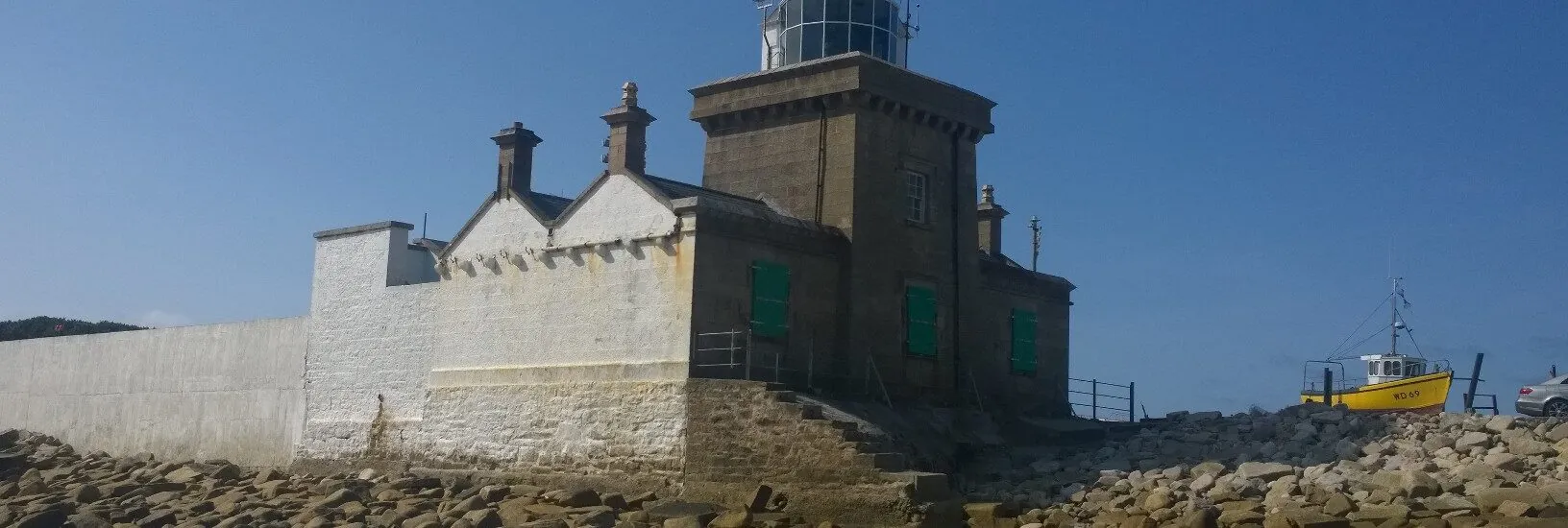
In Blacksod, the road ends near the fishing boats. By the quay, a granite building with green shutters and a small white lantern could almost be mistaken for a seaside house. Yet this County Mayo lighthouse is part of a story that reaches as far as the beaches of Normandy. In June 1944, weather observations gathered at Blacksod helped delay the D-Day landings by twenty-four hours.
Today, Blacksod Lighthouse can be explored on a guided tour, at the southern end of the Mullet Peninsula. Its appeal lies in this rare combination: a working lighthouse, a well-documented human story and a harbour looking out across the bay, with the hills of Achill on the horizon. It is worth including in an itinerary for its scenery, but also for what you discover once you step inside.
Blacksod bears little resemblance to the tall, isolated towers perched on cliffs. Its compact outline combines living quarters and a square tower, built in local granite with shades of grey and pink. Standing twelve metres high, the tower has a specific purpose: helping vessels find anchorage in the bay, alongside the offshore Blackrock Lighthouse.
Work began in the 1860s. According to the archives of the Commissioners of Irish Lights, the light was first lit on 30 June 1866. This date should be distinguished from 1864, which often appears in descriptions of the monument and marks the start of its construction. Its lantern retains an unusual architectural feature: it is designed to fit the top of a square tower, rather than crown a large cylindrical shaft.
Over time, the building also became part of village life. Between 1969 and 1972, a post office was temporarily housed there while its usual premises were being rebuilt. Beyond its technical role, then, it is a place that was lived in, maintained and visited, in constant contact with the harbour community.
Blacksod’s most famous episode began with everyday tasks: recording atmospheric pressure, observing the wind and transmitting the results. Maureen Flavin, who came from Kerry, had worked at the local post office since 1941. Weather observations were among the team’s responsibilities, and Ted Sweeney, whom she would marry after the war, helped to check them.
On 3 June 1944, her twenty-first birthday, Maureen took her readings as conditions worsened. Pressure was falling, the wind was strengthening and rain was setting in. This information became part of the data used by Allied forecasters. Ireland remained neutral, but an agreement allowed weather information to be exchanged with Great Britain.
At the time, no satellite could survey the Atlantic at a glance. Stations in western Ireland held a valuable position for tracking weather systems before they reached Great Britain. At Blacksod, a carefully taken reading could therefore shed light on a still uncertain situation across the sea.
The D-Day landings were initially planned for 5 June. Allied meteorological teams disagreed on how the weather would develop, and James Stagg, meteorological adviser to General Dwight D. Eisenhower, had to turn their assessments into a recommendation. Observations from Blacksod Lighthouse, including the falling barometer and wind strength, supported the assessment of unfavourable weather.
The decision was taken to postpone the operation by twenty-four hours. A temporary improvement then allowed the landings to begin on 6 June 1944. The Irish readings made an important contribution to the forecasters’ work, within a wider network. It would therefore be reductive to say that one person or one lighthouse decided D-Day.
What makes this story so compelling is precisely its human scale. At the time, Maureen did not know the military significance of her work. Met Éireann states that she only discovered its importance in 1956. On site, the story adds unexpected depth to a visit that might begin with a simple photograph of the harbour.
Open to visitors since 2021, Blacksod offers a guided tour of its historic rooms. It reveals the lives of lighthouse-keeping families and the building’s role in a maritime community. The tour lasts around thirty minutes: a short format that makes it easy to include in a day on the peninsula without turning it into a race against time.
The route outlined by the team includes climbing to the lantern room, where the Fresnel optic is located, followed by access to the balcony when conditions allow. It is an opportunity to see the lighting apparatus and place the lighthouse in its setting. Rather than viewing a tower from the ground, you gain an understanding of how it works with the sea, the landscape and shipping routes.
Before or after the tour, take a moment to look across the bay. In clear weather, the mountains of Achill lend depth to the landscape; in the foreground, the boats are a reminder that Blacksod remains a working harbour. The light changes the colours of the granite and water, sometimes within minutes.
To photograph the lighthouse, look for a viewpoint from authorised public areas, leaving some space around the building. Its low profile is better understood with the quay and bay in the frame than in close-up. Keep clear of fishing operations and access routes needed by professionals. Take particular care along the edge of the quay with children.
Book the interior tour in advance: space and numbers are limited. The calendar on the official Blacksod Lighthouse website allows you to check the tours available on your chosen date. Allow an hour on site to arrive shortly before departure, follow the guide and enjoy the view; more if you plan to take a break or enjoy another activity at the harbour.
For autumn and winter 2026–2027, the operator lists departures on Saturdays and Sundays at 12 noon, 1 pm and 3 pm. Timings for other seasons should be checked on the booking calendar. Do not confuse general opening hours with the departure time of a guided tour.
The official website currently shows an inconsistency in its pricing: its information box states €7 per person, while the detailed text gives €12. Allow €12 as a guide and check the amount when booking. Any concessions and group conditions should be confirmed with the team.
From Belmullet, continue south along the peninsula on the R313 towards Blacksod. For GPS, use the lighthouse address and Eircode F26 KC7V. You can park near the harbour in authorised spaces, keeping professional access routes and areas reserved for site operations clear.
A car makes it easier to explore the surrounding area, but it is not the only option: the lighthouse states that Bus Éireann route 446 connects Ballina, Belmullet and Blacksod. Check outward and return timetables for your chosen day before booking the tour. The existence of a service does not mean a bus will leave immediately after your time slot.
The climb to the lantern is via stairs. If you have mobility difficulties, ask the team which parts of the tour are accessible to you before buying a ticket. The elevated section of the visit may not be suitable for every visitor. Bring sturdy shoes and a windproof layer for the grounds and the balcony.
There are no toilets inside the lighthouse. The operator mentions public facilities near the quay and facilities at the SOLAS centre in Eachléim during its opening hours. Plan this stop in advance, especially if travelling with young children.
Finally, the site retains an operational role as a refuelling point for rescue helicopters. An emergency call-out may require a tour to be suspended at short notice. Follow staff instructions: behind the visitor attraction, maritime services are still at work.
Blacksod is best appreciated as part of an exploration of the southern peninsula, rather than at the end of a long return journey for a single half-hour tour. The SOLAS centre in Eachléim offers a chance to learn more about local history. For a boat trip to the Inishkea Islands, book a separate excursion and allow plenty of time: departures depend, among other things, on sea conditions.
Belmullet is a convenient base for exploring Erris and finding shops, restaurants and accommodation. If you continue on to other Irish lighthouses, distinguish Blacksod from the offshore Blackrock Lighthouse: their names are similar, but access conditions are very different.
Practical information checked with the operator on 26 October 2026. For the events of June 1944, this account draws on Met Éireann publications on the D-Day weather forecast and Maureen Sweeney. The lighthouse’s commissioning dates and characteristics are taken from Irish Lights.
Essential information to help you plan your visit, including key landmarks, access information, and booking options.
R313, Fallmore, Blacksod
54.0987167, -10.0604667
Autumn and winter 2026–2027: tours depart on Saturdays and Sundays at 12 noon, 1 pm and 3 pm. Advance booking is strongly recommended. For other seasons, consult the official calendar. Tours remain subject to availability, weather and the operational requirements of the lighthouse.
Check the opening hours and admission requirements before you leave, especially during peak season or on Irish public holidays.
Guided tour with admission charge. The official website displays two conflicting prices: €7 in its information box and €12 in the description. Allow €12 per person as a guide and check the confirmed price when booking. Ask the operator about concessions and group conditions. Checked on 26 October 2026.