

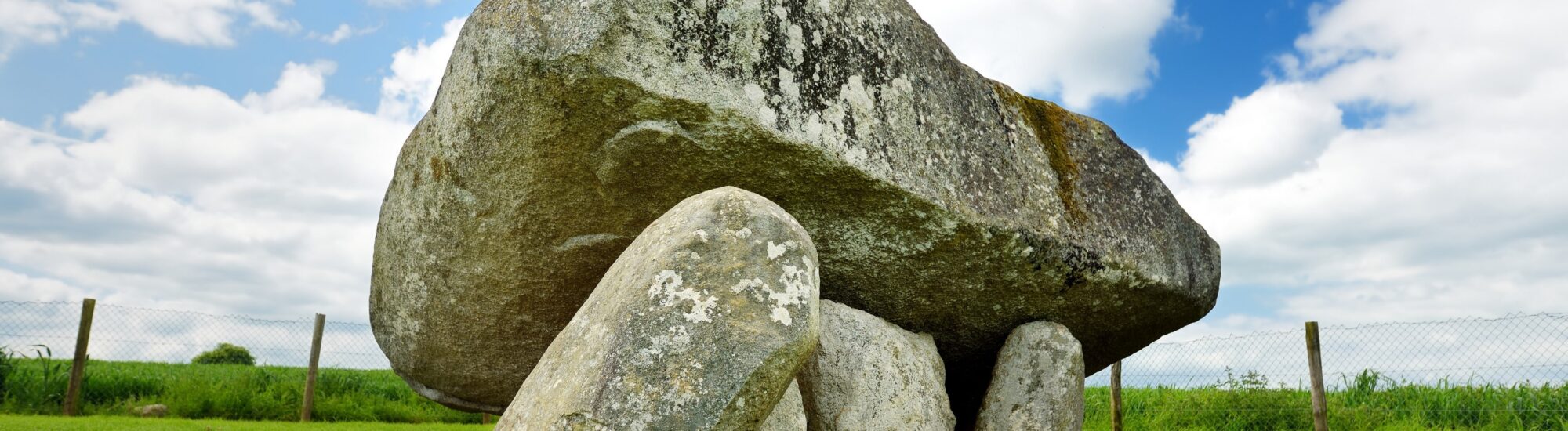
Just three kilometres from Carlow, an immense granite slab seems to hover above a meadow. Brownshill Dolmen, also known as Brownshill Portal Tomb or Kernanstown Cromlech, is one of Ireland’s most impressive prehistoric monuments.
Its capstone, estimated to weigh more than 100 tonnes, is reputed to be the heaviest ever recorded on a European dolmen. Yet the monument stands in a remarkably simple setting: a green field, a few trees and the gentle hills of County Carlow in the background.
Brownshill Dolmen is thought to have been built in the early Neolithic period, around 4,900 to 5,500 years ago. Its construction therefore dates approximately from 3500 to 2900 BC, a time when Ireland’s first farming communities had become firmly established.
These communities built large funerary monuments using blocks of stone. Archaeologists classify Brownshill as a portal tomb, a type of megalithic burial monument distinguished by two large upright stones framing an entrance.
These monuments probably served funerary and ceremonial purposes. Excavations at other Irish portal tombs have uncovered cremated or buried human remains, alongside pottery, flint tools, beads and personal objects.
Brownshill Dolmen itself, however, has never been excavated. Its exact function, any contents it may have held and the identity of those involved in its construction therefore remain unknown. The theory that it was a collective burial site remains plausible, but cannot be confirmed by discoveries from the site itself.
Brownshill Dolmen – © MNStudio
The capstone is the monument’s most striking feature. This granite block measures approximately 6.1 metres long, 4.7 metres wide and up to 2 metres thick. Its weight is generally estimated at more than 100 tonnes, with some estimates putting it at around 103 tonnes.
The stone rests on two upright pillars placed on either side of the entrance, a closing stone and a lower block at the rear. Together, they form a relatively narrow chamber beneath a vast slab of extraordinary proportions.
How this capstone was transported and put in place still raises many questions. Its builders had neither lifting machinery nor metal tools. They probably used a combination of levers, logs, ropes and ramps made from earth and stones. This remains a hypothesis, however: no evidence allows the construction process to be reconstructed precisely.
Its construction points to an excellent understanding of materials, collective organisation and a considerable mobilisation of people. Brownshill is therefore evidence not only of technical expertise, but also of the social or spiritual importance attached to the monument.
The dolmen visible today is probably only the framework of the original tomb. Like many monuments of this type, the chamber may have been partly covered by a mound of earth and stones.
The entrance, located between the two large upright stones, faces approximately east. This arrangement is found at several Irish portal tombs. It is impossible, however, to say that Brownshill was designed to align precisely with the sunrise or a particular astronomical event.
The possible disappearance of the mound gradually exposed the supporting stones and the immense capstone. This stripped-back structure has become the classic image of a dolmen, although it probably reflects only part of its Neolithic appearance.
The dolmen lies around three kilometres east of Carlow, close to the R726 towards Hacketstown. A small roadside car park allows visitors to leave their vehicle before walking to the monument.
A path crosses the field for a few hundred metres. The walk takes just five to ten minutes, but the ground can become wet and muddy after rain. Closed shoes are therefore preferable, particularly in autumn and winter.
There is no visitor centre, café or toilet facilities on site. Brownshill is an unguided archaeological site in a farming landscape. This simplicity is a major part of its atmosphere: visitors find themselves alone before a structure that is five millennia old.
Around half an hour is generally enough to walk the path, view the monument and return to the car park. Morning light brings out the dolmen’s entrance, while late afternoon often gives the granite a more dramatic atmosphere.
Brownshill Dolmen is a national monument owned by the Irish State and managed by the Office of Public Works. Despite its apparent solidity, the structure is ancient and potentially unstable.
Do not climb on the stones, attempt to go beneath the capstone or move any of the smaller elements around the monument. Doing so may weaken the site and expose visitors to the risk of falls or injury.
The dolmen stands amid farmland. Dogs must be kept under control, particularly when livestock is present. Visitors should also keep to the designated path, close any gates they pass through and leave no litter behind.
A small free car park is located near the R726, around three kilometres east of Carlow. From the car park, an unpaved path crosses a field to the dolmen.
The terrain is relatively flat, but the path crosses a meadow and may be uneven. Its accessibility for wheelchairs and pushchairs therefore depends greatly on ground conditions and the weather.
Official information is available on the Heritage Ireland page for Brownshill Portal Dolmen.
Want to extend your visit without having to rush around? Here are a few well-located places to stay near the must-see attractions.
Essential information to help you plan your visit, including key landmarks, access information, and booking options.
52.837337, -6.881004
20 minutes
Brownshill Dolmen is an outdoor archaeological site, with no ticket office or visitor centre. It is accessible all year round and no booking is required.
There is no lighting at the site. It is therefore recommended to visit during daylight hours, so that you can easily follow the path across the field and see any uneven ground.
The ground can be muddy after heavy rain. Spring, summer and early autumn generally offer the most pleasant conditions. A morning visit also allows you to enjoy interesting light on the monument’s east-facing entrance.
Temporary restrictions may still apply for safety, maintenance or agricultural reasons. Please respect any signs and barriers in place.
Check the opening hours and admission requirements before you leave, especially during peak season or on Irish public holidays.