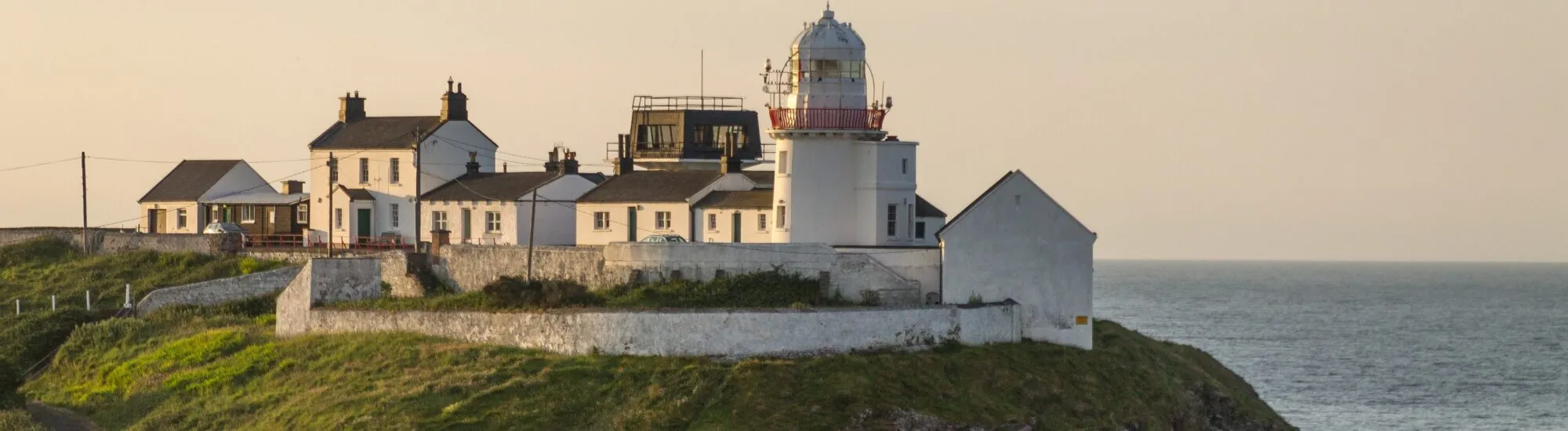
At the entrance to Cork Harbour, a white tower rises above the rocks and grassy slopes. In front of it, ships leave the sheltered waters of the harbour for the Celtic Sea. Roches Point Lighthouse has occupied this passage since the 19th century: a strategic position that has become a fine vantage point over the east County Cork coastline.
The lighthouse is worth stopping for, both for its silhouette and history, and for the seascape around it. One detail does, however, affect how you plan your visit: the tower and its grounds are not open for independent visits. Roches Point is generally experienced from nearby public areas, where visitors can watch maritime traffic and photograph the landmark from a distance.
The lighthouse’s story begins with a question of safety. In 1813, Vice-Admiral Thornborough drew attention to the dangers faced by vessels using Cork Harbour without a light at its entrance. The project passed through several authorities, while the acquisition of the site involved negotiations with Edward Roche, who owned a tower already standing on the headland.
That earlier tower had been used as a place of leisure and a lookout over the harbour. The lighthouse eventually built was, however, a separate structure, designed by George Halpin, Inspector of Works and Lighthouses for the Ballast Board. Its first light entered service on 4 June 1817. The lighting apparatus then consisted of oil lamps and reflectors.
The first structure proved too small for the needs of a major port. In 1835, it was replaced by the tower seen today, standing around 15 metres high. The old lighthouse did not disappear entirely: dismantled, it was moved to County Wexford and rebuilt at Duncannon to help mark its approach.
Roches Point forms an architectural ensemble with its glazed lantern, outer gallery and keepers’ buildings. The National Inventory of Architectural Heritage highlights the quality of its surviving details and the heritage interest of this group of buildings. The dwellings matter as much as the tower: they are a reminder that a lighthouse was also a place to work and live.
From outside, take a moment to look at the building’s proportions. Its cylindrical shaft, windows and the platform surrounding the lantern create an architecture that is both legible and functional. Its white colour makes it especially recognisable in the coastal landscape.
Like many Irish maritime stations, Roches Point evolved with lighting technology. A second-order Fresnel lens was installed in 1876, followed by electricity in 1970. On 1st April 1995, automation brought an end to the permanent presence of keepers needed to operate the light.
The lighthouse remains active and is monitored remotely. Its signal has white and red sectors: the colour seen varies according to the direction of observation and helps identify navigational areas. It should not, therefore, be thought of as a monument preserved for its beauty alone. Roches Point continues to guide mariners into the harbour.
The foghorn, meanwhile, was discontinued in 2011. This change is also a reminder that coastal soundscapes evolve. The light remains, but navigation methods, maintenance and working conditions have profoundly transformed the station.
The main appeal of the outing lies in the meeting of the lighthouse and its headland setting. From permitted public areas nearby, you can take in the open harbour entrance, the changing light on the water and, depending on port movements, passing ships. Binoculars allow you to follow the details without trying to get close to the installations.
Allow 30 minutes to an hour for an unhurried stop, photographs and time to take in the landscape. This is a suggested duration for an outdoor visit, not a guided tour. Ships do not pass on demand: it is better to enjoy the panorama than arrive expecting a large cruise liner to photograph.
There is currently no confirmed regular interior tour. The station and neighbouring properties must not be entered without permission. A road leading towards the lighthouse does not provide access to its buildings, gardens or gallery.
An open day allowed the public to climb the tower on 4 June 2017, marking the bicentenary of the first light entering service. This historic event does not constitute an annual programme. Should an exceptional opening be announced in future, check the date and arrangements with the organiser before planning your journey.
The view from the sea reveals Roches Point’s position particularly well: the tower rises above the low buildings and rocky headland. If your sea journey takes you nearby, keep your camera ready while remaining in the permitted areas of the boat. Whether you can see the lighthouse depends on the route taken.
On land, seek out views available from public space rather than trying to frame a shot by crossing private property. Side light brings out the tower’s form; a clear sky makes its white stand out against the green and blue. A phone is enough to compose an interesting image if you take the time to choose your viewpoint.
Roches Point lies on the eastern side of the entrance to Cork Harbour, beyond Whitegate and Trabolgan. From Cork, head towards the Midleton area on the N25, then follow the route to Whitegate, including the R630. Continue towards Trabolgan and Roches Point, following local signs and your navigation system.
Be sure to choose “Roches Point Lighthouse, Co. Cork” as your destination. The lighthouse is not in Cork city centre or on Cobh’s waterfront. Distances can appear short on a map of the harbour, but the water creates detours: plan your day around actual driving times.
The final roads also serve homes. Drive slowly and park only in permitted places, without obstructing residential or service access. By bicycle, the headland can be a destination from the Midleton area, but the roads are shared with vehicles: this is not a continuous greenway.
Viewing the lighthouse from permitted public areas does not require a ticket for the monument. However, no regular interior tour price or opening time can be given, as the station does not normally receive visitors. The arrangements for any occasional opening would need to be checked separately.
Choose a daytime visit, with weather that allows you to enjoy the views. Heavy mist can obscure the panorama. In strong winds or rough seas, avoid exposed areas and do not go down onto the rocks for a better photograph.
Bring a windproof jacket, sturdy shoes and water. Do not rely on the lighthouse buildings for toilets, a shop or a public shelter. For a meal and everyday services, plan a stop in one of the towns along your route rather than assuming they are available at the foot of the tower.
With children, keep a comfortable distance from the edge and supervise them near roads. If you have particular mobility needs, check parking options and the surfaces that are genuinely accessible before coming: the absence of an interior visit does not guarantee that all outdoor viewpoints are accessible.
The lighthouse combines naturally with a day in the Midleton area and on the eastern shore of Cork Harbour. For a short stay, group your stops on this side of the harbour to limit backtracking.
Travellers drawn to the history of transatlantic crossings can devote another part of their visit to Cobh, formerly Queenstown. On 11 April 1912, the last passengers to board in Ireland reached the Titanic by tender. This history belongs to the harbour as a whole: it would be misleading to present the lighthouse itself as an embarkation quay for the liner.
To discover another maritime landmark in the county, Ballycotton Lighthouse offers a different setting, on an island. The two places require separate planning: at Roches Point, a typical visit takes place on land, centred on the exterior views.
Information checked on 26 October 2026. The lighthouse’s history and characteristics draw in particular on the Irish Lights archives and the national architectural inventory. Please respect signs and access restrictions on site.
Essential information to help you plan your visit, including key landmarks, access information, and booking options.
Trabolgan, près de Whitegate
51.7931, -8.2547833
No regular interior visiting hours are confirmed. For exterior views from permitted public areas, choose daylight and favourable weather, subject to local restrictions. The open day in June 2017 was an exceptional event and is not an annual fixture.
Check the opening hours and admission requirements before you leave, especially during peak season or on Irish public holidays.
No ticket is needed to view the lighthouse from permitted public areas. The tower and its grounds are not open for independent visits: no regular interior tour price is confirmed. Any exceptional opening must be checked with its organiser.