 A.-K. D. / Wikimedia Commons,
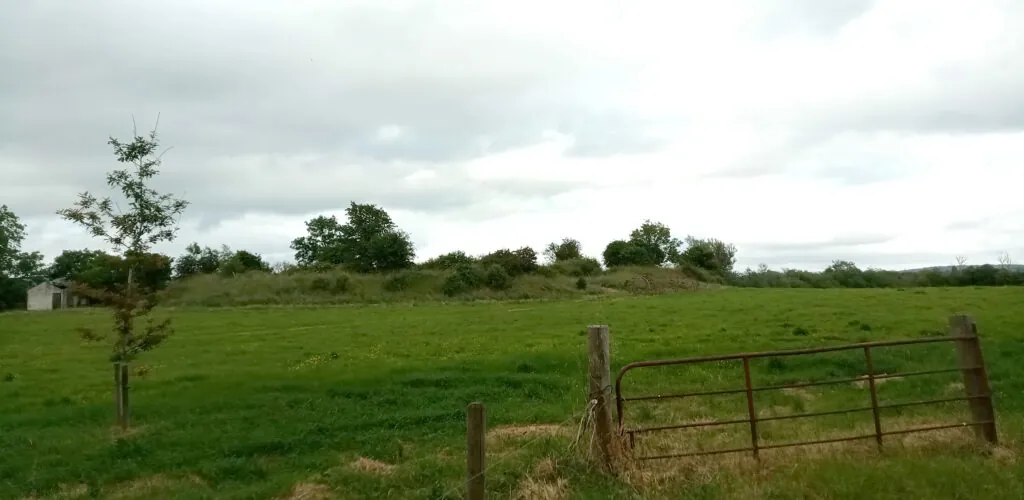
In Blanchardstown, north-west Dublin, the Sport Ireland campus cross-country course has a 75-metre-diameter circle as its neighbour. It takes archaeological equipment and test trenches to make it out: beneath the surface lies a ringfort, an early medieval fortified rural settlement. On the same site, excavators unearthed a flint scraper that could be twice as old as the enclosure.
On 4 September 2026, Uisce Éireann had already reported the discovery at Sheephill, in the Abbotstown area. On 12 November, Sport Ireland returned to the excavations, detailing the enclosure’s size, its date and some of the objects found. The investigations were carried out ahead of the Greater Dublin Drainage project.
A 75-metre circle beneath the Sport Ireland campus
How archaeologists found the enclosure
The project archaeologist, Derek Gallagher, explains that the team combined geophysical surveying with test trenches. The former helps identify differences beneath the surface; the latter make it possible to examine traces in the soil. Together, these methods revealed the circular outline. Sport Ireland dates the enclosure to between AD 600 and 900.
The team was struck by its 75-metre diameter, which it sees as an indication of the site’s importance. The dimensions alone, however, tell us neither how many people lived there nor what their status was. The two local history and heritage societies invited to view the excavations discovered a place where these questions can now be explored through material remains.
What was a ringfort used for in Ireland?
The word “fort” suggests a garrison or a castle. In Ireland, many of these enclosures instead surrounded a farm: a family could live there, work there and shelter its livestock. The National Monuments Service distinguishes in particular between enclosures marked by a bank and ditch and those whose perimeter is built of stone. In both cases, the circle marks the boundary of a living space.
Flint, pottery and several different periods
Why the oldest object does not date the fort
The flint scraper, estimated to be between 2,500 and 3,000 years old, is considerably older than the medieval enclosure. Conversely, the Leinster-type cooking pottery mentioned by Sport Ireland dates from the 12th to the 15th centuries, after the period proposed for the fort. The team also mentions sheep-head remains, without assigning them a date in the statement.
These differences are what make the site so interesting. An object may be older or more recent than the structure near which it is found. To link the two, it is necessary to know which layer it was in and how that layer formed. The dates published for Sheephill provide several points of reference over time; they are not enough to establish continuous occupation of the site.
Where to see a ringfort on a trip around Ireland
From Sheephill to Kerry’s stone walls
In Blanchardstown, the statements describe an archaeological excavation and a visit arranged for local associations. They do not announce that the site will open to the public. Sport Ireland says that the excavation records will be handed over to the National Monuments Service and the objects to the National Museum of Ireland; this deposit does not amount to an announcement of an exhibition.
To see a circular enclosure in the landscape, head to Cahergal Fort, near Cahersiveen in Kerry. Discover Ireland dates it to the 8th or 9th century and notes that its stone walls have been reconstructed. The stairways built into their thickness make the shape of the fort particularly easy to read. It is an example worth visiting to understand the principle of a circular enclosure, whose materials and state of preservation vary from one site to another. The guide to ringforts to visit in the Republic of Ireland offers a way to continue exploring.