
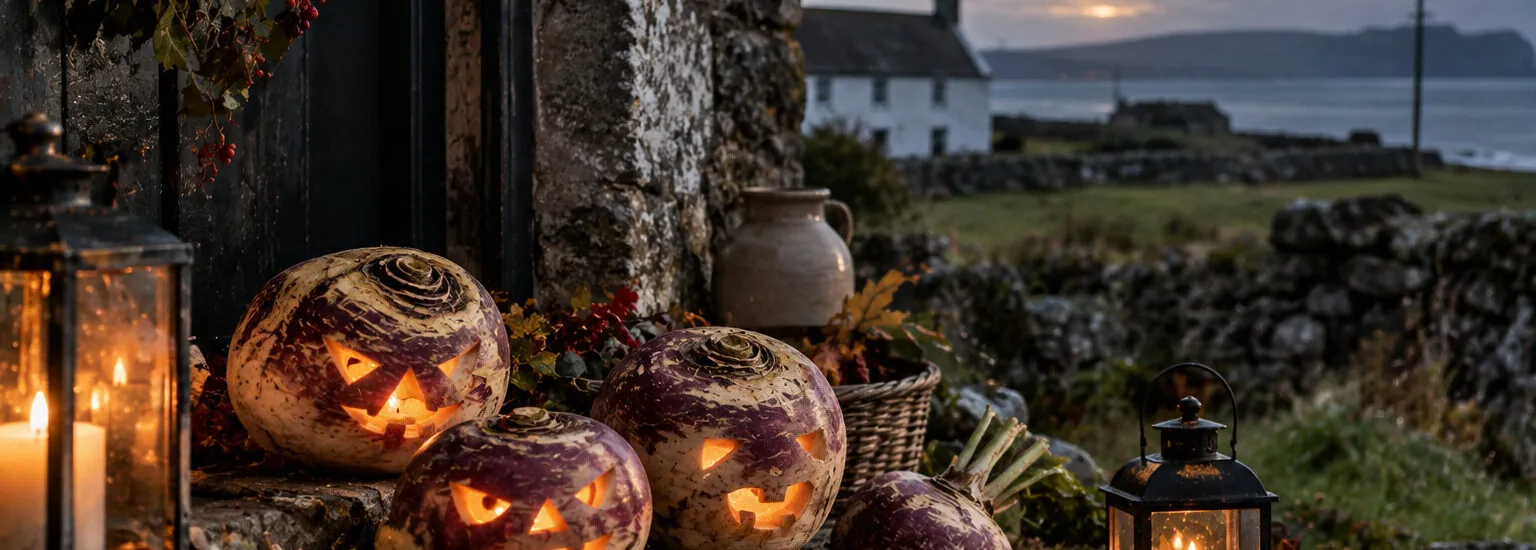
Before orange pumpkins became the universal face of Halloween, Ireland had something smaller, tougher and arguably far more unsettling: a hollowed-out turnip carved with a face and lit from within. These eerie lanterns are not a modern attempt to make Halloween look more Celtic. They are documented in Irish museum and folklore collections.
The National Museum of Ireland preserves a remarkable “ghost turnip” associated with Fintown, County Donegal, while the Irish folklore archive records similar Halloween practices elsewhere. Together, they offer a tangible glimpse of Halloween in Ireland before the pumpkin took over.
The idea was straightforward: hollow out a turnip, cut eyes and a mouth through its dense flesh, then place a candle inside. The result was less polished than a modern pumpkin and considerably creepier.
Accounts in the Schools’ Collection include Halloween customs in which a candle was placed inside a turnip carved as a face. The National Museum of Ireland also notes that such lanterns could be carried or placed on windowsills. In the darkness of Oíche Shamhna, subtle mood lighting this was not.
One of the best-known objects linked to the custom is associated with Fintown in County Donegal. The museum records it under reference F1943.350. In 1943, teacher Rois Ní Braonáin presented a turnip lantern representative of those traditionally made in the area around 1900; a painted plaster cast was produced by artist Eileen Barnes.
Its crude, irregular features are precisely what make it so effective. The museum explains that candles were placed inside these turnips and that the lanterns were used, among other things, to frighten people on Halloween night.
Turnips were readily available in rural Ireland and robust enough to become lanterns, although carving their hard flesh required considerably more determination than working with a pumpkin.
That difficulty shaped their appearance. Narrow cuts, uneven faces and pale flesh created something closer to a distorted head than cheerful seasonal décor. The lanterns fitted naturally into an Irish Halloween already rich in disguises, games, divination, pranks and supernatural beliefs.
The National Museum of Ireland describes the Halloween pumpkin as an American development of the older carved-lantern idea. Pumpkins available in North America offered an obvious advantage: they were larger, softer and much easier to hollow out.
The historical story deserves more nuance than the familiar claim that “the Irish invented the Halloween pumpkin”. What the evidence clearly shows is that carved turnip lanterns were part of Irish Halloween tradition before the modern pumpkin lantern, and that the pumpkin represents a later North American development of the practice.
Today the term Jack-o’-lantern is inseparable from illuminated Halloween faces. Irish popular tradition also links carved lanterns with stories of Jack, the wandering figure left with only a makeshift light.
Those stories exist in multiple forms and changed through oral transmission. The material evidence for turnip lanterns is firmer: museum objects and folklore testimony demonstrate that they were genuinely used in Ireland.
Pumpkins now dominate Halloween in Ireland too, but the turnip has become a powerful symbol of the festival’s older local traditions. Museums, heritage organisations and folklore enthusiasts regularly bring it back into the spotlight.
It is easy to understand why. A pumpkin can be cute. A roughly carved turnip illuminated by a trembling candle looks as though it knows something you do not. More than a century after the Donegal example was in use, the “ghost turnip” remains one of the most memorable objects through which to explore the history and Irish roots of Halloween.