Reservations are recommended
Powered by GetYourGuide

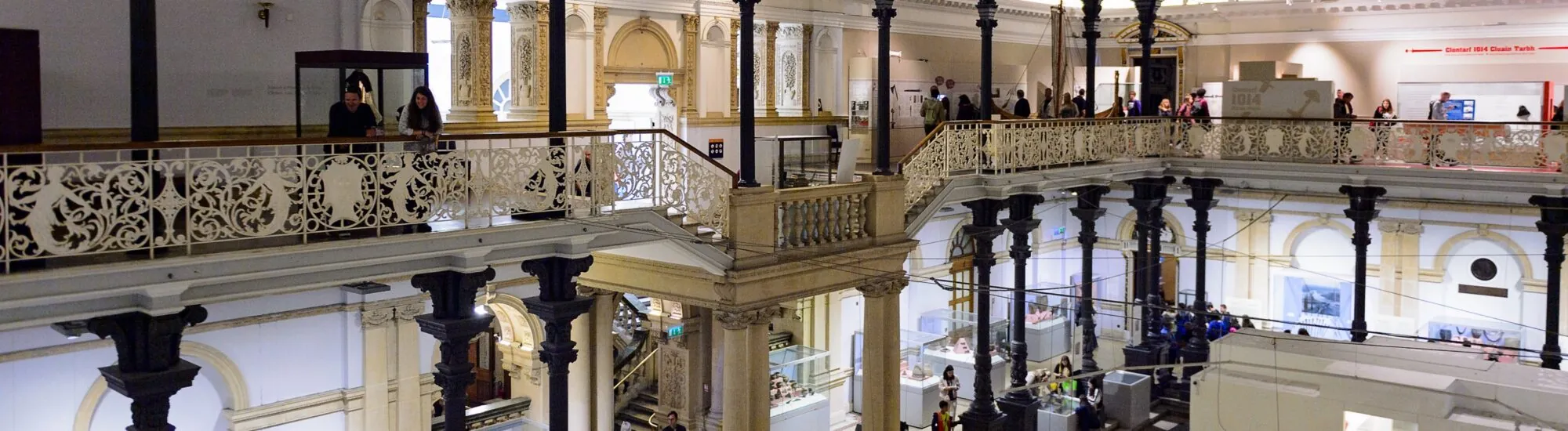
A gold necklace crafted more than 3,000 years ago, the preserved body of a man discovered in a bog, or the Ardagh Chalice, a masterpiece of medieval Irish art: the collections of the National Museum of Ireland span several millennia of history.
In Dublin, the national museum is not confined to a single building. Its collections are spread across the Archaeology museum on Kildare Street, the Decorative Arts & History museum at Collins Barracks, and the Natural History Museum on Merrion Street. The latter is currently closed for renovation, but a selection of its taxidermied animals can be seen at the Dead Zoo Lab in Collins Barracks.
The National Museum of Ireland in Dublin – © Anton Ivanov Photo
The National Museum of Ireland holds the country’s principal national collections of archaeology, history, decorative arts, folk traditions and natural sciences. Its holdings are spread across several buildings because of their scale and the diversity of the objects preserved.
Three branches are located in Dublin:
A fourth site, the National Museum of Ireland – Country Life, is at Turlough Park, near Castlebar in County Mayo. It is devoted to rural life and Irish folk traditions.
Admission to the different sites is free. As the buildings are some distance apart, it is best not to try to visit them all fully in the same half-day.
The Archaeology museum on Kildare Street holds several of the best-known objects in Ireland’s heritage. Its collections trace the history of the island from the earliest hunter-gatherer communities to the end of the Middle Ages.
The building opened to the public in 1890. Its Victorian architecture, marble columns and domed rotunda provide a spectacular setting for the collections.
The rotunda floor is decorated with a mosaic depicting the signs of the zodiac. Around this central space, the galleries are arranged according to the major periods of Ireland’s early history.
A full visit can take several hours. Travellers short on time may wish to focus on the prehistoric gold collections, bog bodies, the Viking Age and the treasures of medieval art.
Ireland has one of Europe’s richest collections of prehistoric goldwork. The objects displayed on Kildare Street bear witness to the skill achieved by craftspeople as early as the Bronze Age.
The display cases contain sun discs, bracelets, necklaces and delicate ornaments known as lunulae. Recognisable by their crescent shape, these were made from hammered sheets of gold and decorated with geometric patterns.
The precise purpose of some objects remains unknown. Their rarity and the quality of their workmanship nevertheless suggest that they were associated with prestige, power or ritual practices.
The abundance of these finds also reveals Ireland’s integration into long-distance exchange networks. The island was not isolated: raw materials, techniques and styles were already circulating between the different regions of Atlantic Europe.
The Kingship and Sacrifice exhibition presents several human bodies discovered in Irish bogs. Acidity, lack of oxygen and the particular properties of peat preserved skin, hair and certain organs for more than 2,000 years.
These men appear to have met violent deaths. Injuries recorded on their bodies have led archaeologists to consider ritual executions connected with kingship, territory or Iron Age beliefs.
Old Croghan Man and Clonycavan Man are among the most striking discoveries. Their state of preservation makes it possible to study their diet, health, appearance and the circumstances of their deaths.
The display is understated and well contextualised, but the sight of human remains may be unsettling for children and sensitive visitors.
The gallery known as The Treasury brings together several masterpieces of Insular art. These objects combine Celtic traditions, Christian influences and techniques from other parts of Europe.
The Ardagh Chalice, discovered in 1868 in County Limerick, was made around the 8th century. Its silver structure is embellished with gold, glass, enamel and exceptionally fine filigree.
Despite its name, the Tara Brooch was not discovered on the Hill of Tara. It was found near Bettystown in County Meath. Its more prestigious name was given to it by a jeweller to strengthen its association with the ancient kings of Ireland.
The museum also displays the shrine of Saint Patrick’s Bell, the Cross of Cong and various pieces of religious metalwork. Their refinement testifies to the artistic vitality of Irish monasteries in the early Middle Ages.
The Viking exhibition displays weapons, tools, jewellery and everyday objects discovered in Ireland, notably during the major archaeological excavations carried out in Dublin.
The first Scandinavian expeditions reached the island at the end of the 8th century. After a period of raids, the Vikings established permanent settlements that developed into port towns. Dublin became one of their principal political and commercial centres.
Swords, spearheads and shields recall their reputation as fighters. Scales, weights, combs, tools and jewellery, however, reveal a far more complex society based on craft and trade.
Excavations at Wood Quay have made it possible to gain a better understanding of the layout of houses, trades and daily life in Viking Dublin. Some of the objects from this research are now held by the national museum.
The museum on Kildare Street is not limited to Irish heritage. It also holds collections from Egypt, Cyprus and the Roman world.
The Egyptian gallery brings together funerary objects, amulets, figurines, vessels and several mummies. These collections were assembled chiefly in the 19th and early 20th centuries.
The Cypriot objects offer an insight into the evolution of forms, decoration and techniques in Mediterranean pottery. Their presence places Irish archaeology within the broader history of ancient societies.
The Decorative Arts & History museum occupies Collins Barracks, on the north bank of the Liffey. This former military barracks was built from 1702 and remained in use for almost three centuries.
The site was originally called Royal Barracks. After independence, it was renamed in tribute to Michael Collins. The Irish army gradually left the site, which was converted to house the national collections.
The museum opened to the public in 1997. Its vast buildings surround a large parade ground known as Clarke Square, whose proportions recall the site’s former military function.
Collins Barracks presents particularly varied collections: furniture, clothing, jewellery, ceramics, glass, silverware, design, military objects and material relating to Irish social history.
The galleries devoted to decorative arts show how objects made and used in Ireland have evolved over the centuries. They bring together prestigious pieces and more ordinary elements of domestic life.
The furniture traces changes in the home, from aristocratic interiors to modern design creations. The silverware collections illustrate the work of goldsmiths in Dublin, Cork and other urban centres.
The rooms devoted to glass and ceramics feature Irish production as well as imported objects. They demonstrate the role played by trade and changing tastes.
The collections of clothing, jewellery and accessories, meanwhile, reveal changes in Irish society. Fashion emerges as a marker of status, occupation, gender and cultural identity.
Collins Barracks holds an important collection devoted to Eileen Gray, the Irish architect and designer who became one of the leading figures in 20th-century design.
Born in County Wexford in 1878, she moved to Paris and first became known for her work in lacquer. She later developed furniture with modern lines before turning to architecture.
Her creations combine elegance, functionality and research into use. They include armchairs, adjustable tables, lighting and various elements designed for modern interiors.
Long overlooked, Eileen Gray is now recognised as a major artist. The collections at Collins Barracks place her work within the international history of modernism.
The Soldiers & Chiefs exhibition explores several centuries of Irish military history. It looks at the men and women who fought in the British, European, American and Irish armies.
Uniforms, weapons, flags, documents and personal objects offer an insight into individual experiences behind the major conflicts. The exhibition also covers revolutionary movements, the War of Independence and the creation of the Irish state’s armed forces.
This history does not follow a simple path. Irish people served on opposing sides and for very different causes. The exhibition highlights these multiple commitments without reducing the story to a single military tradition.
Some galleries may be temporarily closed for works or reorganisation. It is advisable to check the programme before visiting if military history is the main purpose of the trip.
The Changing Ireland galleries examine the political, social and cultural changes that have transformed the country. They address state-building, work, migration, civil rights and evolving identities.
The narrative moves beyond major political figures to present the experiences of ordinary citizens. Photographs, clothing, personal objects and testimonies show how national changes have influenced everyday life.
This approach links the early history presented on Kildare Street with contemporary Ireland. The national museum emerges not only as a guardian of the past, but also as a place where the country’s collective narrative is shaped.
The Dead Zoo Lab was installed at Collins Barracks during the closure of the Natural History Museum. It displays around 1,300 objects from the zoology and geology collections.
Some of the animals are among Merrion Street’s most popular specimens, while others had not been shown to the public for many years.
The space does not seek to reproduce the former ‘Dead Zoo’ in its entirety. It also reveals the work carried out behind the scenes: cataloguing, moving, studying and conserving tens of thousands of specimens.
Visitors can therefore discover why museums keep taxidermied animals and how these collections make it possible to study the evolution of species, biodiversity and environmental change.
The Natural History Museum of Dublin, known as the Dead Zoo, has been closed to the public since 1st September 2024.
Before the works, the building retained a display largely inherited from the Victorian era. Thousands of taxidermied animals were arranged in historic display cases, while several whale skeletons were suspended from the roof structure.
The closure will make it possible to assess the structure, restore the building and improve its accessibility and conservation conditions. Around 30,000 specimens had to be protected or moved.
No specific reopening date has yet been announced. The National Museum of Ireland estimates that the works will last several years. Travellers should therefore not go to Merrion Street hoping to visit the former galleries.
The national museum has a fourth branch at Turlough Park, near Castlebar. Unlike the other sites, this one is not in Dublin but in the west of Ireland.
The National Museum of Ireland – Country Life is devoted to rural life from the mid-19th century to the mid-20th century. Its collections present trades, homes, agriculture, clothing, beliefs and folk traditions.
The museum is set on an estate comprising a Victorian house, gardens, woodland and trails. It complements the Dublin collections by giving a central place to the experience of rural Ireland.
The Archaeology museum on Kildare Street is the best choice for discovering Ireland’s origins, the Vikings, the Bronze Age and masterpieces of medieval art. It is particularly suited to enthusiasts of archaeology and early history.
Collins Barracks offers the chance to explore a far wider range of subjects: decorative arts, design, clothing, military history and changes in society. The presence of the Dead Zoo Lab also makes it of interest to families and natural science enthusiasts.
A first visit to each site takes at least 1 hour 30 minutes. It is nevertheless possible to spend half a day there, given the scale of the collections.
Guided tours, workshops and family activities are often offered free of charge. Some events require booking, even when there is no admission charge.
Programmes, temporary closures and access conditions are published on the official National Museum of Ireland website.
Essential information to help you plan your visit, including key landmarks, access information, and booking options.
Kildare Street, St Stephen’s Green, St Stephen’s Green
53.34026043648818, -6.254940290313255
2h00
The Archaeology museum on Kildare Street and the Decorative Arts & History museum at Collins Barracks observe the following opening hours:
The Dead Zoo Lab is located at Collins Barracks and normally follows that site’s opening hours.
The Natural History Museum on Merrion Street has been completely closed for renovation since September 2024. No reopening date has yet been announced.
Opening hours may change during works or events. Please check the official National Museum of Ireland website.
Check the opening hours and admission requirements before you leave, especially during peak season or on Irish public holidays.
Admission to the permanent collections is free for both adults and children. No ticket is generally required for a self-guided visit.
Public guided tours and many workshops are also free. However, advance booking may be required when numbers are limited.
Please check the conditions in the official National Museum of Ireland events calendar.
Compare tickets, guided tours, and excursions available through our partner platforms.