

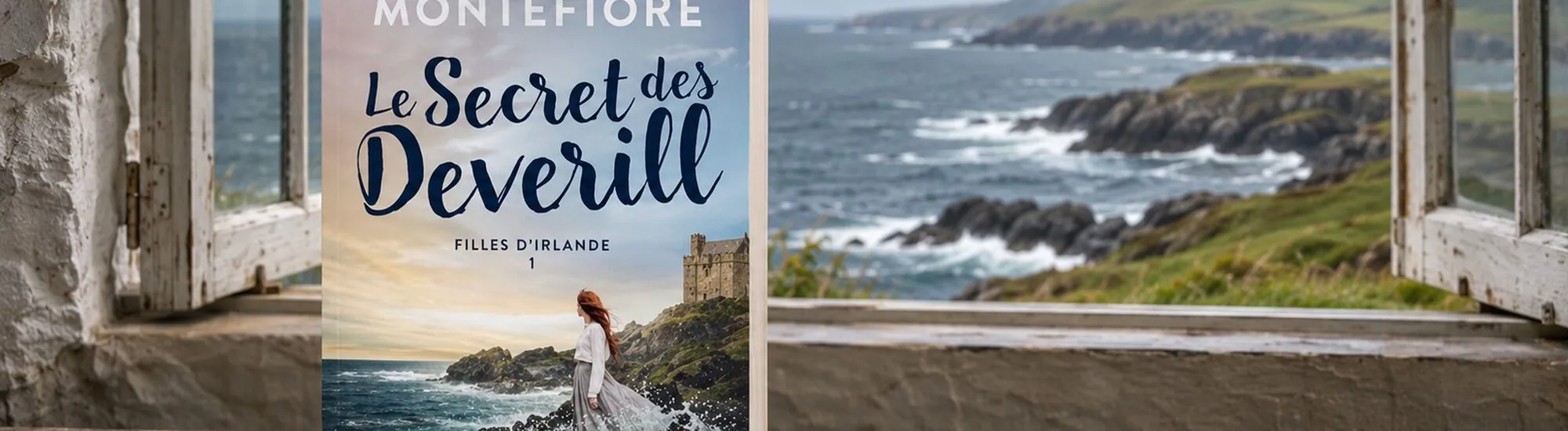
In 1900, in a castle in West Cork, two girls grow up close enough to become inseparable. Kitty Deverill belongs to the family that owns the place. Bridie Doyle is the cook’s daughter. As children, they share the same playground. As adults, they discover that the castle doors do not open in quite the same way for each of them. Their friend Celia, Kitty’s English cousin, completes the trio. When Ireland rises up against British rule, the three young women’s friendship must withstand the loyalties that their birth seems to have chosen for them.
This premise is what gives Daughters of Ireland, Santa Montefiore’s saga, its strength. With each generation, someone returns home, lays claim to an inheritance or asks a question the Deverills would rather have left unanswered. In France, five novels have already been published by Verso. The sixth, Les Adieux à Deverill, is due to be released on 4 December 2026. Here is the story behind the phenomenon, and the order in which to read the books, without revealing their endings.
Kitty grew up on the masters’ side of the divide, but her ties reach beyond the boundaries of her social world. Her love for Jack O’Leary gives an intimate face to the divisions that the struggle for independence will make harder to avoid. Bridie knows another geography of the estate. From the kitchens, she sees what the guests fail to notice, and learns early on the cost of depending on a house owned by others. Celia, who comes from England, retains memories of a happy childhood at the castle. She is prepared to spend a fortune to get it back.
By moving the story between the three women, the novel brings their disagreements into sharper relief. The home Celia wants to save is also the place where Bridie learnt the difference between being loved and having rights. Kitty, meanwhile, wants to choose her loyalties without losing the people who matter to her. The novelist lets these contradictions play out over decades. A decision made for love in one volume can become, for the next generation, a silence whose origins no one understands.
At the beginning of the saga, the island is still part of the United Kingdom. The Easter Rising of 1916, the War of Independence from 1919 to 1921 and the Civil War from 1922 to 1923 provide landmarks for understanding the speed at which the Deverills’ world changes. When the second novel opens, in 1925, the Irish Free State has existed for three years. The desire to rebuild the castle takes on particular resonance. What does it mean to restore a family home when the society that gave it its power has been transformed?
The castle and its inhabitants are fictional. The burning of country houses, however, marked the revolutionary years. An exhibition devoted to the Big Houses, created by historian Terence Dooley, traced what the wars of independence and civil war did to these estates and their owners. In an interview with Voice Magazine, Montefiore explained how important research into these two conflicts had been in writing the Deverill novels.
Born in England in 1970, Santa Montefiore grew up on a farm in Hampshire. At 19, she left to teach English to three children on an estancia in the Argentine pampas, through her Anglo-Argentine mother. In her biography, she describes the sense of belonging she felt during that stay, followed by the dislocation she experienced on her return, when the lives of those she knew had continued without her. The experience informed her first novel, Meet Me Under the Ombu Tree, published in 2001 and centred on an Argentine family.
This question of returning also runs through Daughters of Ireland. Celia wants to reclaim a place as she knew it. Faye, who grew up in the United States, instead seeks to understand what her mother never wanted to tell her. In Montefiore’s work, a house has as much to say about the absent as it does about those who hold its keys. West Cork also offers her a natural boundary in the Atlantic, beyond which her characters can change their names, their circumstances or their lives, while remaining connected to the country they left behind.
The publishing story began in 2015 with Songs of Love and War, the first instalment in the Deverill Chronicles. When the British paperback was released in 2016, Book Oxygen noted its place among the Sunday Times bestsellers. In France, the series arrived at Verso in 2024, translated by Dominique Haas and Stéphanie Leigniel. Two volumes were published that year, followed by two more in 2025. The first volume’s paperback release from Points in June 2025, followed by audiobook editions, widened the ways in which readers could discover the series. In 2026, a sixth volume, due in December, joins the fifth on the publishing schedule.
The Verso description reproduced on the fifth volume’s listing states that Santa Montefiore has sold more than eight million copies worldwide and has been translated into more than twenty languages. This total covers her entire body of work. Paperback reissues, audiobooks and the continued French publication give an indication of the Deverills’ reach, although their cumulative French sales remain difficult to quantify publicly.
The series has found part of its readership among readers of Lucinda Riley and Kate Morton. It offers the pleasure of linking distant eras and understanding, through a gesture or a confidence, how a family has fashioned its own version of the past. Montefiore nevertheless gives this past a very concrete role. Rebuilding the castle costs money. Living in it requires knowing who owns it. And telling its story sometimes means listening to the people the owners have kept at a distance. The romantic impulses and apparitions lend the saga its Gothic dimension. Questions of class and inheritance give it weight.
| Volume | French title | French hardback publication |
|---|---|---|
| 1 | Le Secret des Deverill | 2024 |
| 2 | Les Héritières de Deverill | 2024 |
| 3 | Les Dernières Heures des Deverill | 2025 |
| 4 | Le Destin des Deverill | 2025 |
| 5 | Le Serment des Deverill | 5 June 2026 |
| 6 | Les Adieux à Deverill | 4 December 2026, announced |
Kitty, Bridie and Celia grow up in the orbit of Deverill Castle. Kitty grows close to Jack O’Leary as the independence movement gains momentum. Bridie glimpses the possibility of another life, beyond the place she has occupied since childhood. The first volume establishes the ties on which the entire series depends. Here, the castle is still a shared home, even though each of the three women already has a different idea of what it means.
In 1925, the castle has burned down. Celia has the means to rebuild it and believes she can recover something of her childhood happiness. Kitty has married a man other than Jack, without letting go of what she feels for him. In New York, Bridie has gained a freedom and status she could never have imagined in her youth, but old humiliations continue to weigh on her choices. By bringing these paths back to the estate’s ruins, the novel turns reconstruction into a struggle over who the house will belong to and what it will represent.
In 1939, Martha Wallace leaves America to find her biological mother. In Dublin, she meets JP Deverill and grows close to a family that may hold the answers she is seeking. Bridie tries to make the castle her home, while Jack’s return unsettles Kitty’s balance. The third instalment closes the saga’s first great cycle. Decisions made when Kitty, Bridie and Celia were young enter the lives of a generation that knows only part of their story.
Arethusa Clayton has spent much of her life in the United States. Yet she asks for her ashes to be scattered on an Irish hill overlooking the sea. Her daughter Faye travels to Ballinakelly to honour this wish and discover what drove her mother to leave. The investigation shifts the series’ centre of gravity. The village and the castle take on another face through Faye’s eyes; she grew up on the other side of the Atlantic with only fragments of a story as her inheritance.
Margot Hart moves into the castle, now a hotel, to write the history of the Deverills. Her most valuable witness is also the most reluctant. JP has withdrawn from the world after accumulating the debts that forced the sale of the estate. As she approaches the old man and his son Colm, the biographer must contend with the interests and wounds of those whose lives she wants to tell. What seemed set to be an investigation into the past becomes a very present concern for the family.
The final volume announced by Verso returns to 1865. While her sisters covet marriage to one of the Deverill brothers, Eliza Fairfield prefers the edges of Ballinakelly and the wondrous world she glimpses there. It is this independence of spirit that attracts Lance Deverill. The book has already been published in Dutch under the title De stem van het meer in 2024. The description of that edition reveals a second storyline in 1925, when Gabriella Tremaine stays with her great-aunts at Cavan Court and senses strange presences there. The French release is announced for 4 December 2026.
Ballinakelly and Deverill Castle belong to the novel’s geography. To put landscapes to this reading, start with Bantry House, a historic house open to visitors in West Cork. From the garden terraces, the view takes in Bantry Bay. The house offers a sense of both the scale of a great estate and its relationship with the sea, two elements that account for much of the fictional castle’s presence.
Further east, the Cobh Heritage Centre, in Cork Harbour, tells the other side of this story: that of departures. Its exhibitions place Irish emigration in the long sweep of history, from the Great Famine to crossings to America. If Faye’s journey moved you, it is a stop for understanding how a departure can continue to shape a family generations later.
Start with Le Secret des Deverill and follow the publication order. The sixth goes back to before Kitty and Bridie were born, but reading it last allows you to recognise the places and families it returns to. Volumes 4 and 5 open up new investigations, some of whose echoes make more sense if you already know the first three.
The family, the village of Ballinakelly and the castle are fictional. West Cork, the Irish Revolution and the history of large landed estates provide the saga’s real setting. Santa Montefiore combines historical romance, family secrets and the supernatural.
As of 8 November 2026, five volumes have been published in French by Verso. The sixth, Les Adieux à Deverill, is due on 4 December. The author’s English-language catalogue lists five Deverill Chronicles, while the French numbering includes this sixth novel.