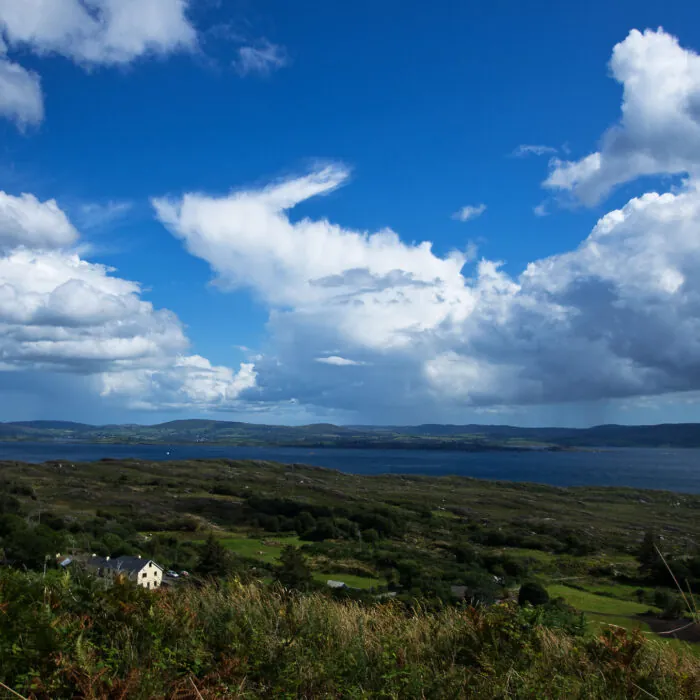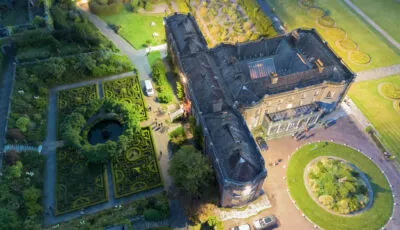


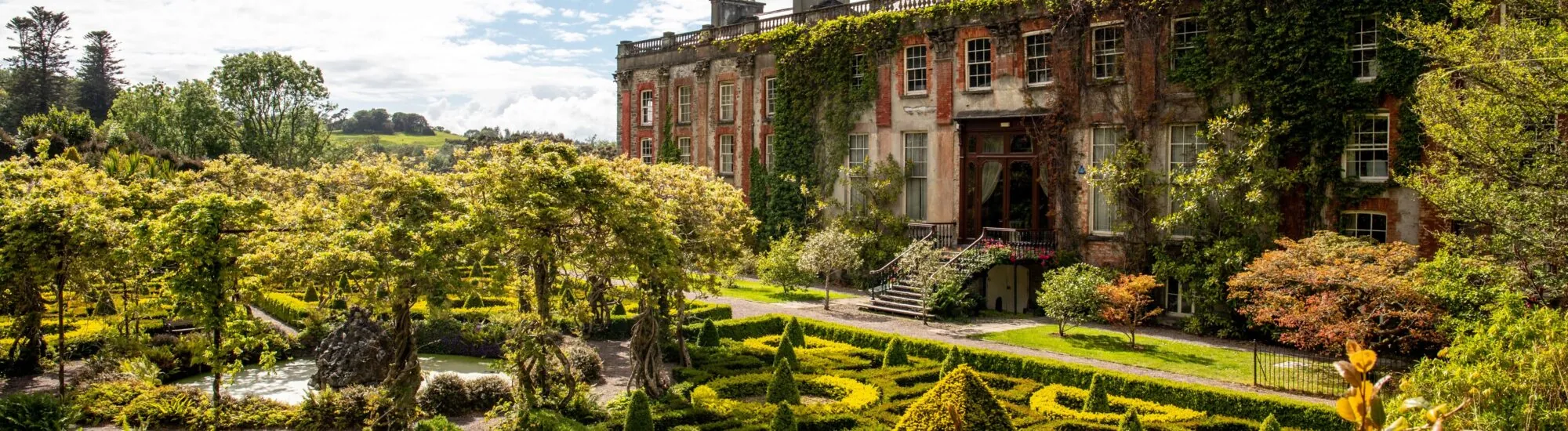
Overlooking the deep waters of Bantry Bay, Bantry House is among the finest historic homes in western County Cork. Its elegant façade, substantial art collection and terraced gardens create an almost Mediterranean setting, facing the mountains of the Beara Peninsula.
The house stands just outside Bantry, on the road to Glengarriff. Still lived in and managed by descendants of the White family, it is not a museum frozen entirely in the past. Bantry House welcomes visitors, concerts, weddings and guests staying in rooms in its East Wing.
A visit offers the chance to discover an Irish aristocratic house, as well as the history of a family closely linked to Bantry Bay, the French expedition of 1796, and the social changes that shaped Ireland in the 18th and 19th centuries.
Bantry House – © Fabiano
The precise origins of Bantry House remain partly uncertain. A house known as Blackrock House already stood on the site in the early 18th century, but the building was altered and extended several times.
It is therefore more accurate to describe it as a house whose oldest parts date from the early 1700s, rather than a building constructed entirely in a single year.
Richard White, known as Counsellor White, officially bought the property in 1765. His family had already been established in the Bantry area for several decades, notably on Whiddy Island. The house has remained in the hands of his descendants ever since.
Blackrock House was subsequently renamed Seafield, before becoming Bantry House in the 19th century. Its present appearance is the result of numerous extensions, undertaken as the White family grew in wealth and influence.
In December 1796, Bantry Bay became the setting for one of the most dramatic episodes in Irish revolutionary history. A major French fleet arrived off the coast of Cork, intending to support an uprising against British rule.
The expedition was organised with the support of Theobald Wolfe Tone, one of the founders of the United Irishmen. Around 40 ships and nearly 14,000 soldiers set out for Ireland under the command of General Lazare Hoche.
The fleet reached Bantry Bay, but storms, fog and disorganisation prevented the soldiers from landing. Several vessels were separated from the rest of the squadron, while the ship carrying Hoche failed to reach the bay at the crucial moment.
Richard White, the future first Earl of Bantry, played an active role in the local defence. He organised coastal surveillance, passed on intelligence and helped mobilise loyalist forces. He did not, however, personally repel the fleet: it was chiefly the weather conditions that caused the French operation to fail.
In recognition of his services, Richard White was created Baron Bantry in 1797, then Viscount Berehaven in 1801. He was eventually made the first Earl of Bantry in 1816.
Several cannons are now displayed in the house gardens. One of them, of French manufacture, may have come from the frigate Surveillante, which took part in the 1796 expedition before being scuttled in Bantry Bay.
Bantry House owes much of its present appearance to Richard White, second Earl of Bantry, who was born in 1800. A keen traveller and art lover, he travelled across Europe between the 1820s and 1840s.
He returned from his journeys with furniture, tapestries, paintings, sculptures and numerous decorative objects. The house was enlarged to accommodate this collection and take on the appearance of a continental palace.
The second Earl also transformed the gardens. Inspired by the villas and terraced gardens he saw in Italy, he devised an extensive landscape composition arranged around the house and opening onto Bantry Bay.
Strictly speaking, Bantry House does not have a formal French garden. Its symmetry and parterre may recall certain classical European gardens, but its principal inspiration is Italian.
Bantry House came through the most turbulent periods of Irish history without being destroyed. During the Civil War, which began in 1922, the house was converted into a hospital. It retained this role for around five years.
During the Second World War, known in Ireland as “the Emergency”, the house and its stables were occupied by the Irish Army’s Second Cyclist Squadron. The Republic of Ireland remained officially neutral, but mobilised its forces to protect its territory.
The house opened to the public in 1946, making it one of Ireland’s first major private houses to welcome visitors. It nonetheless continued to face the considerable costs of maintaining its buildings, works of art and gardens.
Some major paintings were sold during the 20th century to finance the estate. Two works by Francesco and Gianantonio Guardi once kept at Bantry House are now held by the National Gallery of Art in Washington.
The visit gives access to a selection of Bantry House’s historic rooms. The route takes in the reception rooms, the library and several rooms decorated with objects collected by the second Earl of Bantry.
The interiors stand out for their eclectic character. Continental furniture, family portraits, antique tapestries and objects brought back from travels sit side by side. The whole is not exclusively 17th-century in character: the collections and decoration span several periods, chiefly the 18th and 19th centuries.
Bantry House remains a private family property. Not every room is therefore open to the public, and the visitor route may change during a wedding, concert or special event.
The house regularly hosts events by West Cork Music, including the West Cork Chamber Music Festival and Masters of Tradition. On these occasions, some rooms may be closed or arranged for concerts.
The gardens are one of the highlights of a visit. Their present layout was devised in the 19th century by the second Earl of Bantry following his travels in Europe.
The estate is arranged around seven terraces, with the house occupying the third. In front of its south façade lies a geometric parterre featuring a fountain, lawns and a ring of wisteria.
Behind the house rise the famous Hundred Steps. This monumental staircase of 100 steps climbs through azaleas and rhododendrons to a wooded area overlooking the house.
The climb requires a little effort, but the view more than rewards visitors. From above, the eye takes in Bantry House, its terraces, the bay and the wild contours of the Beara Peninsula.
The garden is also dotted with statues, vases and decorative features brought back from Europe. Some sculptures are copies of ancient works or creations associated with the Italian sculptor Antonio Canova.
Among the most unusual pieces is a reproduction of the Warwick Vase, made from Coade stone, an artificial material highly prized in British architecture during the 18th and 19th centuries.
The Tearoom is located in the house’s West Wing. It generally serves soups, sandwiches, cakes, tea and coffee to visitors with an admission ticket or annual pass.
An afternoon tea can also be served in the library or on the terrace. It includes sandwiches, smoked salmon on brown bread, mini scones and pastries.
This experience must be booked in advance. Tearoom opening hours may differ from those of the estate during weddings, festivals and private events.
Visitors are not permitted to bring their own picnic or drinks onto the estate.
Bantry House offers bed-and-breakfast accommodation in its East Wing. Contrary to information previously given, this activity did not begin in 1990, but after the East Wing was restored in 1987.
The six bedrooms look out over the Italian gardens. They now have en-suite bathrooms and combine contemporary facilities with decorative elements inspired by the history of the house.
Guests staying on site can enjoy reserved shared spaces and book certain experiences, such as a private tour led by a member of the Shelswell-White family.
Room rates vary according to the season and events being held. It is best to book directly on the official Bantry House website.
Bantry House is just a few minutes from Bantry town centre. After your visit, you can explore the harbour, wander the small shopping streets or have lunch overlooking the bay.
The house also makes an excellent stop on a drive around the Beara Peninsula. Glengarriff and the gardens of Ilnacullin, better known as Garinish Island, are around 20 minutes away by car.
To the west, the Sheep’s Head Peninsula offers much wilder scenery, punctuated by cliffs, small harbours and walking trails.
Allow around two hours to explore the house and gardens at a leisurely pace. Add more time if you would like a meal in the Tearoom or to climb the Hundred Steps without rushing.
Want to extend your visit without having to rush around? Here are a few well-located places to stay near the must-see attractions.
Essential information to help you plan your visit, including key landmarks, access information, and booking options.
51.677149, -9.465445
45 minutes
Bantry House is currently open daily from 10 am to 5 pm.
Last admission is at 4.30 pm, and the car park closes at 5.30 pm. The Tearoom normally opens from 10 am to 5 pm during the season.
The estate regularly hosts weddings, concerts and private events. The house, gardens or entire site may therefore close occasionally.
For 2026, a full closure has been announced for 10 October 2026. Further changes may be added during the season: be sure to check the official website before making a long journey.
Booking is not required for individual visitors. It is recommended for groups of eight or more and compulsory for afternoon tea.
Parking is available on site. The gardens include slopes, steps and uneven surfaces, particularly around the Hundred Steps.
Dogs are not permitted on the estate, with the exception of assistance dogs. The use of drones is prohibited.
Check the opening hours and admission requirements before you leave, especially during peak season or on Irish public holidays.
A standard ticket grants access to the estate, the visitable part of Bantry House and the gardens.
An annual pass for access to the gardens costs €20. The €50 “Friend of Bantry House” pass allows the holder and three guests to access the estate during the season, subject to the establishment’s terms and conditions.
Afternoon tea served in the library or on the terrace costs €50 per person. This price includes a self-guided visit of the house and gardens, as well as a place on the 2 pm public tour when offered. Booking is compulsory.
Bed-and-breakfast room rates vary according to the date and room type. They should be checked through the official booking system.