Opening of Castle Garden
The former military fort in Manhattan becomes the first major immigrant reception center. Millions of Irish pass through.


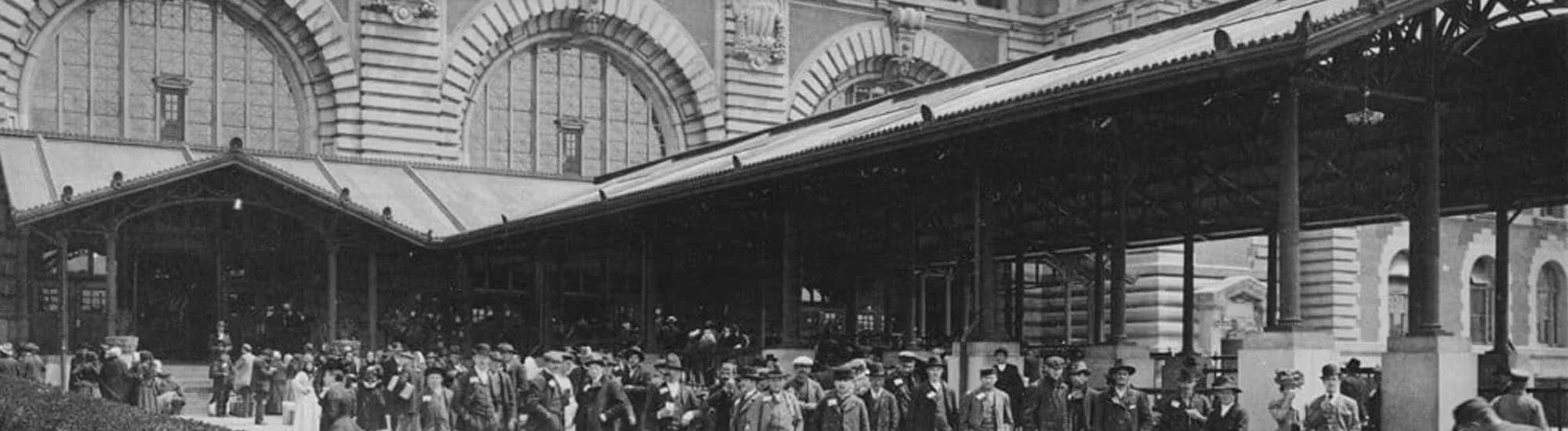
Talking about the history of Irish emigration also means telling the story of migrants arriving on American shores. Before building their future in the streets of Boston or New York, they had to pass a crucial step: going through immigrant reception centers. Two iconic places symbolize this journey to a new life: Castle Garden, active in the 19th century, and Ellis Island, which took over in the early 20th century. These sites were the stage for millions of personal stories, blending anxiety, hope, and determination.
Before Ellis Island, the main arrival point for migrants in America was Castle Garden, located at the southern tip of Manhattan. Originally built as a military fort in the early 19th century, the building was transformed into an immigrant reception center in 1855 by the State of New York.
Between 1855 and 1890, more than 8 million migrants passed through, the vast majority of whom were Irish. Castle Garden was the first glimpse of America for those fleeing famine or poverty on the Emerald Isle.
For many Irish, Castle Garden marked the end of a grueling journey aboard the infamous “coffin ships.” Upon arrival, they were registered, sometimes medically examined, then directed to support associations.
Conditions at Castle Garden were basic. Unlike Ellis Island later on, there was no centralized screening system yet. Migrants were often left to fend for themselves, vulnerable to scammers and unscrupulous recruiters lurking on site.
Despite these challenges, Castle Garden was the first step in Irish integration into the United States. Many settled in New York’s working-class neighborhoods, such as Five Points, where they began to weave their diaspora.
In 1892, the federal government took control of immigration processing and opened a new center: Ellis Island, located on a small island in New York Harbor. Larger and better organized than Castle Garden, Ellis Island became the main entry point for millions of migrants from Europe.
Between 1892 and 1954, over 12 million people passed through Ellis Island. Among them, hundreds of thousands of Irish continued to arrive, especially those fleeing the chronic poverty of rural Ireland at the turn of the 20th century.
The experience at Ellis Island was feared by many. Upon arrival, migrants had to undergo a thorough medical examination. Any suspicion of contagious disease could lead to quarantine or deportation back to Europe.
Next, candidates were interviewed by officers about their identity, origin, financial situation, and plans in the United States. The Irish, often poor and without resources, were sometimes stigmatized. Yet, the majority passed this stage and were granted permission to disembark on American soil.
For many Irish, Ellis Island was just a passage. They quickly joined neighborhoods already populated by their compatriots. Community networks helped with settling in, finding housing, and sometimes securing employment.
These communities actively contributed to the construction of New York and other major American cities. Dockworkers, construction laborers, domestic workers: the Irish held tough but essential jobs for urban development.
Ellis Island was more than an administrative formality. For millions of migrants, it was a moment of truth: the boundary between exile and integration, between hope and failure. Many Irish expressed their anxiety in letters sent back home.
The main building of Ellis Island, with its large inspection hall, remains today a symbol of this ordeal. For descendants, it is an essential place of memory, where registers and archives allow tracing ancestors’ paths.
Castle Garden, now part of Battery Park, no longer functions as an immigration center but remains an important historic site. Ellis Island, meanwhile, has become an immigration museum, visited by millions of tourists each year.
The Irish, who form one of the largest American diasporas, find precious traces of their ancestors here. These sites remind us that every name recorded in the registers represents a life disrupted by exile, a step toward an uncertain but hopeful future.
It is estimated that today nearly 30 million Americans claim Irish ancestry. Many of them have ancestors who passed through Castle Garden or Ellis Island.
These immigration centers are no longer just forgotten administrative places but true identity symbols. They embody the memory of exile, the pain of uprooting, and the pride of successful integration.
The former military fort in Manhattan becomes the first major immigrant reception center. Millions of Irish pass through.
Over 8 million migrants, mostly Irish, transit through Castle Garden before moving on to New York and inland America.
The federal government centralizes immigrant reception in a new, larger, and better-organized site located in New York Harbor.
More than 12 million migrants pass through Ellis Island, including hundreds of thousands of Irish fleeing poverty and seeking a new life.
The immigration center closes after over 60 years of operation. It later becomes an immigration museum.
Castle Garden and Ellis Island are now historic and museum sites, symbols of the hopes and trials of Irish migrants.