A small ball flies across the pitch. Two players charge forward, sticks raised. Everyone in the stands already knows where it will land — except you, perhaps. Welcome to hurling, one of Ireland’s iconic Gaelic sports. Fast, technical and deeply woven into club life, it deserves a place in your itinerary, even if you do not yet know the rules.
To enjoy a match, remember this first: over the crossbar is one point; into the net is a goal worth three points. With that one key, the scoreboard becomes easy to read. The rest soon becomes clear as the game unfolds.
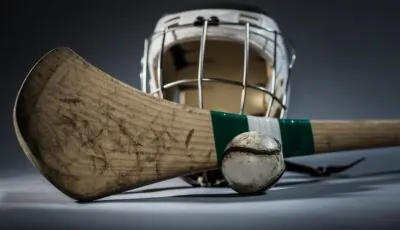
Hurling equipment – © revelpix
Hurling has its roots in Ireland’s long tradition of stick-and-ball games. It appears in the tales of early literature, particularly those devoted to Cú Chulainn. The hero belongs to the realm of legend, however: these stories reflect the game’s place in the Irish imagination, but do not allow its invention to be dated precisely.
For centuries, the game was played differently from one region to another. The turning point for modern hurling came at the end of the 19th century. Michael Cusack helped revive it, before the Gaelic Athletic Association, or GAA, was founded in 1884 to organise and promote Gaelic sports. The adoption of common rules gradually enabled teams to compete within the same framework.
Today, hurling remains far more than a sporting spectacle. Clubs play an important role in passing it on and in local life. In 2018, the game was added to the UNESCO Representative List of the Intangible Cultural Heritage of Humanity.
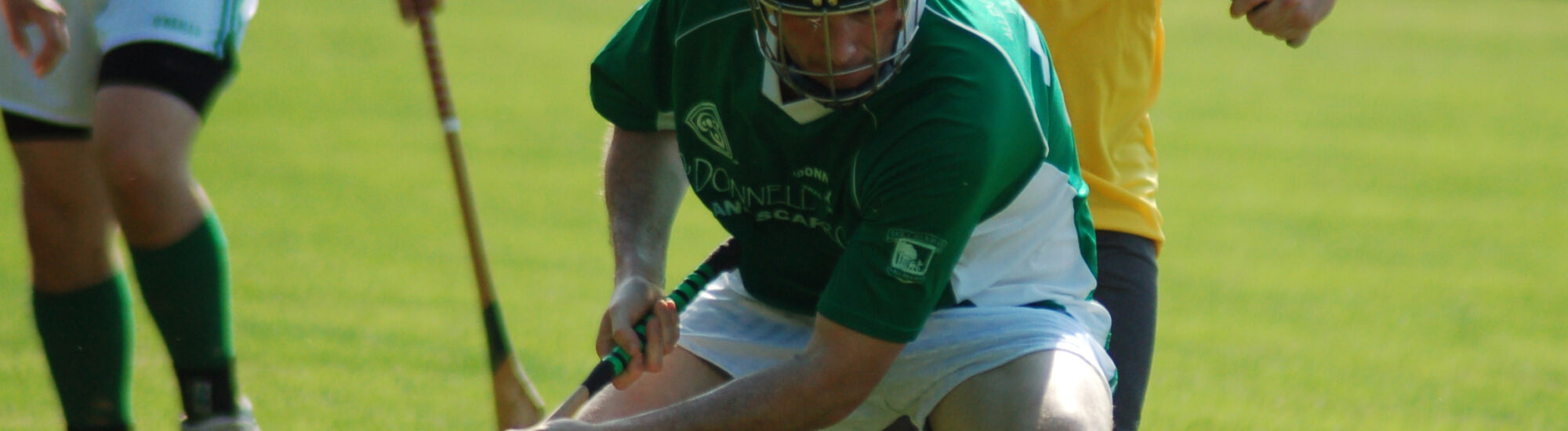
In its usual fifteen-a-side form, each team fields a goalkeeper and fourteen outfield players, divided between defence, midfield and attack. All use a stick known as a hurley in English or a camán in Irish. Its widened end is used to control and strike the sliotar, the game’s small ball. Depending on the play, players may also use their feet or hands.
A helmet with face protection is compulsory, both in training and in matches. Hurling allows some physical contact, but this is governed by rules. Behind its impression of speed and power, the game above all demands skill, anticipation and an outstanding sense of positioning.
A player can strike the sliotar with their stick, kick it or make a legal hand pass. They may carry it briefly in their hand, but not for more than four steps under the current rule. To keep running, they can balance the ball on their stick: this is the solo run, one of the most spectacular skills to watch from the stands.
A sliotar lying on the ground cannot simply be picked up by hand: the player must use their stick to lift it. There is no offside as there is in football. A long strike towards a teammate can therefore turn the situation around in an instant. Keep your eyes on the ball, even when the action seems far from the goals!
The goals are easy to recognise: a netted goal is topped by two tall posts. If the sliotar passes between the posts, above the crossbar, the team scores one point. If it goes into the net, below the bar, it scores a goal worth three points.
The scoreboard separates goals from points. A score of 3-11, for instance, means “three goals and eleven points”, for a total of 20 points: (3 × 3) + 11. If you see 2-15 to 1-17, both teams are level on 21 points each. After a few minutes of play, the calculation becomes almost automatic.
At senior inter-county level, a match is played over two 35-minute halves, with additional time possible. The duration may vary depending on the age group and competition.
A regulation pitch measures between 130 and 145 metres long and between 80 and 90 metres wide. In other words, there is plenty of room to accelerate, switch wings and send the sliotar to the other end of the pitch.
The most prestigious inter-county competition is the GAA Hurling All-Ireland Senior Championship. County teams compete throughout the season to reach the final, played at Croke Park in Dublin. The Allianz National Hurling League is another major competition, organised separately from the championship.
Dates vary from season to season: do not rely on an old listing that routinely gives the final as the first Sunday in September. To plan your trip around a match, always check the official GAA fixtures list.
And do not look only to the final! Inter-county fixtures and club matches also offer the chance to experience the passion surrounding hurling. Depending on your itinerary, look in particular for a fixture near Kilkenny, Cork, Limerick, Clare or Tipperary.
Start by checking which fixtures are scheduled during your stay, then visit the official GAA ticket office. Depending on the match, tickets may be available online or through local governing bodies and clubs. For an All-Ireland final, plan particularly far ahead: tickets are allocated, among others, to counties and clubs.
If no match coincides with your dates in Dublin, the GAA Museum and the Croke Park tour offer an insight into the history of Gaelic sports and behind the scenes of their great stadium. Check which tours are available before booking.
Another option is to watch a televised match in a pub. You will now know why the room suddenly comes alive when a sliotar flies beneath the crossbar. And if the score still escapes you, a local supporter will probably be delighted to explain what is at stake between the two teams.