
Small in size but immense in symbolic significance, the Irish shamrock is one of the emblems most immediately associated with Ireland. It appears on sports jerseys, uniforms, travel souvenirs and St Patrick’s Day decorations. Every 17 March, millions of people around the world wear it to celebrate their connection to the island and its culture.
In English, the Irish shamrock is called a shamrock. The word comes from the Irish seamróg, a diminutive of seamair, meaning ‘young clover’ or ‘little clover’. Contrary to popular belief, the shamrock is not a botanical species found exclusively in Ireland. It refers to various plants with three leaflets which history and tradition have given a shared identity.
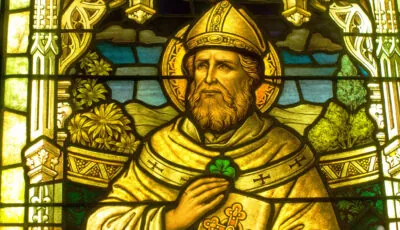
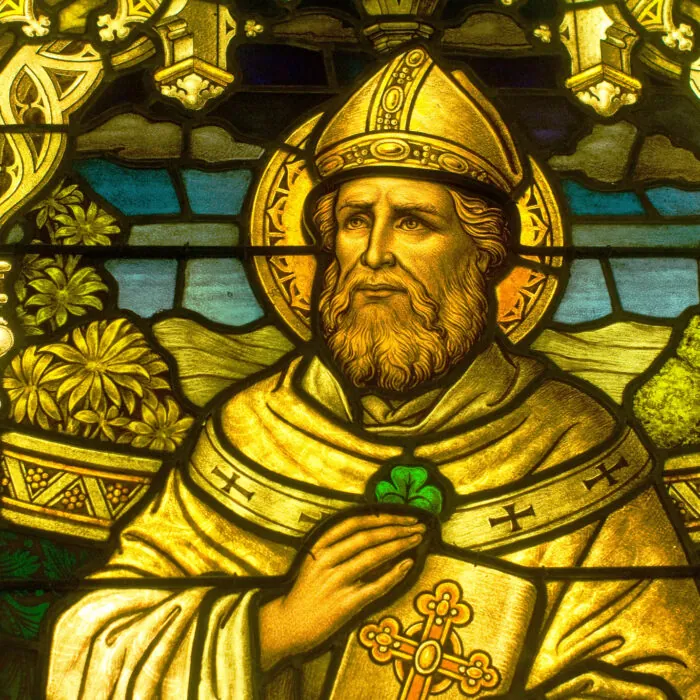
St Patrick, patron saint of Ireland, and the Irish shamrock – Thad Zajdowicz – CC
The shamrock owes much of its fame to St Patrick, the patron saint of Ireland. According to a very popular tradition, the missionary used a plant with three leaflets to explain the Christian principle of the Holy Trinity.
The three parts of the leaf are said to have represented the Father, the Son and the Holy Spirit, united on a single stem in the image of one God. This simple visual comparison is thought to have helped Patrick present Christian doctrine to the people he sought to convert.
It is a lovely story, but it should not be presented as a certain historical fact. Writings attributed to St Patrick mention neither the shamrock nor this teaching method. Medieval sources devoted to the saint are likewise silent on the episode.
The tradition explicitly linking the shamrock to the Holy Trinity appeared much later. It was notably recorded in 1726 by the botanist and clergyman Caleb Threlkeld in a work on plants growing around Dublin. The account may have been older in oral tradition, but no known source allows it to be traced back with certainty to the 5th century.
Some accounts say that St Patrick used the Irish shamrock before King Aengus, sometimes called Óengus, at Cashel. This version probably combines several episodes from traditions concerning the saint.
The conversion and baptism of a king named Aengus at Cashel do indeed feature in later hagiographical accounts. However, historical sources do not establish that the explanation of the Holy Trinity using a shamrock took place there or before that ruler.
It is therefore preferable to present the use of the shamrock as a legend linked to the evangelisation of Ireland, without assigning it a specific place, date or audience.
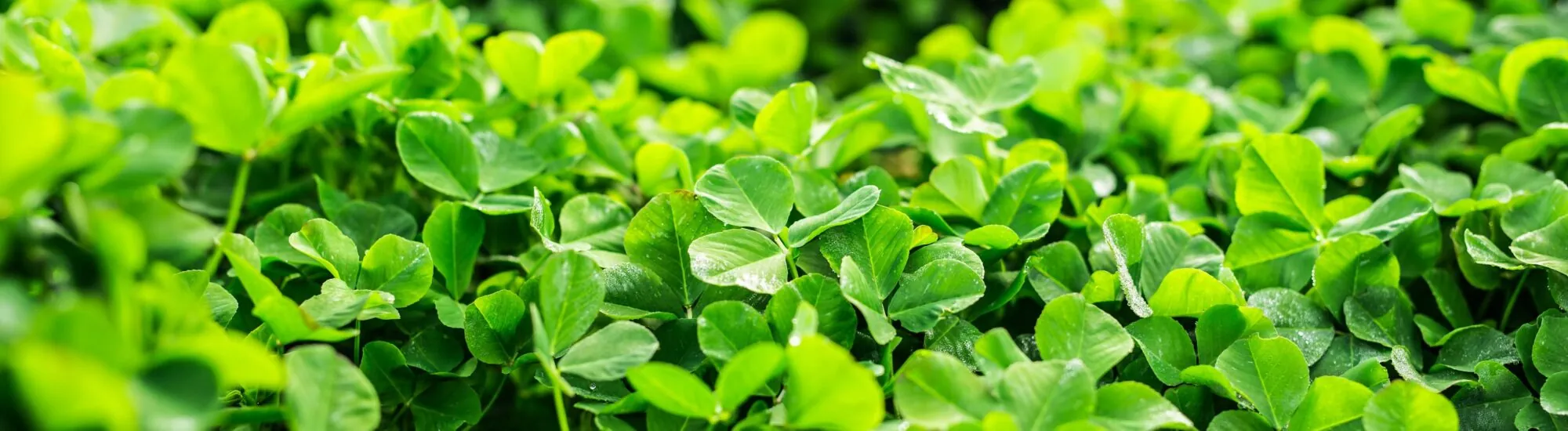
The shamrock does not correspond to a single botanical species. Several small plants with three leaflets are traditionally sold, picked or worn under this name in Ireland.
The species most often identified as the shamrock is Trifolium dubium, known as lesser trefoil or little yellow clover. White clover, Trifolium repens, is also very commonly regarded as a genuine Irish shamrock.
Other plants may be used, including black medick, Medicago lupulina, red clover and wood sorrel. They share a leaf divided into three parts, but do not all belong to the same botanical genus.
Surveys carried out in Ireland in the late 19th century and repeated in 1988 confirmed this diversity. A majority of participants identified Trifolium dubium as the true shamrock, while a significant proportion chose white clover. The Irish symbol therefore rests more on the plant’s shape than on a precise scientific classification.
None of the main species associated with the shamrock is native exclusively to Ireland. Lesser trefoil and white clover grow in many parts of Europe as well as elsewhere in the world.
The connection with Ireland is primarily cultural. The plant fits perfectly into the island’s meadow and pasture landscapes, but its symbolic value stems above all from its association with St Patrick, the national holiday and Irish identity.
The shamrock thus illustrates how an ordinary plant can become a powerful cultural marker. It is not its botanical rarity that makes it exceptional, but the collective history built around its three leaflets.
The shamrock is not merely a popular motif used on postcards and St Patrick’s Day decorations. The shamrock and the harp are recognised as emblems of the Irish State.
Their commercial use is governed by Irish law. A company wishing to use the shamrock in a way that could suggest official recognition must obtain the approval of the relevant authorities. This protection is intended in particular to prevent the emblem from being misused to present a foreign product as being of Irish origin.
The shamrock also appears on the uniforms of Irish military personnel serving abroad and in the visual identities of various institutions, organisations and businesses linked to Ireland. The official conditions governing its use are detailed by the Department of Enterprise, Tourism and Employment.
Wearing a sprig of shamrock on 17 March is one of the oldest customs associated with St Patrick’s Day in Ireland. As early as 1681, the English traveller Thomas Dinely reported that Irish people wore shamrock during the saint’s feast day.
Originally, fresh shamrock could be pinned to a hat or garment. The tradition later evolved: today, the motif is printed on accessories, painted on faces or incorporated into the decorations of parades held in Ireland and around the world.
An old custom known as drowning the shamrock involved placing the sprig worn during the day in a glass before raising a toast to St Patrick. The shamrock was then retrieved and thrown over the shoulder, a gesture believed to bring good luck.
This practice belongs to the historical folklore of the celebration and should clearly not be regarded as an invitation to drink excessively.
The shamrock is particularly visible in sport. The Irish Rugby Football Union logo, for example, combines a rugby ball with three shamrocks. This symbol represents a team bringing together players from the Republic of Ireland and Northern Ireland.
In France, the Irish national rugby team is commonly nicknamed the Shamrock XV. The expression is widely used by French-speaking media, although it is not the team’s official name.
The shamrock also appears in the identities of other Irish clubs, federations and teams. Its instantly recognisable shape makes it possible to assert a shared origin without using the flag of a single state, an important advantage for sporting organisations representing the whole island.
The shamrock has three leaflets. It is this structure that explains its traditional association with the Holy Trinity. The four-leaf clover is a rare variation in certain clover species, generally caused by genetic and environmental factors.
The four-leaf clover is considered a lucky charm in many countries, but it is neither St Patrick’s historic symbol nor Ireland’s official emblem. Using a four-part leaf to represent the shamrock is therefore a common mistake.
In popular traditions, the four leaflets are sometimes associated with faith, hope, love and luck. These interpretations vary, however, according to period and culture.
The three-leaf shamrock is sometimes presented as a lucky charm, particularly in modern depictions of Ireland. This association is reinforced by its ubiquity on St Patrick’s Day and by English-language expressions referring to the ‘luck of the Irish’.
Historically, luck is associated above all with the four-leaf clover because of its rarity. The shamrock has a different meaning: it primarily evokes St Patrick, the Christianisation of the island, belonging to Ireland and the continuity of a cultural identity.
The two symbols have gradually become closer in popular culture and the tourist trade. Nevertheless, they remain distinct both botanically and symbolically.
Each year on St Patrick’s Day, the Taoiseach, the head of the Irish Government, presents the President of the United States with a bowl containing shamrock grown in Ireland.
This diplomatic tradition dates back to 1953, when the Irish ambassador John Joseph Hearne presented a bowl of shamrock to President Dwight D. Eisenhower. John A. Costello was then the first Taoiseach to make the presentation himself, in 1956.
The ceremony has become a major occasion in relations between Dublin and Washington. It recalls the historical importance of the Irish diaspora in the United States and turns the little shamrock into a genuine instrument of cultural diplomacy.
In March 2026, Taoiseach Micheál Martin continued the tradition by presenting the White House with an Irish-made crystal bowl containing fresh shamrock.
The shamrock is one of Ireland’s best-known official and popular emblems, but it shares this role with the Irish harp. The latter is the institutional symbol used by the Government, the presidency and State administrations.
The harp appears in particular on Irish euro coins and on the presidential seal. The shamrock is more closely associated with St Patrick, sport, popular celebrations and the international representation of Irish culture.
The green, white and orange tricolour is the national flag. These three symbols are therefore complementary, but they do not fulfil exactly the same role.
How do you say shamrock in Irish?
Shamrock is seamróg in Irish. The word is a diminutive of seamair, meaning clover.
Did St Patrick really use a shamrock?
It is a later tradition rather than a historically proven fact. No text attributed to St Patrick mentions this episode.
Does the shamrock have three or four leaves?
The shamrock has three leaflets. The four-leaf clover is a rare variation considered lucky, but it is not Ireland’s traditional emblem.
What is the true species of the Irish shamrock?
There is no single species universally recognised as such. Trifolium dubium is most often identified as the shamrock, ahead of white clover, Trifolium repens.