
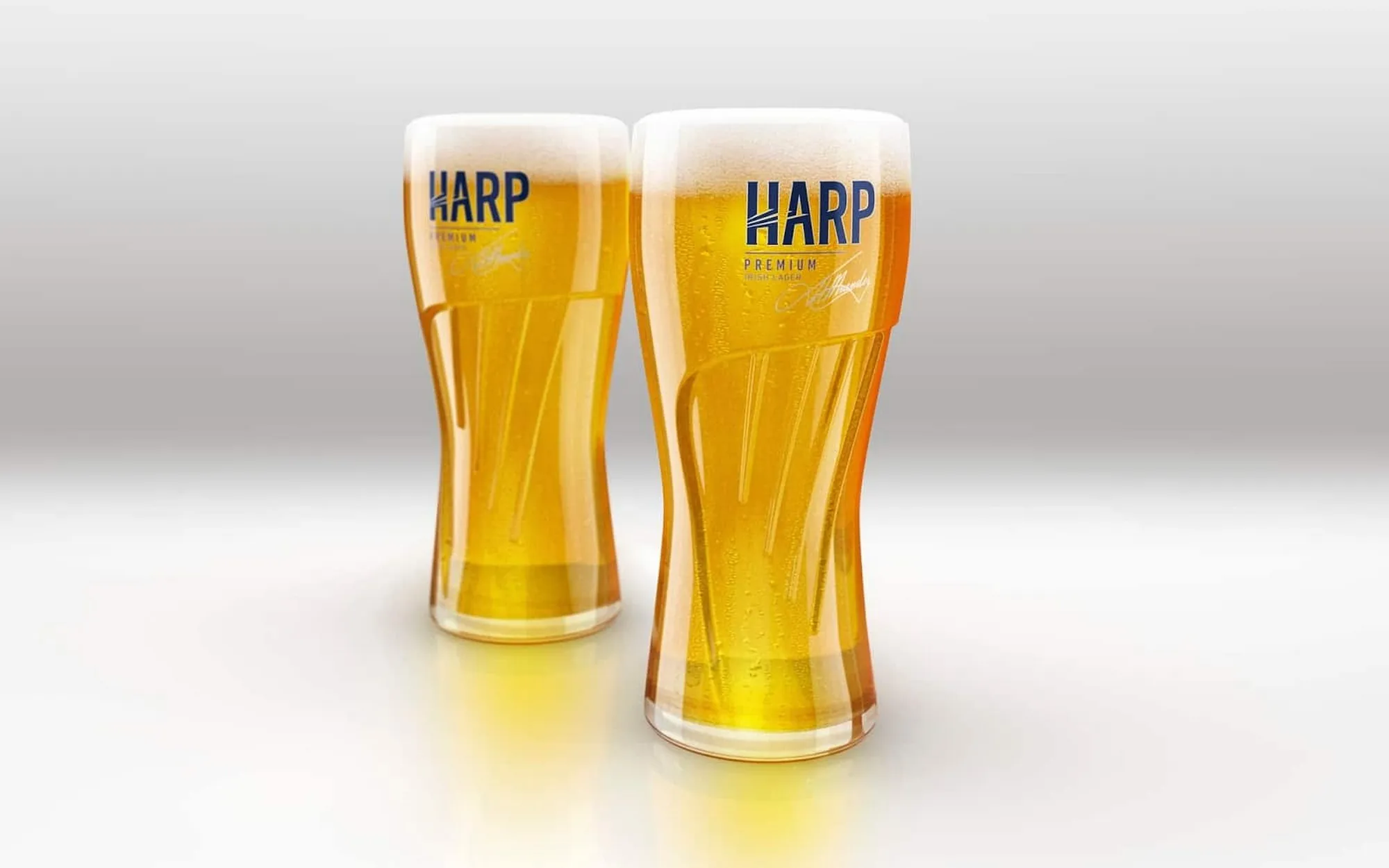
Harp occupies a distinctive place in Ireland’s brewing landscape. Pale, light and refreshing, it contrasts with the dark stouts and malty red ales so often associated with the island. Created by Guinness in Dundalk in 1960, this lager responded to a very real shift: the growing appeal of continental-style pale beers among British and Irish consumers.
By the late 1950s, lagers were gaining ground in Ireland and the United Kingdom. Guinness was already world-renowned for its stout, but the group wanted to establish itself in this rapidly growing market. It chose to convert the Great Northern Brewery in Dundalk, County Louth, into a site specialising in lager production.
The project marked a significant change. Brewing a bottom-fermented beer requires different yeasts, temperatures and methods from those used for a stout. Guinness therefore drew on expertise from continental Europe to develop a beer suited to the desired taste.
The German brewer Hermann Münder helped develop Harp and convert the Dundalk site. The beer was launched in 1960, initially in bottles. Several names are said to have been considered before Harp was chosen.
The choice immediately established a link with Ireland: the harp is one of the country’s most recognisable symbols and has long featured in the Guinness world, too. The new lager therefore acquired a clear Irish identity, despite its continental technical inspiration.
Harp was brewed at the Great Northern Brewery for more than half a century. The site played a major economic and social role in Dundalk, where the beer still holds strong sentimental value. It also became one of Ireland’s key centres of lager production.
That era came to an end in 2013, when brewing ceased at the site. The last Dundalk Harp was produced that year, after which production moved to the St James’s Gate brewery in Dublin. It would therefore be inaccurate today to describe Harp as a beer still brewed in County Louth.
The brand belongs to Diageo’s portfolio, and its Irish production is linked to Guinness’s historic Dublin site. The former Dundalk brewery, meanwhile, has found a new life in the whiskey sector.
Harp nevertheless remains deeply connected to its birthplace. It is still more visible there than in many parts of the Republic of Ireland. Its history thus forms a rather surprising bridge between Dundalk, where it was created, and Dublin, where it is now brewed.
Harp belongs to the lager family. During fermentation, specially suited yeasts work at a lower temperature than those used for ales. A period of cold maturation then helps give the beer its clean, fresh profile.
This method does not mean that a lager is automatically pale or light, but Harp was designed precisely in that spirit. It has a golden colour, a white head and lively carbonation. Its composition and alcohol content may vary according to the country and packaging: the label remains the most reliable reference.
Harp has a straightforward, approachable profile. Grains and pale malt take the lead, accompanied by a light herbal note and moderate bitterness. The finish is dry and refreshing, without heaviness or a strong lingering flavour.
It is not intended to offer the complexity of a beer to be studied at length. Its appeal lies instead in its balance and its ability to accompany a meal or a moment in the pub with ease. Served too cold, its aromas become very subtle; allowing it a few minutes in the glass lets the malt express itself more fully.
Harp and Guinness belong to the same industrial stable, but their profiles are almost opposites. Guinness is known for its black colour, creamy head and roasted coffee or cocoa flavours. Harp favours a pale colour, livelier carbonation and light cereal notes.
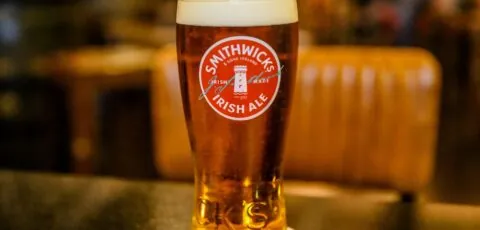
Comparing it with Smithwick’s is equally instructive. Smithwick’s is an Irish red ale with biscuit and caramel notes, whereas Harp offers a more neutral, refreshing finish. Together, these beers show that Irish brewing cannot be reduced to a single style.
Harp is particularly associated with Northern Ireland, County Donegal and Dundalk. It can be harder to find in some pubs in the Republic of Ireland, where other lagers now dominate the taps. Its availability depends greatly on each establishment’s contracts and habits.
This geography is part of its cultural interest. A brand some travellers imagine to be ubiquitous in Ireland is in fact more firmly rooted in the north of the island and in its city of origin.
When available on draught, Harp is generally served like other lagers, in a tall glass that shows off its clarity and head. In a bottle or can, pouring it into a glass makes its aromas easier to appreciate and avoids an overly fizzy sensation.
Its profile pairs easily with fish and chips, sausages, a burger, roast chicken or fried seafood. Its dryness refreshes the palate alongside salty or rich dishes, while its limited bitterness avoids overwhelming the flavours. Harp is an easy beer to order and understand, but its history reveals an important chapter in the modernisation of Irish brewing. Drink responsibly.
Alcohol abuse is dangerous for your health. Drink in moderation.