
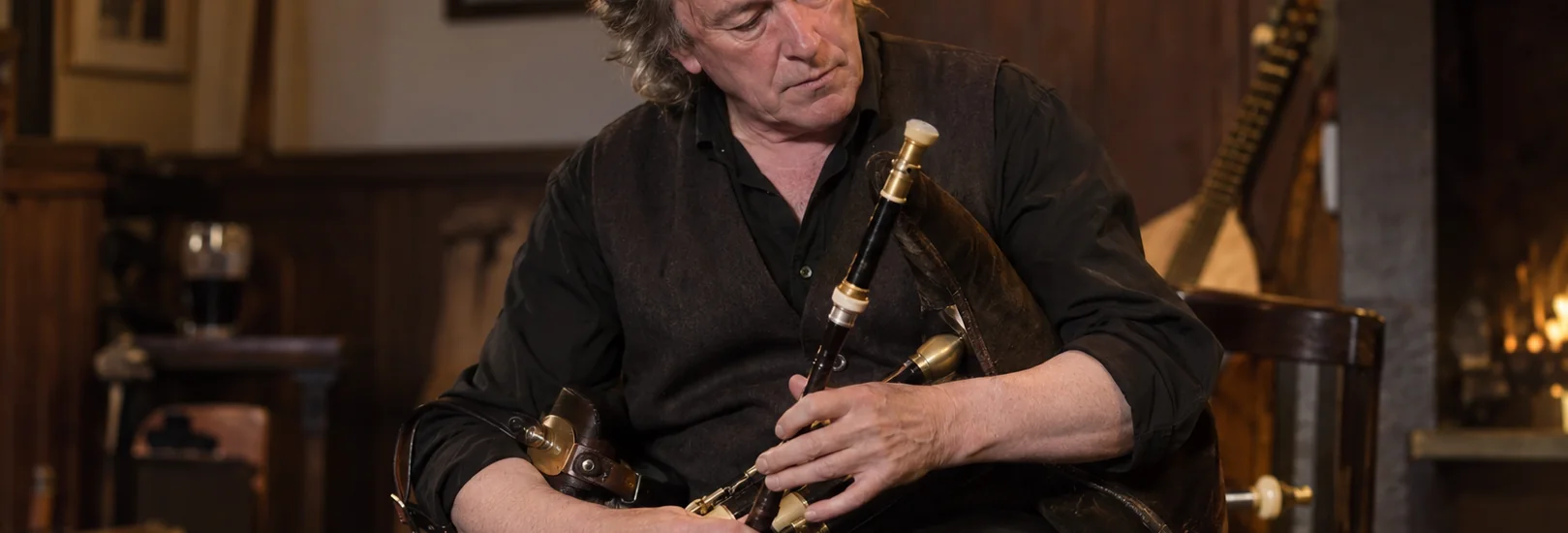
Paddy Keenan made the uilleann pipes an instrument of freedom. Born on 30 January 1950 in Trim, County Meath, and passing away on 9 September 2026 at the age of 76, the Irish musician leaves behind an instantly recognisable style: fast, open, restless and at times almost wild, yet always deeply rooted in tradition. A co-founder of The Bothy Band, he helped drive one of the great transformations in Irish traditional music during the 1970s.
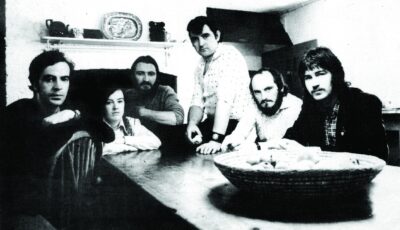
The Bothy Band
Paddy Keenan was born in Trim into a family where music was passed down long before it was learned from books. His father, John Keenan Sr., from Westmeath, was a uilleann piper from the Irish Traveller community. His mother, Mary Bravender, from County Cavan, played the accordion. His paternal grandfather was also a piper, making Paddy the family’s third generation of pipers.
The Keenans gave up their itinerant way of life relatively early and settled in Dublin, without severing ties with their cultural heritage. Musicians came and went from the family home, playing and listening. Young Paddy grew up surrounded by traditional tunes, exchanges between instrumentalists and a style of playing associated with the great Traveller pipers. This background would matter throughout his life, both in his music and in the way he spoke about his journey.
His brother Johnny first introduced him to the tin whistle when he was still a child. At around the age of ten, Paddy began seriously learning the uilleann pipes under his father’s demanding guidance. The instrument is anything but docile: one elbow works the bellows, the other controls the bag, the melody is played on the chanter and, on a full set, the regulators are used to produce chords. In short, it is a small musical factory that must be operated sitting down, with both arms already fully occupied.
Paddy Keenan’s talent quickly became apparent. At 14, he gave his first major concert at Dublin’s Gaiety Theatre. He later played with members of his family in The Pavees, a group whose name uses a term by which Irish Travellers refer to themselves.
At 17, Paddy Keenan left Ireland for England. He sang and played guitar on the London Underground, then travelled and performed on the streets of several European countries. This period temporarily took him away from the pipes, but it sharpened his ear. He discovered the blues in particular, retaining its taste for tension, improvisation and direct expression.
Yet the uilleann pipes eventually drew him back. Their melodic power, as well as the attention they commanded from audiences, reminded him that this instrument remained his most personal voice. On returning to Ireland, he rejoined the Pavees and became part of Dublin’s thriving folk scene.
In the mid-1970s, Paddy Keenan played with Mícheál Ó Domhnaill, Tríona Ní Dhomhnaill, Paddy Glackin, Tony MacMahon and Matt Molloy. Dónal Lunny soon joined the group, temporarily named Seachtar, meaning ‘seven people’ in Irish. After several changes of musicians, the line-up took the name The Bothy Band.
The group did not simply preserve old tunes under glass. It gave them fresh momentum through tight arrangements, powerful rhythms and performers capable of spectacular virtuosity. Between 1975 and 1979, The Bothy Band recorded several albums that became benchmarks, establishing an energy that would have a lasting influence on traditional music groups.
Within the group, Paddy Keenan’s playing stood out for its speed and intensity. Where the uilleann pipes can sound meditative or solemn, he made them leap. Dónal Lunny would compare him to the ‘Jimi Hendrix of the pipes’, a phrase often repeated because it captures the effect rather well: a traditional instrument pushed to its limits without being betrayed.
His style was more complex than a mere display of speed, however. Keenan mastered variations, counter-melodies and changes in dynamics. He could give a reel an almost electric drive, then stretch a note until all its fragility could be heard. That tension between fire and sensitivity became his signature.
Paddy Keenan played chiefly in the style known as ‘open fingering’, in which the chanter is not systematically closed against the knee between notes. This approach encourages a fluid, powerful sound rich in ornamentation. It belongs to a lineage associated with Traveller pipers such as Johnny Doran.
Keenan nevertheless explained that he had not heard a recording of Johnny Doran until he was around 19 or 20. The most direct influence therefore came from his own father, himself a bearer of that aesthetic. His playing thus tells the story of a genuine family transmission, rather than the late imitation of a celebrated model.
Over the course of his career, Paddy Keenan played several instruments. For decades, he notably used a set made by the Crowley family, paired with a Leo Rowsome chanter. From 2000, he adopted a set made by the English maker Dave Williams, designed in the spirit of his earlier instrument. For Keenan, pipe-making was never a minor detail: the response of the chanter, the pressure of the bag and the balance of the drones all directly shaped his phrasing.
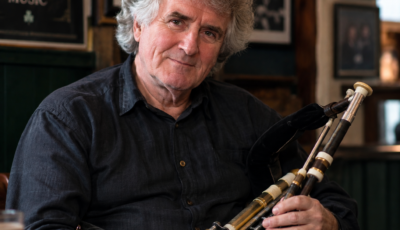
Editorial illustration of Paddy Keenan with his uilleann pipes – Guide-Irlande.com
Alongside The Bothy Band, Paddy Keenan built a personal discography. His self-titled debut album was released in 1975. He then recorded Doublin’ with fiddler Paddy Glackin in 1978, followed by Poirt an Phiobaire in 1983. Ná Keen Affair, released in the 1990s, confirmed a musical personality unwilling to choose between respect for tradition and a taste for adventure.
In 2001, he released The Long Grazing Acre with singer and guitarist Tommy O’Sullivan. The record highlights a more stripped-back style of playing, in which the pipes converse with voice and guitar. Paddy Keenan also collaborated with numerous artists and performed in Europe, North America, Japan, Australia, Cuba and as far afield as Borneo.
In the mid-2000s, Paddy Keenan travelled across Mali with Liam Ó Maonlaí, singer and musician with Hothouse Flowers. Their journey took them to the Festival au Désert, near Timbuktu, and led to the documentary Dambé: The Mali Project, directed by Dearbhla Glynn and released in 2008.
The film shows a curious musician, able to enter into dialogue with traditions far removed from his apparent musical world. Encounters with Malian artists reveal unexpected correspondences between melodies, modes of transmission and music’s social role. Keenan does not act as Ireland’s official representative: he listens, responds and lets the instruments get to know one another.
In 2002, Paddy Keenan was named Musician of the Year at the TG4 Gradam Ceoil, one of the most prestigious honours in Irish traditional music. The Irish Music Association then presented him with a Lifetime Achievement Award in 2011.
These awards honoured an artist long admired by his peers. His contribution went beyond virtuosity alone: he helped bring the uilleann pipes to major stages, showed that a tradition can evolve without losing its memory, and made the Travellers’ musical heritage heard within Irish cultural history.
Paddy Keenan’s death in September 2026 prompted many tributes in Ireland and far beyond. His work remains inseparable from The Bothy Band, but it cannot be reduced to the group. His solo recordings, collaborations and concerts conveyed a particular vision of traditional music: a living material, able to embrace the blues, improvisation and encounters without becoming diluted.
For those wishing to discover his playing, The Bothy Band’s albums offer a spectacular introduction. His own records then make it possible to hear more clearly his phrasing, his use of variations and his very particular way of making the pipes breathe. For Paddy Keenan, technique was never a circus act. It served a voice: proud, untamed and profoundly human.