

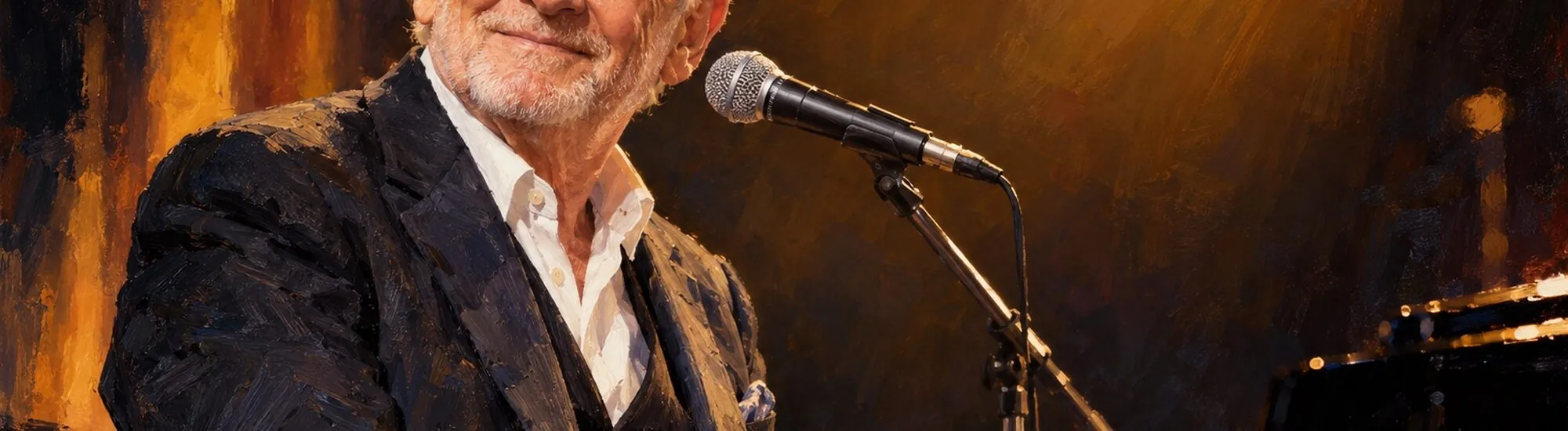
The same signature can lie behind the light-hearted refrain of Congratulations, the gravity of The Town I Loved So Well and the voices of a stadium singing Ireland’s Call. That signature belongs to Phil Coulter. Born in Derry in 1942, the composer, pianist, arranger and producer has moved through several musical worlds: British pop, the Irish folk revival and, later, sweeping instrumental melodies. To discover his work, listen both to the records released under his own name and to the voices to which he has entrusted his songs.
Phil Coulter was born on 19 February 1942 in Derry, Northern Ireland. Music was part of everyday life in the family home: his mother played the piano and his father the violin. Young Phil grew up in a city whose streets, people and memories would later provide the material for one of his most important songs.
After St Columb’s College, he continued his studies at Queen’s University in Belfast. His musical training fostered a taste for structure and harmony, while rock’n’roll offered him another kind of freedom. This blend explains part of his career: Coulter could write for a popular voice while thinking in terms of the colours of an arrangement. In 1964, he left for London to try his luck.
In 1960s London, Coulter worked as an arranger and songwriter. His meeting with the Scot Bill Martin in 1965 led to an especially fruitful partnership. Martin concentrated chiefly on the lyrics, Coulter on the music.
Their international breakthrough came with Puppet on a String, performed by Sandie Shaw: the song won Eurovision for the United Kingdom in 1967. The following year, Cliff Richard performed Congratulations, which came second. These two songs were enough to establish the duo in an industry where an instantly memorable chorus can travel far beyond its country of origin.
His connection with the contest continued in 1975: Coulter co-wrote Toi with Pierre Cour, sung for Luxembourg by Geraldine, who would become his wife. It came fifth. Eurovision is therefore part of his personal history, too.
With Bill Martin, Coulter also wrote for the Bay City Rollers, notably Shang-a-Lang and Saturday Night. The latter reached number one on the US Billboard Hot 100 in 1976. Their repertoire also included songs for Cilla Black, Kenny and Slik.
Another song worth placing in context is My Boy, recorded by Elvis Presley. It is an English adaptation, by Martin and Coulter, of the French song Parce que je t’aime, mon enfant. It is therefore not an original composition by Coulter alone. In his work, the roles overlap: composing, adapting, arranging and producing do not describe quite the same contribution.
While his pop career was flourishing, Coulter also worked with leading figures in folk music. He produced the first three albums by Planxty, the group featuring Christy Moore, Andy Irvine, Liam O’Flynn and Dónal Lunny, among others. This work places him within a decisive period of the Irish musical revival.
With the Dubliners, and Luke Kelly in particular, another dimension of his writing emerged. Song became a space for speaking of dignity, memory and collective wounds. The producer accustomed to radio hits gave greater room to storytelling and the power of performance.
Released on the Dubliners’ 1973 album Plain and Simple, The Town I Loved So Well is inseparable from Derry. The narrative first evokes a modest childhood, neighbourly ties and the place of music. Then the perspective shifts: the return to the city confronts the narrator with the violence and militarisation of the Troubles.
The song’s power lies in this progression. We encounter lives before meeting the conflict that upends them. Luke Kelly gives it an intensity that has helped secure its enduring place in the Irish repertoire. For travellers, listening to it before exploring Derry offers an evocative gateway into the city’s recent history; it remains, however, the perspective of a songwriter, not a historical summary of Northern Ireland as a whole.
Scorn Not His Simplicity was inspired by Paul, Coulter’s son, who was born with Down’s syndrome. In interviews, the composer has spoken of the difficulty of putting this intimate experience into words and of Luke Kelly’s encouragement. The song asks listeners to see the child with respect and tenderness, in a society where disability was still heavily stigmatised.
This text opens up an essential facet of his work: behind the familiar melodies lie personal experiences, too. His life with the singer Geraldine Brannigan and their family is also part of his story. To discover him in his own voice, his memoir Bruised, Never Broken, published in 2019, is a valuable companion to listening to his records.
In the early 1980s, Classic Tranquility opened a new chapter. Coulter placed the piano and instrumental arrangements at the heart of his public identity. Irish melodies meet strings and supple orchestration, with constant attention paid to the clarity of the theme.
Sea of Tranquility and Phil Coulter’s Ireland extended this approach. For first-time listeners, these records offer a more contemplative introduction than his pop songs or the Dubliners’ performances. They are arrangements reworked for album and stage, to be heard differently from a traditional pub session.
This path continued through collaborations, notably with the flautist James Galway. The album Highland Cathedral, released in 2000, earned him a Grammy Awards nomination in 2001 in the New Age category. It was a nomination, not a Grammy win.
Written for Irish rugby, Ireland’s Call has accompanied the team since the 1995 World Cup. As the team represents the whole island, the song offers a unifying symbol around the four provinces. It is not the national anthem of the Republic of Ireland: its role is tied to this shared sporting identity.
The Irish Rugby Football Union credits both the lyrics and music to Coulter. The melody’s effectiveness is immediately apparent: it allows a crowd to sing together and carry the chorus beyond its original performers.
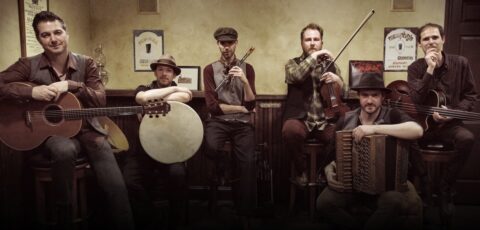
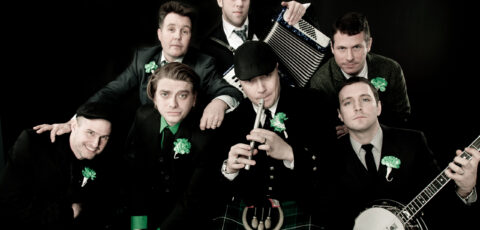
From 2007, Coulter also helped create Celtic Thunder with Sharon Browne. He was involved in repertoire selection, writing and musical direction. Particularly visible in North America, this vocal project continued his work of bringing music to a wide audience.
His catalogue includes original albums, collaborations, compilations and numerous reissues. The following selection traces its main threads; it does not claim to list every edition. Dates for some older recordings vary according to market and reissue.
| Album | Release landmark | Place in his career |
|---|---|---|
| Classic Tranquility | Early 1980s | The starting point of his best-known instrumental world. |
| Sea of Tranquility | 1984 | A major extension of the piano-and-orchestration formula. |
| Phil Coulter’s Ireland | 1985 | Another gateway into his Irish instrumental repertoire. |
| Recollections | 1993 | A landmark in his 1990s discography. |
| American Tranquility | 1994 | An extension of the Tranquility series. |
| Celtic Horizons | 1996 | A continuation of his exploration of Celtic melodies. |
| Legends, with James Galway | 1997 | A meeting between his musical world and Galway’s flute. |
| Winter’s Crossing, with James Galway | 1998 | A second important landmark in this collaboration. |
| Highland Cathedral | 2000 | The album nominated for the 2001 Grammy Awards. |
| Lake of Shadows | 2001, Windham Hill edition | A stage in his international instrumental catalogue. |
| Heartland: The Composer’s Salute to Celtic Thunder | 2011 | A link between his personal work and Celtic Thunder. |
| Return to Tranquility | 2019 | A return to the family of albums that shaped his career as a performer. |
Begin with The Town I Loved So Well and Scorn Not His Simplicity in Luke Kelly’s performances to discover the storyteller. Then move on to Puppet on a String, Congratulations and Saturday Night to hear the writer of popular hits. Finally, an album from the Tranquility series lets you hear the pianist and arranger.
This three-part listening journey reveals what connects his different careers: a melody designed to be remembered, then brought to life by a voice, an instrument or a whole audience. To find his projects and concerts, visit the official Phil Coulter website.