

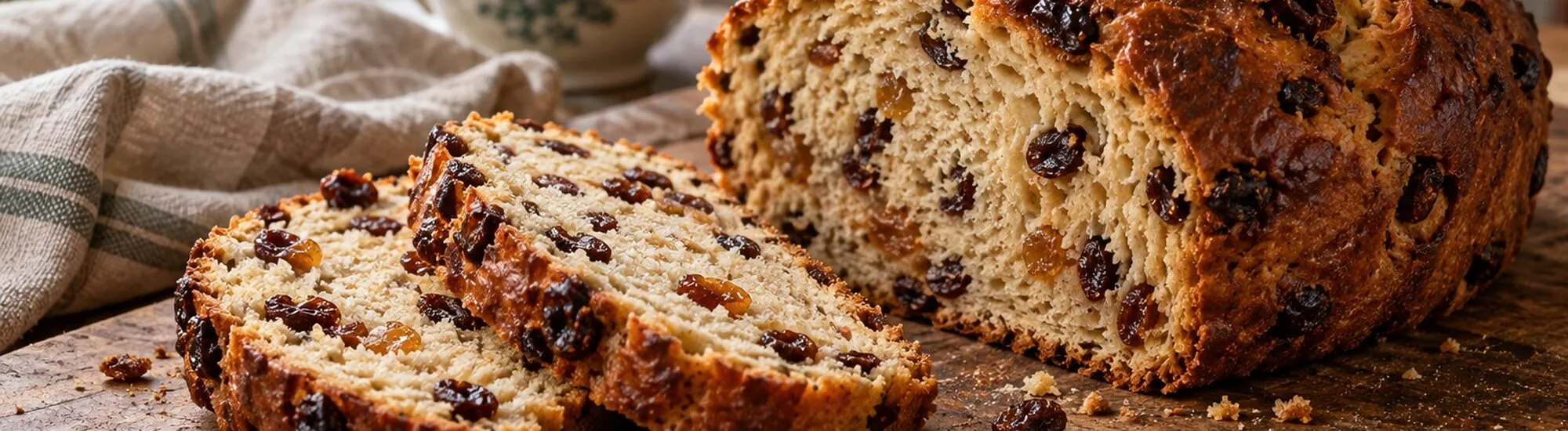
A slice of fruit bread, a cup of tea, then a small glint of metal in the crumb: at Halloween, some Irish cakes hold a surprise that resembles a marriage proposal. Yet nobody needs to get down on one knee. The ring in a barmbrack is part of a fortune-telling game: it symbolically foretells marriage for the person who finds it.
The meaning most often associated with the ring is a forthcoming marriage, sometimes said to take place within the year. In an account of the custom published by Tourism Ireland, baker and author Graham Herterich recalls this prediction, while describing today’s ring as a lucky sign for whoever finds it.
This small ritual turns sharing into something more than an afternoon treat. The bread is sliced, everyone receives a portion, and the discovery of an object turns an ordinary slice into a talking point. The prediction is, of course, folklore: finding a ring is neither a real promise of marriage nor a commitment to anyone around the table.
Traditionally, what is described as a ‘cake’ is in fact a sweet bread enriched with dried fruit. Herterich distinguishes Halloween barmbrack, which is yeast-raised, from tea brack, whose fruit is soaked in tea and which can be made with self-raising flour. Culinary practices and names sometimes overlap; not every fruit bread sold in Ireland therefore contains a ring.
The Irish word breac, meaning ‘speckled’, evokes the fruit scattered through the dough. The other part of the name refers to barm, the yeast-rich foam produced during beer brewing. The oddity of the jewellery thus lies in a deeply everyday food: a bread that is sliced and can be enjoyed with butter.
An account preserved in the Schools’ Collection on Dúchas.ie describes a barmbrack in Kilmurry, County Cork, containing a ring, a stick, a pea, a bean and a piece of cloth. The informant, Patrick Sheehan, associates the ring with marriage, the pea with poverty and the bean with prosperity. Other objects were given less happy meanings or meanings connected with religious life.
These details are valuable because they show a custom passed down in different communities and families. They do not form an unchanging code, identical throughout Ireland. A table claiming that every object has only one interpretation would erase this diversity.
The Cork record and the baker’s contemporary account do not always give the same meanings to the small objects. That is the nature of an oral tradition: memories, local variations and family habits all play a part in its transmission. The ring and marriage remain the most recognisable connection, while the rest of the distribution may vary.
The National Museum of Ireland notes that Samhain traditionally marked the first day of winter, on 1 November, with celebrations beginning the night before. Marriage divination games formed part of the evening, alongside seasonal foods, costumes and beliefs concerning the return of the dead.
The ring belongs to this wider set of practices in which the future is consulted at the turning of the seasons. It would, however, be rash to claim that today’s barmbrack, its recipe and all its objects have come down unchanged from Celtic antiquity. The context of Samhain sheds light on the custom; it does not, by itself, date every detail of its modern form.
As 31 October approaches, barmbrack offers a delicious way to discover Halloween in Ireland. To find out whether a product contains a ring, check its packaging or ask the seller: its presence should never be assumed. Ingredients and allergens also depend on the recipe used.
If an object is present, remove it before eating, particularly when children are sharing the bread. At home, you can also tell the fortune by placing a ring beside the dish, rather than hiding anything in the food. The pleasure of the tradition lies as much in the story being shared as in the surprise.
Perhaps that is what makes this custom so endearing: amid a festival filled with ghosts, the most eagerly awaited object may be a simple ring. A small promise of the future, tucked into autumn bread.