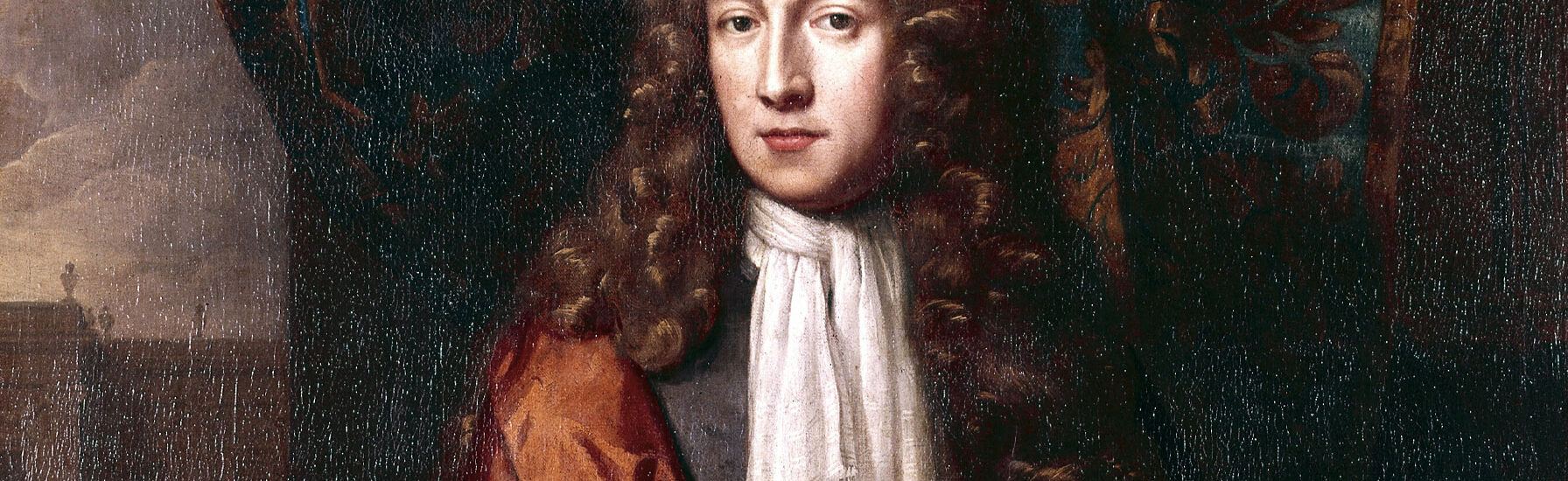
Robert Boyle (January 25, 1627 – December 31, 1691) was an Anglo-Irish natural philosopher, chemist, physicist, and inventor. He is widely recognized as one of the founding fathers of modern chemistry and is best known for Boyle’s law, which describes the inverse relationship between the pressure and volume of a gas at constant temperature.
Robert Boyle was born at Lismore Castle in County Waterford, Ireland. He was the fourteenth child of Richard Boyle, 1st Earl of Cork, a wealthy English nobleman. At the age of eight, he was sent to Eton College in England for his education. After Eton, Boyle traveled across Europe with a private tutor, visiting France, Switzerland, and Italy, where he studied philosophy, languages, and sciences.
In 1645, Boyle returned to England and settled at his family estate in Stalbridge, Dorset. He joined an informal group of scholars and natural philosophers known as the “Invisible College”, who met to discuss new scientific ideas of the time. This group later became the Royal Society of London.
In 1654, Boyle moved to Oxford, where he continued his scientific research. He was a strong advocate of the experimental method and emphasized the importance of observation and experience to understand the natural world.
In collaboration with Robert Hooke, Boyle built an improved air pump and conducted a series of experiments on the properties of air and gases. In 1662, he formulated the law that bears his name, describing how, at constant temperature, the pressure of a gas is inversely proportional to its volume. This discovery was published in his work “New Experiments Physico-Mechanical, Touching the Spring of the Air and its Effects”.
Boyle’s most influential work in chemistry is “The Sceptical Chymist” (1661), where he critiques alchemical and Aristotelian theories of matter, which were based on the four classical elements (earth, water, air, fire). He proposed a new definition of chemical elements as fundamental substances that cannot be broken down into simpler substances. This book is considered a foundational text of modern chemistry.
Boyle was also deeply religious and saw science as a way to better understand God’s work. He wrote several theological treatises and was interested in translating the Bible into foreign languages. He financially supported missions and evangelistic efforts.
In 1668, Boyle settled in London with his sister Katherine Jones, Viscountess Ranelagh, with whom he maintained a close relationship throughout his life. He continued his research until his death on December 31, 1691.
Robert Boyle left a lasting legacy in the scientific world. His promotion of the experimental method influenced generations of scientists. Boyle’s law remains a fundamental principle in physics and chemistry, taught worldwide. In recognition of his contributions, he is often called the “father of modern chemistry”.