
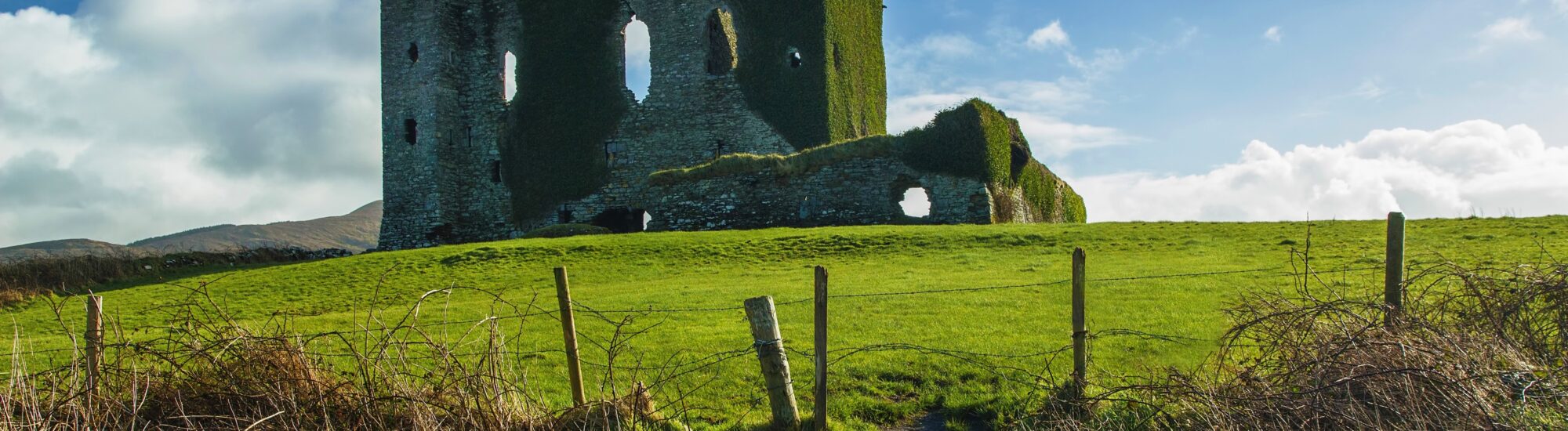
All across Ireland, they appear around a bend in the road, atop a hill, or in the middle of a field. Crumbling towers, ivy-covered walls, windows open to the sky, collapsed keeps: castle ruins are an integral part of the Irish landscape.
For many French visitors, one question keeps coming up: why does Ireland let its castles fall into ruin?
How can a country so attached to its history allow so many monuments to disappear? Why are some fortresses perfectly restored while others seem abandoned for centuries?
The answer lies in the island’s turbulent history.
Ireland is home to between 3,000 and 5,000 castles, fortified houses, medieval towers, and fortifications scattered throughout the country.
Contrary to the romantic image of a grand stone castle, most of these structures were actually fortified towers built between the 15th and 17th centuries.
Certain regions like Clare, Galway, Cork, and Tipperary have an exceptional concentration of ruins.
It’s not uncommon to spot several castles during a single day of travel.
Irish history has been marked by numerous clashes.
Norman invasions, wars between Gaelic clans, English military campaigns, rebellions, and Confederate Wars have left significant marks.
Many castles were burned, besieged, or deliberately destroyed to prevent their reuse by enemies.
In the 17th century, campaigns led by Oliver Cromwell notably caused the destruction of many fortresses.
Some ruins visible today still bear the scars of these conflicts.
From the 18th century onwards, the great landowning families gradually abandoned medieval fortresses.
Old castles were considered uncomfortable.
Windows were small, rooms dark, and facilities poorly suited to modern lifestyles.
Owners preferred to build large Georgian houses that were brighter and more comfortable.
The old castles stopped being maintained.
Time then began its work.
Ireland has a particularly wet climate.
Frequent rains, Atlantic storms, and constant humidity gradually weaken buildings.
Plants take root in cracks.
Ivy, moss, and roots sometimes speed up the deterioration of walls.
When a roof disappears, the process accelerates dramatically.
Sometimes just a few decades are enough to turn an abandoned building into a ruin.
Between 1845 and 1852, the Great Famine caused an unprecedented human catastrophe.
Millions of Irish people died or emigrated.
Many estates lost their income.
Some owners left the country.
Others no longer had the means to maintain their properties.
Several castles then fell permanently into abandonment.
Restoring a castle often involves very large sums.
Work can reach several million euros.
Walls must be stabilized, sites secured, structures restored, and strict heritage regulations respected.
Not all buildings have enough tourist or economic potential to justify these investments.
Simply put, Ireland has too many castles to restore them all.
Many sites today are stabilized but deliberately left in ruins.
This approach allows:
These stone silhouettes fully contribute to the identity of Irish landscapes.
Some monuments have benefited from major restoration work.
Among the most famous examples:
These sites welcome thousands of visitors each year.
Other castles have been transformed into hotels, museums, or event venues.
For many travelers, Irish ruins have a unique atmosphere.
Fog, moss-covered stones, sheep grazing around towers, and wild landscapes create almost unreal scenes.
Unlike other European countries where monuments have sometimes been fully rebuilt, Ireland often embraces the traces of its history.
Ruins tell stories of wars, famines, departures, lost fortunes, and upheavals that shaped the country.
Ruins allow us to imagine past lives.
They spark the imagination.
They evoke Gaelic clans, Norman knights, English lords, and great Irish families.
Every fallen wall tells a story.
Every solitary tower reminds us that in Ireland, the past remains ever-present in the landscape.
It’s probably this blend of nature, history, and mystery that explains why ruined castles captivate travelers so much.