
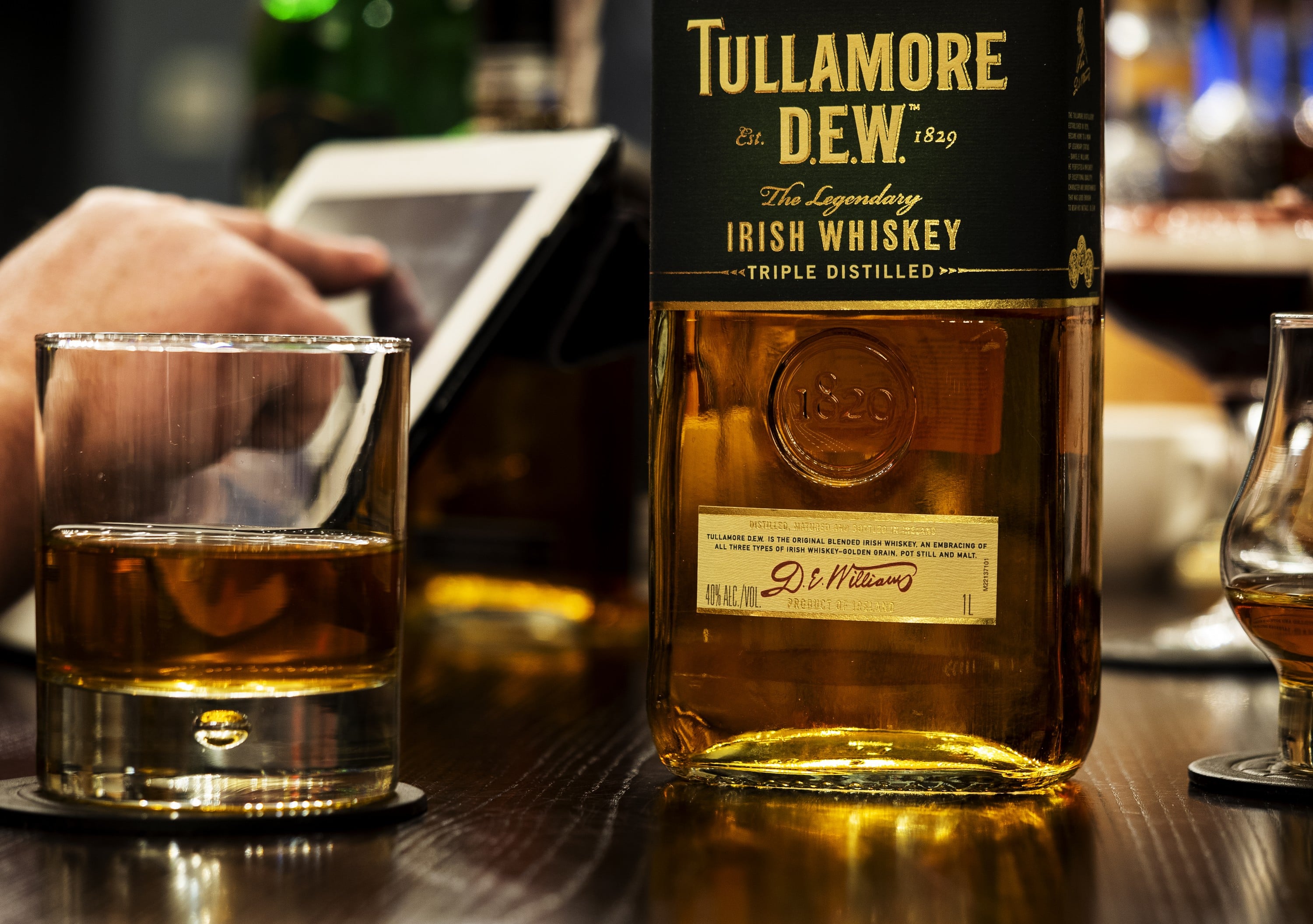
Tullamore D.E.W. is one of the leading names in Irish whiskey. Created in County Offaly in the 19th century, it stands out for its smooth, fruity and gently spiced profile, designed to remain approachable without lacking character. Its three initials refer neither to a distillation method nor to a mysterious recipe: they pay tribute to Daniel Edmund Williams, the man who made a lasting transformation to the Tullamore distillery.
The story began in 1829 with the establishment of a distillery in Tullamore, a small town in the Irish Midlands and now the county town of Offaly. The site gradually developed in a region well placed to receive grain, access water and dispatch its production. Like many Irish distilleries, however, it went through a succession of prosperous periods and crises.
The brand name remains inseparable from Daniel Edmund Williams. Having joined the distillery at a very young age, he rose through the ranks to become its general manager. Under his leadership, the business modernised and grew in importance. The letters D.E.W. added to the name Tullamore simply correspond to his initials.
Daniel E. Williams’s career forms much of the brand’s story. According to the official account, he began working at the distillery as a stable boy at the age of 15, before taking charge at just 25. His rise illustrates both his business acumen and Ireland’s industrial transformation in the late 19th century.
Williams did not simply oversee the whiskey. He helped modernise Tullamore and develop the company’s activities. His name still appears on every bottle today, more than a century after his time at the helm of the distillery.
Irish whiskey experienced a long period of decline during the 20th century. The consequences of independence, the loss of certain markets, American Prohibition and competition from Scotch weakened the entire sector. Production in Tullamore finally ceased in 1954.
The brand did not disappear, however. It changed hands and production was transferred to other Irish sites, notably Midleton in County Cork. For several decades, Tullamore D.E.W. thus continued to exist even though no whiskey was distilled in its home town.
William Grant & Sons acquired the brand in 2010 and then began building a new distillery in Tullamore. It opened in September 2014, bringing production back to County Offaly after an interruption of 60 years. The project was subsequently expanded to bring together on site the various components needed for blending.
This timeline helps avoid a common misunderstanding: Tullamore D.E.W. is no longer produced in Midleton. Its production is now once again linked to Tullamore, in a modern facility built near the historic town.
The Original expression is a blended Irish whiskey. It combines three families of spirits: grain whiskey, malt whiskey and pot still whiskey. Each plays a different role. Grain brings lightness, malt develops fruity notes, while pot still whiskey adds texture and spice.
The brand also highlights triple distillation and maturation involving several types of cask. These choices seek balance rather than power. The result does not have the smoky profile of many peated Scotch whiskies: instead, it favours smoothness, fruit and measured spicy warmth.
In Ireland, the spelling whiskey, with an “e”, is the most common. In Scotland, whisky is generally used. This linguistic difference is not, however, an absolute technical rule and is not enough to define a bottle’s taste or quality.
Tullamore D.E.W. is indeed an Irish whiskey. Its nature as a blend means that several complementary whiskeys are brought together by a master blender to achieve a consistent profile from one bottle to the next.
In its Original expression, Tullamore D.E.W. generally offers aromas of apple, pear, cereal and vanilla. On the palate, fruit, light caramel and sweet spices follow through. The finish remains smooth, with moderate warmth and a woody touch.
This profile makes it an interesting introduction for those unaccustomed to whiskey. It nevertheless remains sufficiently structured to be enjoyed neat. Other expressions in the range may emphasise the malt, cask influence or length of maturation: the label makes it possible to identify exactly which bottle you have chosen.
For a first taste, pour a small measure into a narrow glass and leave it to rest for a few moments. Taste the whiskey neat first, then add a few drops of water if desired. This light dilution can open up the aromas without chilling the drink excessively.
Tullamore D.E.W. also works well in cocktails thanks to its balanced profile. It can be used in an Irish coffee, a whiskey sour or a highball topped up with soda water. At the table, its fruity notes pair well with pork, apple desserts, caramel or a cheese that is not too strong.
Tullamore lies in the heart of the Midlands, between Dublin and Galway. The presence of the distillery has restored whiskey to a visible place in the local identity. For travellers, this stop offers the chance to connect a familiar bottle with a real town and a tangible industrial history.
In Irish pubs, Tullamore D.E.W. is widely available. It can be ordered neat, with a little water, over ice or in a cocktail. As the alcohol strength and characteristics vary between expressions, it is best to check each label. Enjoy whiskey in moderation.
Alcohol abuse is dangerous for your health. Drink in moderation.