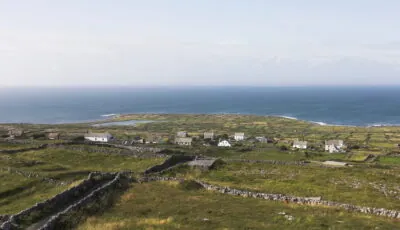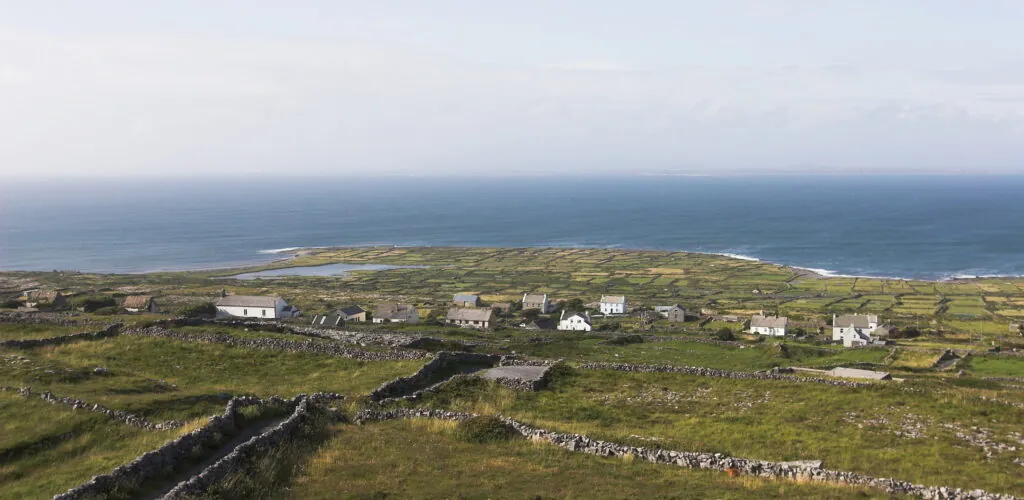
On Inis Mór, stone walls shape a landscape that seems to stand up to the ocean. But as the days grow shorter, the largest of the Aran Islands becomes more than a day trip between ferry crossings. It reveals what summer visits can sometimes leave in the shadows: a lived-in place, where travel, supplies and appointments are planned with the sea in mind.
A report published by the Irish Times on 26 October 2026 brings this reality to the fore by giving residents a voice. It highlights, in particular, the need to plan ahead for supplies when storms disrupt connections. This daily reality does not mean that the island closes in winter. Rather, it calls for a different pace of travel.
When the day-trippers leave, island life goes on
A landscape experienced in a different way
Inis Mór is one of those destinations whose images often precede the first encounter: dry-stone-walled fields, narrow roads, cliffs and coastal fortifications. Out of season, these features do not move. What changes is their accessibility for the traveller: shorter days, less predictable weather and services that need to be confirmed make it necessary to choose rather than try to fit everything in.
This difference can lend a stay another dimension. Stopping in a village, taking time over a meal or deciding against an exposed outing becomes a way to discover the island without imposing a mainland itinerary upon it. Peace and quiet are not guaranteed, however: school holidays, events and travel conditions can affect visitor numbers.
Island life is about more than isolation
The Irish Times report describes the precautions taken in case connections are disrupted. For a resident, keeping supplies on hand is part of daily organisation; for a visitor, the same reality chiefly calls for flexibility. It would be misleading to conclude that Inis Mór is continuously cut off from the world during winter.
The key is to see the island as a place where people live. Houses are not elements of a backdrop, paths are used for getting around, and businesses primarily serve local needs. Respecting private property, asking before photographing someone and accepting that an establishment keeps its own opening hours are all part of that encounter.
Getting to Inis Mór in winter: leaving from the right port
Rossaveel maintains a year-round service
Aran Island Ferries confirms that it operates the year-round service between Rossaveel, or Ros an Mhíl, in Connemara and Inis Mór. The operator gives a crossing time of around 40 minutes. Rossaveel is some 37 kilometres west of Galway, so the port should not be confused with the city centre.
The company offers a shuttle from Galway. Before booking, check the ferry, any shuttle service and the return journey together: a timetable found on an old page is no substitute for availability on your chosen date. Direct departures from Galway are described by the operator as seasonal; they should not be assumed to be available throughout the winter.
Flying is also an option, but the weather still matters
Aer Arann Islands states that it operates year-round flights from Connemara Regional Airport and publishes a winter timetable. This departure point is also outside Galway. An air connection broadens the options, but it does not remove the need to check operating conditions and travel arrangements.
For a short stay, the most useful advice is not to build an overly tight connection between your return from the island and an international flight. Allowing some leeway on the mainland makes it easier to absorb a change. How much time you need depends on your itinerary and the forecast: no time buffer can guarantee that there will be no disruption.
What to discover as the season slows down
Dún Aonghasa can still be visited, subject to conditions
Heritage Ireland announces year-round opening for the Dún Aonghasa site, with shorter winter hours and closure from 24 to 30 December. In November and December, outside this closure period, the published hours are 9.30 am to 4 pm. They should be checked again before visiting.
Preparation matters as much as opening hours. The fort is reached from the visitor centre via an uphill walk of around one kilometre, with the final section crossing uneven natural rock. The Office of Public Works recommends sturdy footwear and notes that there is no barrier along the cliff edge. In strong winds or bad weather, follow staff instructions and be prepared to alter your plans.
Walk less far, look more closely
There is no need to make every day a complete circuit of the island. A walk suited to the conditions, a trip arranged with a local provider or a heritage visit may be enough. When cycling, wind, rain and visibility should carry as much weight in the decision as the distance shown on a map.
The available daylight also means allowing enough time for the return journey. Exposed coastal sites are not places to seek a dramatic photograph during a storm. A landscape can remain striking from a sheltered spot; it will still be there when conditions allow you to get closer.
Preparing for an off-season stay without unwelcome surprises
Confirm services before paying for the crossing
Accommodation listed online is not necessarily open on every winter date. Before finalising transport, have your overnight stay, possible arrival time and meal options confirmed. If you are relying on bike hire, a tour or a transfer, check that these are operating on the planned day too.
Bring waterproof clothing, warm layers and suitable footwear, along with your usual medication for the duration of your stay and a reasonable margin. Keep your accommodation provider’s and transport operator’s contact details close at hand. The aim is to make your itinerary adaptable, not to turn a short break into an expedition.
Accepting that the Atlantic has the final say
Inis Mór in winter is particularly suited to those seeking a slower stay and willing to accept that a day may take a different shape than planned. It is less suited to an itinerary in which every hour is committed and a single crossing determines the rest of the trip.
What visitors come for remains very simple: an island, its landscapes, its heritage and time to understand them. Behind the postcard image, winter is a reminder that a good journey sometimes begins with this quiet awareness of a place’s constraints.
Information checked on 26 October 2026. Sources: Irish Times report of 26 October 2026 (context and testimonies, with no interview conducted by our editorial team); Aran Island Ferries; Aer Arann Islands; Heritage Ireland / OPW. Timetables, services and conditions may change.