When we talk about Ireland, we think of its wind-swept cliffs, its warm pubs, or its traditional songs. But there is another reality, inseparable from the history of the Emerald Isle: emigration. For several centuries, millions of Irish people have left their homeland to seek elsewhere what their country could not offer. The history of Irish emigration is one of successive tragedies and rebirths, poverty and advancement, uprootings and integrations.
The First Migration Flows
Ireland in the British Orbit
From the 17th century, Irish emigration took shape. After the religious wars and the consolidation of English power, many Irish Catholics found themselves marginalized in their own country. Some left to serve as mercenary soldiers on the European continent, notably in Spain and France, giving rise to the phenomenon known as “the Wild Geese”.
At the same time, Protestant settlers from Ulster emigrated to North America. They formed a powerful community in the Appalachians, the Scots-Irish, who deeply influenced American culture. These early departures heralded a migratory tradition that would grow.
The Great Famine and the Massive Exodus
When Survival Imposes Exile
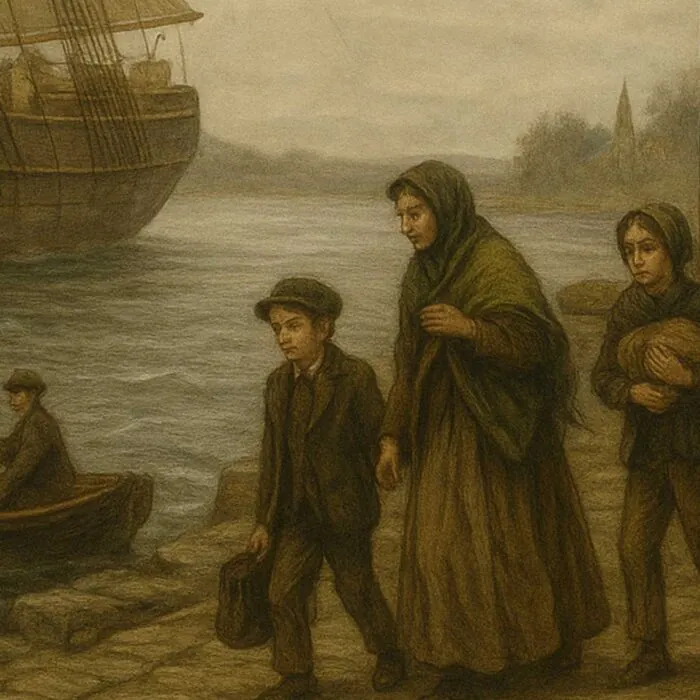
The central event remains the Great Famine (1845–1852). The Irish population’s dependence on the potato was tragically revealed when the potato blight devastated the crops. Over a million people died, and two million others emigrated.
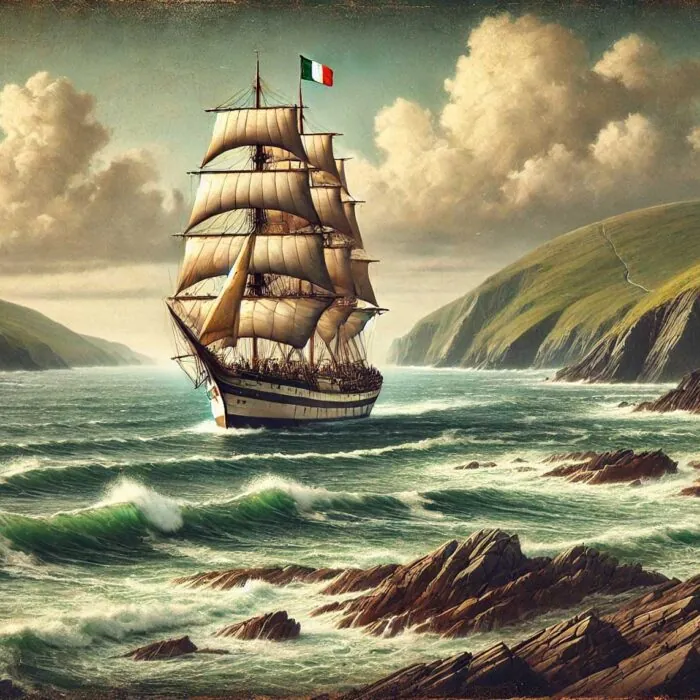
Most took the Atlantic route, boarding overcrowded ships nicknamed “coffin ships” due to the deadly crossing. The United States was the main destination, but Canada, Australia, and Great Britain also welcomed large contingents of Irish.
In New York, Boston, or Philadelphia, their arrival disrupted the demographic balance. Irish neighborhoods became synonymous with poverty and overcrowding, but also solidarity and community culture.
The Irish in Great Britain
A Nearby and Continuous Migration
England, Scotland, and Wales were natural destinations for the Irish. Liverpool, Glasgow, and London welcomed hundreds of thousands of migrants. Many worked in docks, mines, or construction sites.
These communities were often stigmatized. Caricatures depicted them as violent, alcoholic, and miserable. The sadly famous expression “No Irish Need Apply” reflected this rejection. Yet, the Irish contribution was decisive in British industrialization, and their descendants are now an integral part of the social fabric.
Emigration to North America
United States and Canada, Lands of Hope
The United States received the majority of Irish emigrants. In Boston, the Irish quickly became the dominant foreign community. Often confined to the hardest jobs, they organized politically and religiously around the Catholic Church. Their electoral weight eventually gave them considerable influence, culminating with the election of John F. Kennedy in 1960, the first American president of Irish origin.
In Canada, the arrival of migrants was marked by tragedies such as the Grosse Île disaster, a quarantine station where thousands of Irish died of typhus in 1847. However, integration was rapid, especially in Quebec where many orphaned children were adopted by Francophone families. Even today, Irish heritage is very present in Canadian culture.
Exile to Australia and Beyond
Convicts and Settlers
Another destination was Australia. Initially a land of deportation for Irish convicts sent by the British administration, it later became a land of voluntary colonization. The Irish participated in the gold rush, agricultural development, and political life.
Their influence is found in contemporary Australian culture, where nearly a third of the population claims Irish origins.
Irish emigration did not stop there. Significant communities are also found in Argentina, where Irish pastors settled in the pampas, as well as in South Africa and New Zealand.
Contemporary Waves of Emigration
From Poverty to Globalization
While the great waves of 19th-century exile belong to the past, Irish emigration has never completely stopped. In the 20th century, many left for England to work, especially after World War II.
The Celtic Tiger period in the 1990s and 2000s saw a return of expatriate Irish, but the 2008 financial crisis reignited the exodus, notably to Australia, Canada, and the United States. Even today, Ireland experiences significant mobility among its educated youth.
Heritage and Memory of Emigration
A Global Identity
Irish emigration has shaped a diaspora estimated at over 70 million people worldwide. This diaspora maintains a strong connection with Ireland, whether cultural, political, or touristic.
The St. Patrick’s Day celebration is the most visible symbol, celebrated lavishly in New York, Sydney, Buenos Aires, or Toronto. Museums, such as the EPIC Museum in Dublin, recount this exceptional journey and make it a major tourist attraction.
More than an exodus, Irish emigration has become a constitutive part of the country’s identity, a story of resilience and adaptation that still resonates today.



 +
+