Hurling
A small ball flies across the pitch. Two players charge forward, sticks raised. Everyone in the stands already knows where it will…

A small ball flies across the pitch. Two players charge forward, sticks raised. Everyone in the stands already knows where it will…
In Ireland, Gaelic sports are much more than competitions. They tell the story of attachment to a village, a parish and a county. In the stands, jerseys display local colours while several generations of the same family come to support a team made up of amateur players.
Gaelic football and hurling are the best-known disciplines, but the Gaelic sports family also includes camogie, women’s Gaelic football, Gaelic handball and rounders.
Watching a match is one of the most authentic cultural experiences of a stay in Ireland. You still need to understand the rules, choose the right competition and know where to buy tickets. Here is everything you need to know before entering an Irish stadium.
The expression Gaelic sports refers to a group of sporting disciplines originating in Irish culture. Six games now belong to this broad family:
Gaelic football, hurling, handball and rounders are administered by the Gaelic Athletic Association, better known by the acronym GAA. Camogie comes under the Camogie Association, while women’s football is organised by the Ladies Gaelic Football Association.
These organisations work together and share the same sporting culture. Competitions are based mainly on local clubs and teams representing the traditional counties of the island, in both the Republic of Ireland and Northern Ireland.
The Gaelic Athletic Association was founded on 1 November 1884 at Hayes’ Hotel in Thurles, County Tipperary. Its founders wanted to make sport more accessible while preserving Ireland’s games, language and traditions.
At that time, the rules of football and hurling differed greatly from one region to another. The creation of the GAA made it possible to harmonise them, organise competitions and encourage the creation of clubs throughout the country.
The association quickly became one of the major forces behind the Irish cultural revival. Its influence extended beyond the pitch: it contributed to the reaffirmation of a national identity at a time when the island was still under British rule.
The GAA’s headquarters are now located at Croke Park in Dublin. With a capacity of approximately 82,300 spectators, this stadium hosts the main national finals and is one of the great symbols of Irish sport.
Gaelic football is the most widely played Gaelic sport in Ireland. Two teams of fifteen players compete on a large rectangular pitch equipped with H-shaped goals.
The round ball can be played with the foot or hand. A player may carry it for four steps before having to bounce it or perform a solo, a movement in which the ball is dropped onto the foot and kicked back into the hands.
Bouncing the ball twice in succession is forbidden. To make a hand pass, the player must clearly strike the ball with a fist or an open hand: they cannot simply throw it.
Gaelic football is distinguished by its changes of pace. Play moves very quickly from defence to attack, with long kicks, runs, aerial catches and regulated physical contact.
The posts resemble rugby posts, but also have a net beneath the crossbar.
When the ball enters the net beneath the crossbar, the team scores a goal worth three points. The referee positioned behind the posts signals it with a green flag.
When the ball passes over the crossbar and between the two posts, the score is normally worth one point, signalled by a white flag.
Since 2026, the new rules for men’s Gaelic football have become permanent. A successful kick from outside the 40-metre arc can earn two points. This score is signalled with an orange flag.
A result may be displayed in the form “1-15”. The first figure represents the number of goals and the second the total number of points. In this example, the team scores 18 points in total: three for the goal and fifteen for the other scores.
Following an experimental phase conducted in 2025, the GAA adopted several permanent changes from 1 January 2026.
The 40-metre arc now rewards long-range shots with the possibility of scoring two points. Teams must also keep at least three outfield players in the opponents’ half and four players, including the goalkeeper, in their own half during play.
Other changes concern goalkeeper kick-outs, quick restarts, tactical fouls and exchanges with the referee. The general aim is to limit overly defensive phases and give more room to running, contests and kicking.
For a first introduction, there is no need to master every subtlety. Concentrate above all on the value of the scores and watch the flags raised by the referees behind the goals.
Hurling has a history stretching back to ancient Ireland. Mythological stories, particularly those from the Ulster Cycle, already mention a ball-and-stick game played by the hero Cú Chulainn.
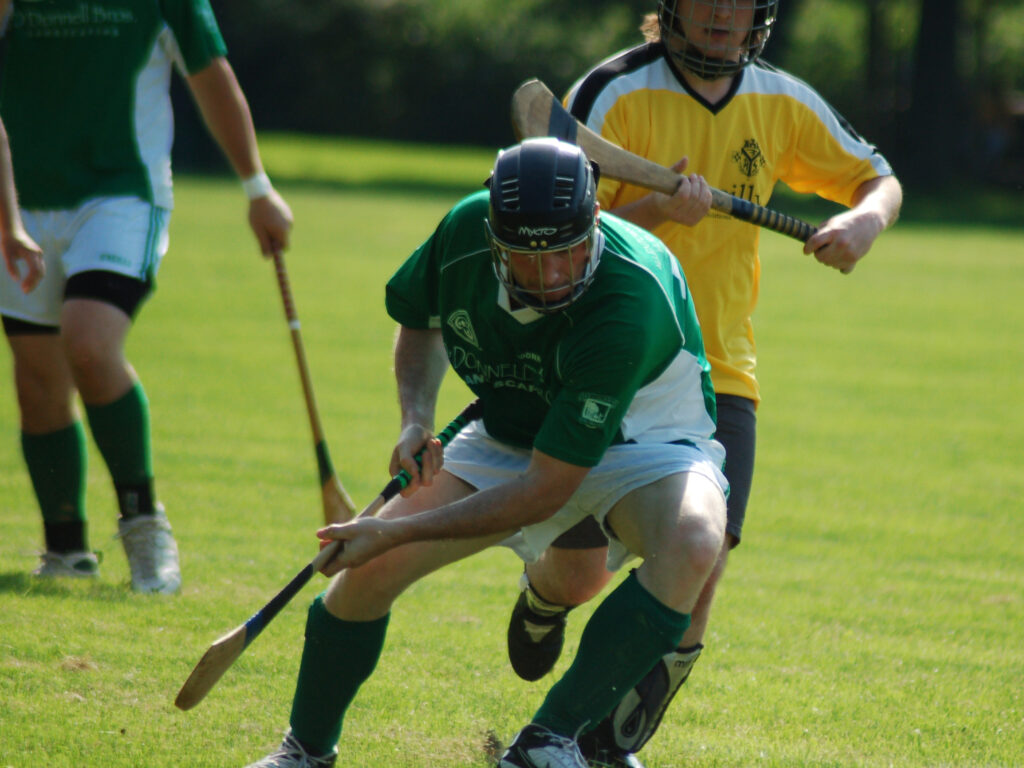
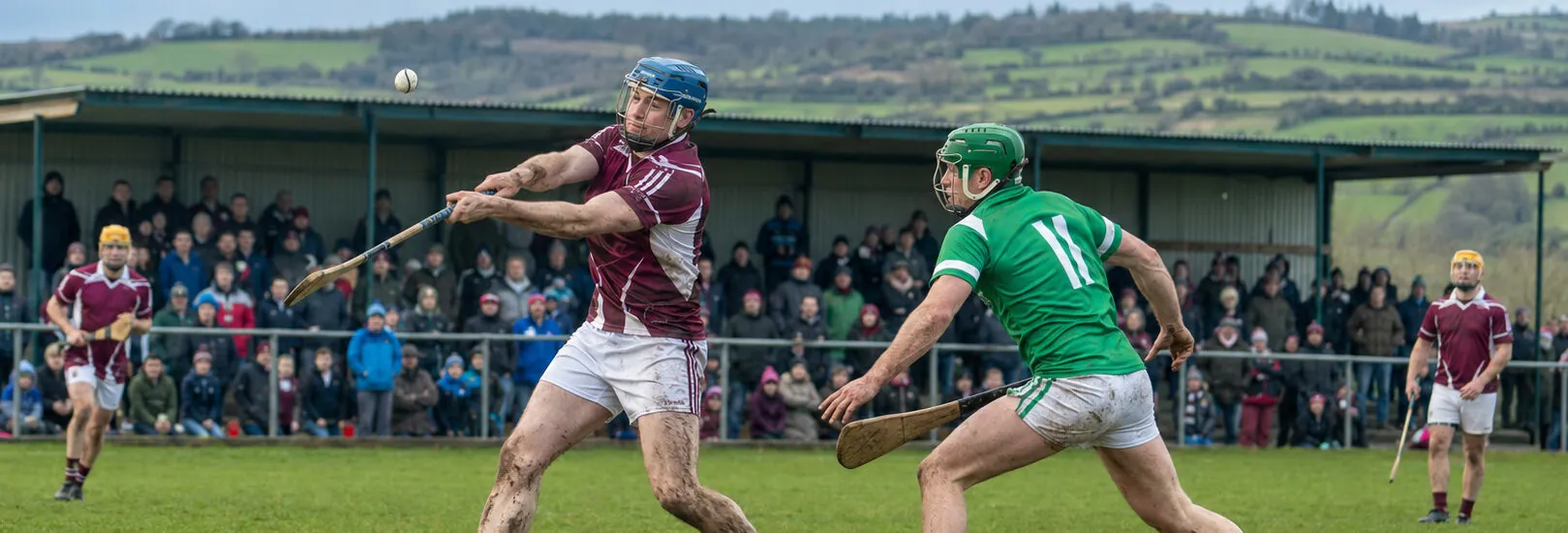
In its modern form, two teams of fifteen players compete on a pitch similar to that used for Gaelic football. Each player uses a wooden stick called a hurley or camán. The ball, smaller than a tennis ball, is called a sliotar.
The sliotar can be struck along the ground or through the air, carried balanced on the hurley, caught with the hand or sent to the other end of the pitch with a long strike.
The speed of the game is impressive. In high-level matches, the ball can travel across a large part of the pitch in a few seconds. Players must wear a helmet fitted with a protective grille.
A shot sent into the net beneath the crossbar earns three points. A sliotar struck over the crossbar and between the posts earns one point.
Unlike men’s Gaelic football, hurling does not use the two-point score from the 40-metre arc.
The goalkeeper protects the net with their hurley while defenders attempt to block shots. An attack can therefore end with a long-range shot over the crossbar or with a much closer attempt aimed at the goal.
Hurling is particularly popular in counties such as Kilkenny, Cork, Tipperary, Clare, Limerick, Galway, Waterford and Wexford. Matches between these great hurling counties produce some of the most intense atmospheres in Irish sport.
Camogie is a stick sport very similar to hurling, played by women’s teams. Its name comes from camóg, a term once used for a shorter stick.
The discipline became organised at the beginning of the twentieth century and has its own organisation, the Camogie Association. Matches generally involve two teams of fifteen players on a pitch equipped with the same H-shaped goals.
The essential principles remain comparable to those of hurling: the sliotar can be struck along the ground or through the air, carried on the stick and sent over the crossbar or into the net.
Wearing an approved helmet with facial protection is compulsory during matches and training sessions. The All-Ireland camogie championship final is now one of the major events in the Irish sporting calendar.
Women’s Gaelic football is administered by the Ladies Gaelic Football Association, founded in 1974. It is not simply a women’s competition integrated into the GAA: the discipline has its own organisation and certain specific rules.
The game nevertheless remains very close to men’s Gaelic football. Teams seek to send the ball into the net to score a goal or over the crossbar to score points.
In April 2026, the LGFA adopted several changes inspired by developments in men’s football, including the two-point arc, the solo and go and the requirement to keep players in each half of the pitch. Their implementation varies according to the age and level of the competitions.
Major matches now attract a considerable crowd, particularly the All-Ireland final held at Croke Park.
Gaelic handball is played by two or four people. Participants strike a small ball with their hand against a wall, trying to make the return difficult or impossible for their opponent.
The principle may recall pelota or squash, but the rules, courts and techniques have their own particular features.
Several variations exist depending on the type of ball and the layout of the court. Some are played in an enclosed facility, while one-wall handball requires only a single wall.
Less visible than Gaelic football or hurling, this discipline is nevertheless played in many clubs and has national and international competitions.
Rounders pits two teams against each other, alternating between attack and defence. Players use a bat to hit a ball before running around several bases.
The game clearly resembles baseball and softball, but has its own system of rules. It officially forms part of the sports administered by the GAA.
Rounders receives far less media coverage than hurling and Gaelic football. It is nevertheless played in clubs, schools and various competitions organised throughout Ireland.
Gaelic football, hurling and camogie players compete in a system based on amateurism. Even at the highest level, they are not professional athletes paid by their team.
They nevertheless train with considerable intensity, follow demanding fitness programmes and can play in front of tens of thousands of people. Most continue with professional work or studies alongside their sporting careers.
This model strengthens the bond between teams and their supporters. Players generally represent their home club and then, for the best among them, their county. Transfers exist, but the system is nothing like the player market in professional football.
The club is the foundation of Gaelic sports. Every town, village or parish often has its own team. Children can start there at a very young age and continue wearing the same colours as adults.
The best club players are selected to represent their county. Teams from the island’s 32 traditional counties take part in various competitions, alongside teams representing London or New York in particular.
This organisation explains the intensity of the rivalries. Dublin, Kerry, Mayo, Donegal and Armagh, for example, have a strong football tradition, while Kilkenny, Cork, Tipperary, Clare and Limerick are particularly associated with hurling.
These trends are not absolute: many counties play both disciplines and the hierarchy changes over the generations.
The inter-county season generally begins with the national leagues, played during the winter and early spring. They are organised by divisions and allow teams to prepare for the championships.
Provincial and then national championships occupy the spring and early summer. Teams seek to reach the final stages of the All-Ireland Senior Championship.
The hurling final and the men’s Gaelic football final take place at Croke Park. They are among the most closely followed sporting events in the country.
Club competitions become more important at the end of summer and during autumn. For a traveller, these local matches are often easier to attend and offer a particularly authentic atmosphere.
You do not need to attend a national final to discover Gaelic sports. A provincial championship, national league or club match is already enough to experience the supporters’ passion.
Inter-county matches take place in the main regional stadiums. Among the best-known venues are Croke Park in Dublin, Semple Stadium in Thurles, Páirc Uí Chaoimh in Cork, Fitzgerald Stadium in Killarney and Gaelic Grounds in Limerick.
Check the official GAA calendar or the calendar of the county committee where you are staying. Times may change because of broadcasts, previous results or the organisation of double-headers.
Plan to arrive at least 30 to 45 minutes before the match begins. Around the stadium, supporters wear their county colours, meet in pubs and buy flags, hats or scarves.
In 2026, tickets for official GAA matches generally need to be bought in advance. They are not systematically sold at the stadium box offices on match day.
The official channels are the GAA’s online ticket office via Ticketmaster, certain SuperValu and Centra stores, and local committees and clubs.
Tickets for ordinary matches are generally easy to obtain. The situation is very different for All-Ireland finals: tickets are mainly distributed through the clubs and counties that have qualified, with no conventional public sale.
Before travelling, consult the ticket section on the official GAA website. Avoid unauthorised resellers, particularly for the most in-demand matches.
For a first experience, hurling is probably the most spectacular sport. The speed of the sliotar, aerial strikes and players’ precision immediately convey the difficulty of the discipline.
Gaelic football is generally easier to understand if you already know football or rugby. Its runs, passes and scoring system become clear after a few minutes.
An inter-county match offers the biggest stands and an impressive atmosphere. A club match, on the other hand, lets you get closer to the pitch and observe the place sport truly occupies in local life.
If your itinerary takes you through a small village on match day, ask at the tourist office, your accommodation or the local pub. A fixture that looks modest on the calendar may conceal a rivalry followed passionately for several generations.
Outside match days, Croke Park can be explored through a guided stadium tour. The route presents the stands, changing rooms, the tunnel used by the teams and the behind-the-scenes areas of Ireland’s main sporting venue.
The GAA Museum traces the history of hurling, Gaelic football and the association. Objects, trophies, archives and interactive displays help visitors understand the social and political importance of these sports.
The stadium also occupies a painful place in Irish history. On 21 November 1920, during the War of Independence, British forces opened fire on spectators attending a Gaelic football match. Fourteen people were killed on that day, now known as Bloody Sunday.
Croke Park is therefore at once a stadium, a place of remembrance and one of the great symbols of contemporary Irish culture.
The GAA operates on an all-island basis rather than according to the political border separating the Republic of Ireland from the United Kingdom. The counties of Northern Ireland therefore take part in the same sporting structures as those in the Republic.
Antrim, Armagh, Derry, Down, Fermanagh and Tyrone have clubs and county teams. Armagh, Derry, Down and Tyrone have an especially important history in Gaelic football, while Antrim retains a strong hurling tradition.
In the north of the island, the GAA has also long been a major cultural marker for the Irish nationalist community. This historical and identity-related dimension remains sensitive, although clubs now strongly emphasise welcome, sport and community life.
What is the most popular sport in Ireland?
Gaelic football has the highest number of participants nationally. Hurling nevertheless dominates the sporting culture of several counties in the south and west.
Are GAA players professional?
No. Gaelic sports are based on an amateur model, including the main inter-county competitions.
What is the difference between hurling and camogie?
Both disciplines use a stick and a sliotar. Camogie is organised by a separate association and has certain specific rules, but their general principles are very similar.
How many players make up a team?
Senior teams in Gaelic football, hurling, camogie and women’s Gaelic football generally have fifteen players on the pitch.
Can you buy a ticket on match day?
You should not rely on sales at the stadium. The GAA states that tickets must be bought in advance through its official channels, notably Ticketmaster and certain SuperValu or Centra stores.
Can you watch a match all year round?
The richest period runs from the end of winter to autumn. Leagues, inter-county championships and club competitions follow one another, but the calendar changes every year.