The Great Famine in Ireland (1845-1848) was one of the darkest periods in Irish history. It is estimated that the disaster caused between 500,000 and 1 million deaths, plunging the island into a state of great misery. Deadly and harrowing, it marked the 19th century with its considerable losses and encouraged emigration to the New World. Beyond the tragic human circumstances, the Great Famine also saw the emergence of a brutal conflict: a complex political struggle in which the British Empire chose to play the card of indifference while a country under its rule was pleading for help…
History of the Great Famine in Ireland
Historical context of the Great Irish Famine
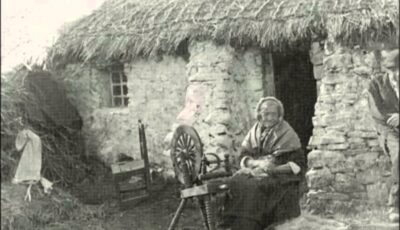
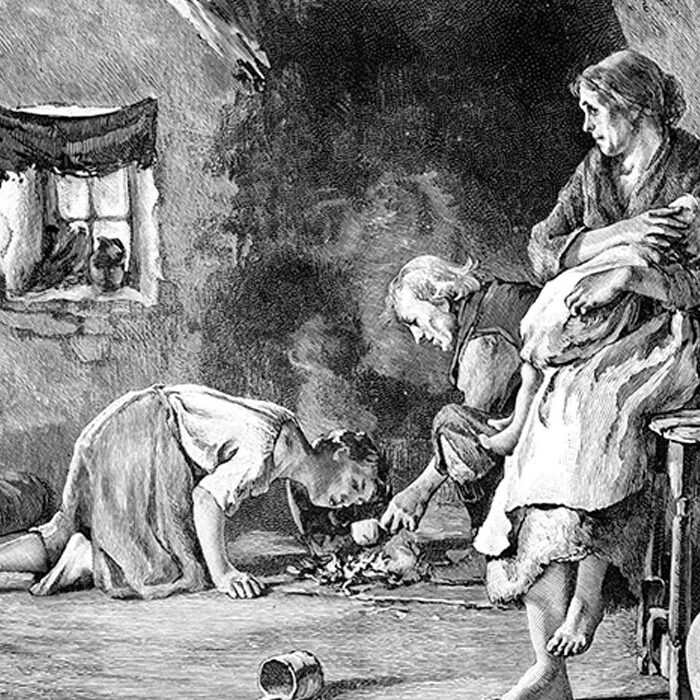
An Irish hearth during the Great Famine – Public domain
We are in the 1830s. At that time, Ireland was under British rule… An occupation that had lasted since the 16th century, where the Irish suffered daily discrimination and social rejection. The Irish, mostly Catholic, experienced a climate of repression. Many lived below the poverty line and endured misery.
Yet, at that time, Great Britain was fully exploiting the island’s resources. The British government saw Ireland as a perfect territory for agriculture and the production of all kinds of foodstuffs…
That is why over 95% of Irish lands were owned by British landlords. These landlords employed the Irish to cultivate their lands, raise livestock… and then ship entire cargos of goods to England… feeding up to 2 million Britons, just from these precious Irish resources!
Grains, vegetables, meat, eggs, cheese, milk, salmon, alcohol, wool… At that time, England used Ireland as its “provision basket”… without considering the widespread misery of the Irish, who, although supposed to live as equals with the British, seemed to be regarded as a sub-race to govern.
The Irish had to make do with the little the English left them.
At that time, many Irish tenant farmers and peasants rented small plots of land from wealthy British landlords. They then tried to cultivate the potato, an essential means of subsistence for their daily lives. Tasty and nourishing, it ensured the survival of the poorest… Although money was scarce, families lived with full stomachs.
When blight starved the Irish…

Potatoes affected by blight – © nskyr2
1845: A parasitic fungus, blight, which traveled in the holds of ships from South America, spread over Irish crops.
Its proliferation was astonishingly rapid. It destroyed everything in its path, and the moisture allowed its massive spread to most potato plants.
Infested by blight, the potato tuber became inedible: it withered and rotted, preventing any partial recovery.
This natural disaster plunged Ireland into a large-scale food shortage, worsening existing rural misery, starving the population and depriving them of any means of subsistence. The most affected populations were those in western Ireland.
These already impoverished people crowded weakly into squalid huts made of mud and straw. Families were often large, and men, women, and children were gripped by hunger. They were forced to work even harder for the landlords, who promised to give them poor-quality grains in exchange for this hard labor.
As a result, the Irish managed to survive… at first…
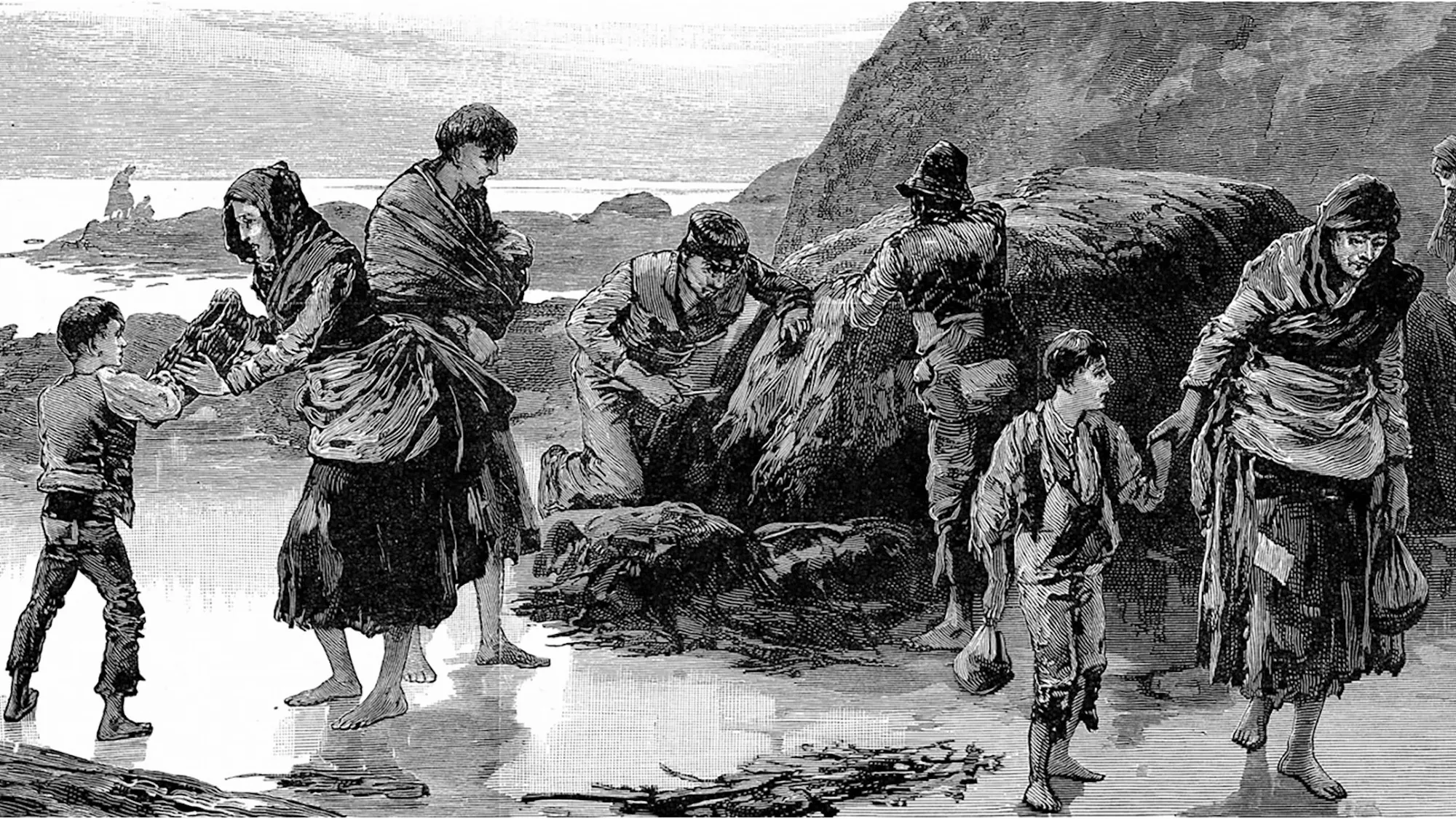
In 1846, the blight returned even stronger than in 1845… This is when the Famine worsened. There was no longer enough food for everyone… The Irish were on their knees. Some tried to turn to fishing, others gathered seaweed, while others begged… But the harsh winter dealt the population a final blow.
Hunger caused extreme weakness among the Irish and led to countless diseases such as typhus, cholera, typhoid fever… Hundreds of dead were buried in mass graves… Children saw their parents die and vice versa…
England’s (deliberate?) inaction plunges Ireland into horror
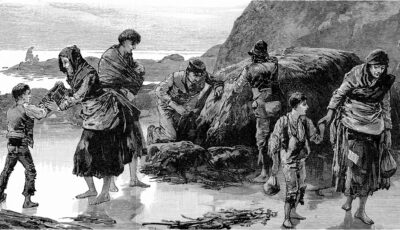
A scene from the Great Irish Famine – Public domain
From then on, British authorities in Dublin alerted London… Action was needed quickly… But for England, it was all exaggeration… And the government had spent enough on the Irish cause… The empire preferred to let things be, faithful to its liberal doctrine of the time.
Worse still, it is said that some high British officials saw in this Great Famine an opportunity to transform Ireland by targeting the poorest… For some, Ireland had to evolve and model its system on that of Scotland or Wales.
The decision was then made to stop distributing grain in exchange for work… The Irish sank deeper into misery… and sought any means to earn food…
Meanwhile, England continued to export Irish foodstuffs to London, favoring Britons over the Irish…
Discontent grew.
The Irish then tried to protest and rise up… But the strong English military presence on Irish soil plunged the population into resignation… Unable to pay their rents, they were gradually evicted by British landlords…
To survive, they stole, resorted to violence, and tried to survive by any means… Some women prostituted themselves, some ate animal carcasses (dogs, cats…)… And some cases of cannibalism were even recorded…
England organizes soup kitchens… in exchange for conversion to Protestantism
England then decided to organize soup kitchens: it distributed soup to the Irish, asking them to make a choice: famine or conversion to Protestantism.
Recall that the Irish were then mostly Catholic. And England constantly sought to impose Protestantism whenever possible.
Thus, the soup kitchens were organized under the aegis of Protestant clergy, determined to encourage the poorest to join the Protestant faith. The slogan “Take the Soup” became famous throughout Ireland… while causing scandal at the same time.
Thousands of Irish chose to take the soup and convert. They were then nicknamed “jumpers“.
In reality, “soupism” was a rare phenomenon that was far from widespread in the country, but it left a lasting mark on the popular memory of the famine. It also tarnished the memory of the relief work of many Protestants who helped without proselytizing.
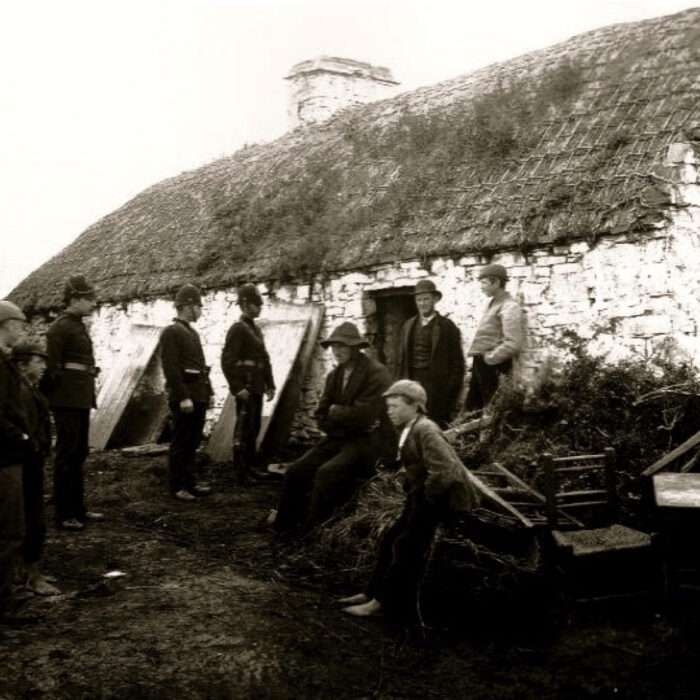
The international community is moved by the Irish catastropheThe Ballinglass Incident – Public Domain
The situation in Ireland became untenable and was known beyond Irish borders. The Catholic Church then mobilized: Italy sent money, as did the United States and France…
International opinion was outraged by the UK’s inaction… But the London government did not budge. It organized a few soup kitchens where cheap grains were distributed: oats, corn… But it remained insufficient.
In 1847, the blight did not return. Great Britain considered the Great Irish Famine over… Wrongly.
The year 1847 was the worst year for Ireland: the winter was terrible, and misery and hunger were still present. Food was lacking while London closed soup kitchens and abandoned more than 4 million Irish still suffering from hunger. Worse still: London continued to send the little available food from Ireland to England…
At the same time, a law was enacted: no more aid was to be given to Ireland… unless it was funded by Irish local taxation… The final blow: the law stipulated that no aid could be given to Irish people owning more than a quarter of an acre of land. It was a fatal blow for the local population, forced to give up their land, their homes, and what little they had left…
As a result, in seven years, more than half a million Irish were evicted from their homes. The evictions were carried out with cruelty and violence. The British threw the Irish out… disregarding law and justice. (See the Ballinglass Incident). Worse still: the British deliberately destroyed the roofs of the evicted houses: a way to make the property uninhabitable and force the population to leave.
The Irish were reduced to camping in ditches, on beaches… wherever they could. The Irish climate finished their resistance: cold and rain condemned them to death. These evictions were essentially just killing them a little further away… a little faster…
Workhouses emerge
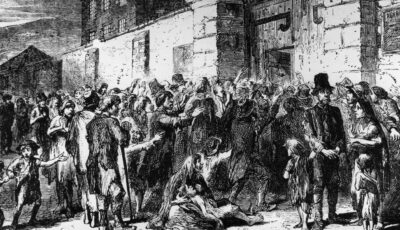
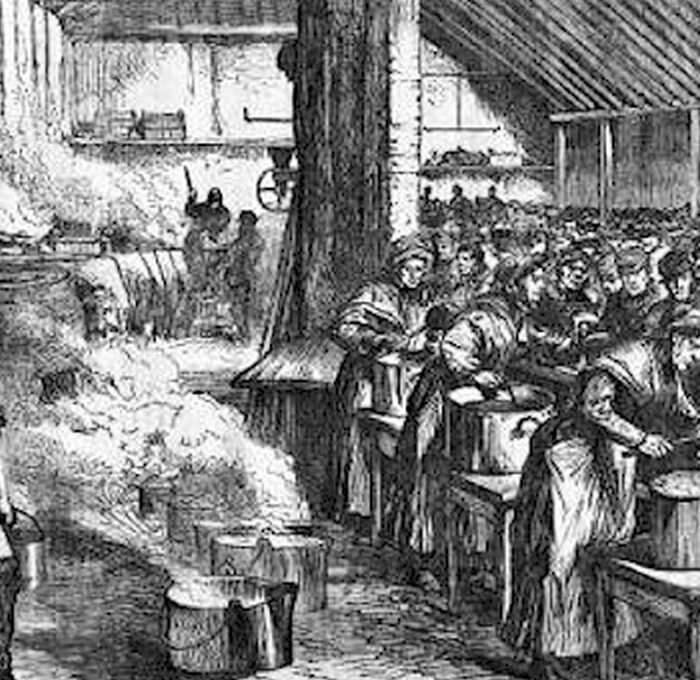
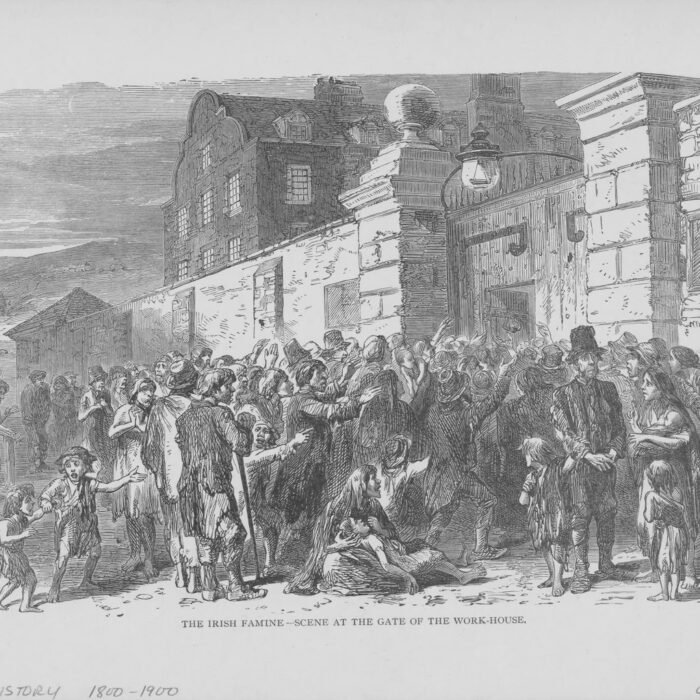
The Irish trying to enter workhouses – Public domain
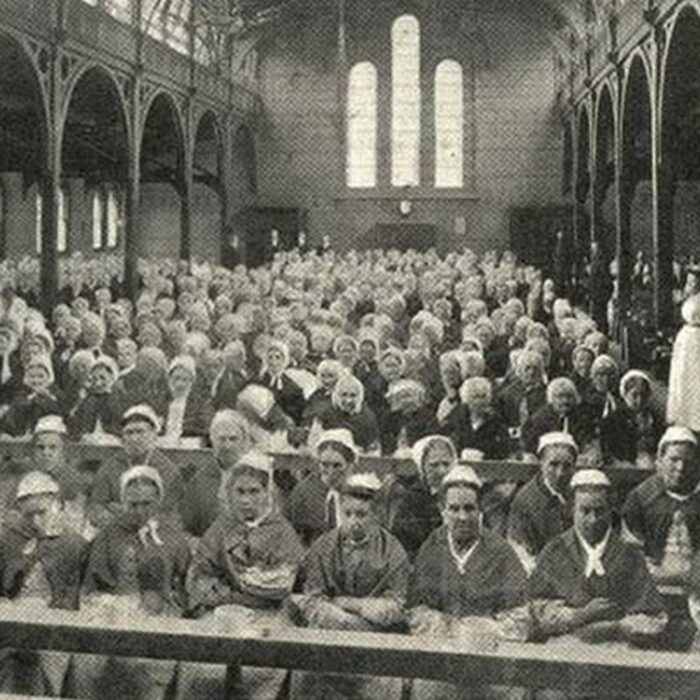
To survive, all means were good. The Irish had little choice but to turn to workhouses. These were institutions offering lodging and food, on condition of forced labor and confinement.
During the Great Irish Famine, there were 130 workhouses… spread throughout Ireland. Built in 1842, they had a maximum capacity of 100,000 people…
But at that time, between 1847 and 1848, more than a million Irish tried to find a place in these houses… Few managed to enter… creating dramatic queues at the entrances…
Inside these workhouses, conditions were particularly harsh and based on a single doctrine: work to earn your keep. Families were separated: men, women, and children lived in separate quarters. They had to perform work worthy of convicts. A kind of penal colony where one agreed to enter voluntarily… but from which one could not leave.
Despite food distribution and regular visits from public assistance doctors, not all inmates could be saved. The mortality rate in these houses remained considerable, and many children died there. The dead were buried in mass graves within the workhouses themselves.
It is estimated that more than 200,000 people died in these workhouses during the famine.
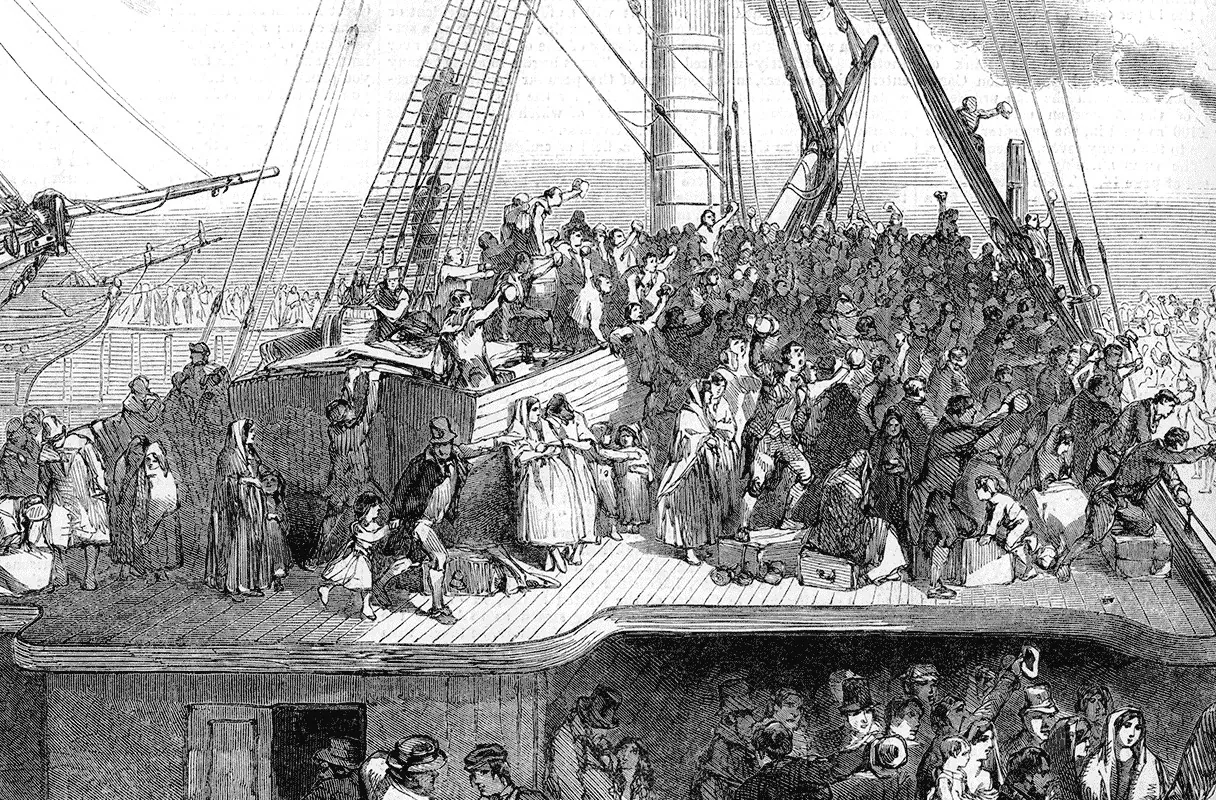
Thousands of Irish decide to flee to the United States
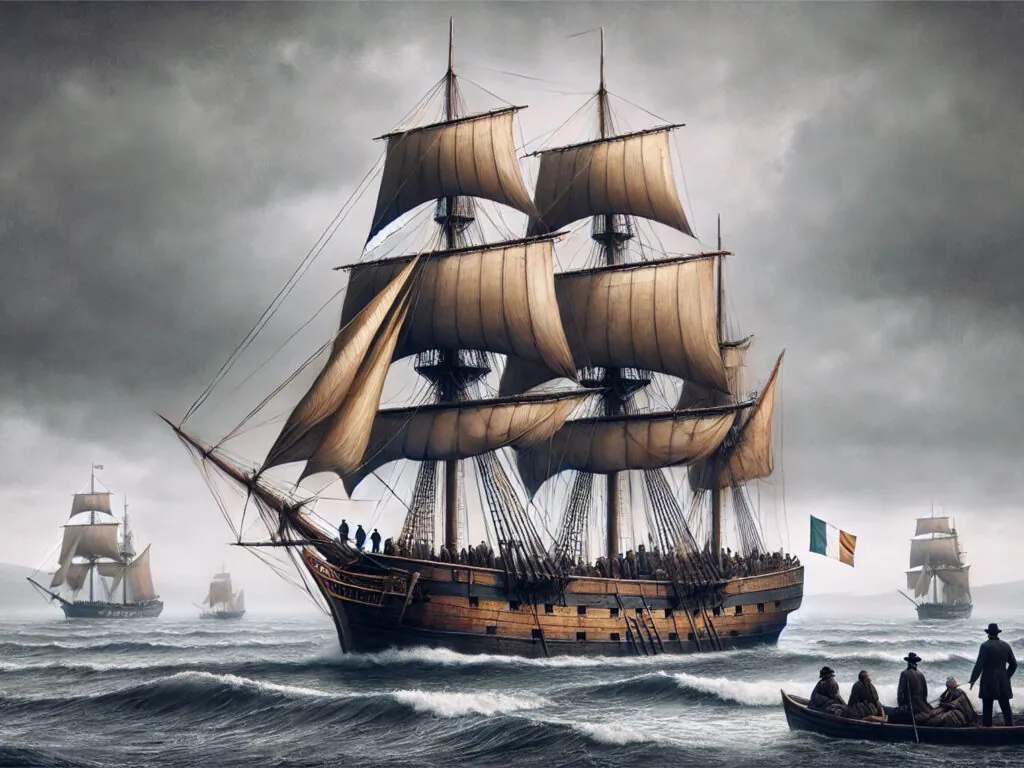
Faced with so much misery, the Irish saw America as an ideal solution to escape the famine.
Ready to try anything, they crowded onto ships bound for more promising lands.
Although some died due to storms and diseases from long sea voyages, thousands of Irish reached the American coast and formed a true Irish diaspora that still exists today.
For them, the United States offered a real dream of a fresh start: the famous “American Dream” opened new prospects, both economically and in the struggle for Ireland… For they saw in the United States the possibility of total freedom free from British domination. And they were ready to fight from afar for their island.
Thus, over 10 years, it is estimated that:
- 1,500,000 Irish joined the United States,
- 340,000 landed in Canada,
- 300,000 Irish settled in England,
- and 50,000 preferred Australia and New Zealand.
Despite their misery, they found what they came for: work and food. Difficult and dangerous jobs for men, while women became seamstresses, cooks, or domestic workers. Enough to survive in better conditions compared to those who stayed in Ireland.
For these expatriates, the time was now for solidarity. Although settled thousands of kilometers from Ireland, they were still firmly determined to support those who remained there.
To do this, emigrants sent funds to nationalists remaining in the country and founded the Fenian movement, an active organization aiming to carry out violent operations against the British government to achieve full independence for Ireland.
Their goal: to use the Irish famine as a strong argument to end British abuses, aid the Irish on site… and obtain the creation of a fully independent Irish state, free from British rule. For them, the Famine must end, and the Irish population must reject oppression. It is time for the island to choose its destiny…
However, the Great Famine began to recede in 1848. The blight withdrew, and some regions saw a marked improvement. Nevertheless, although the Great Irish Famine is estimated to have lasted 3 years, it actually lasted much longer… Some regions took more time to recover from the tragedy, and it is estimated that the Famine persisted in some parts of Ireland until around 1851…
The Great Irish Famine in a few figures
The Great Famine lasted 4 years, but its consequences extended over more than a decade. Human losses were estimated between 500,000 and 1 million deaths.
Refugees were estimated at 2 million, and emigrants also at 2 million. This tragic toll forever marked Ireland: it was the result of a natural disaster combined with centuries of British political abuses on Irish soil.
Even today, this tragic episode in Irish history has left an indelible mark on the Irish spirit.
Forced emigration allowed the Irish to develop a diaspora worldwide. Great names like John Fitzgerald Kennedy and Joe Biden succeeded and are direct descendants of Irish emigrants. The Great Irish Famine thus influenced not only Ireland but the entire globe!


 +
+