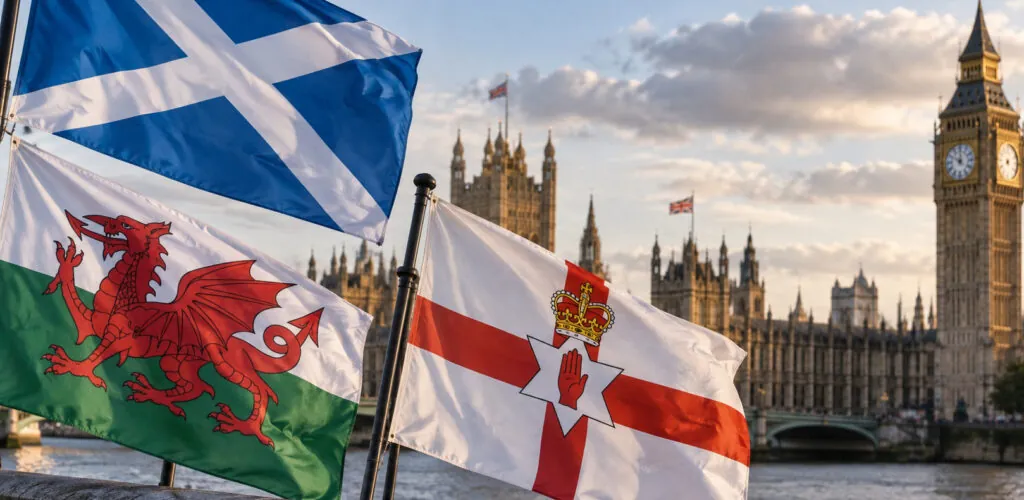
The United Kingdom is entering a new phase of constitutional tension. Meeting in Cardiff on 14 September 2026, the leaders of Scotland, Wales and Northern Ireland set out a shared aim: to defend their nations’ right to choose their constitutional future and step up pressure on London. It is a symbolic initiative, but one with significant political weight, at a time when Scottish independence, Welsh self-determination and Irish unity are once again coming to the fore.
An unprecedented summit between Scotland, Wales and Northern Ireland
Three governments led by forces in favour of constitutional change
The summit in Cardiff brings together the leaders of the United Kingdom’s three devolved nations. Its stated aim is to strengthen cooperation on several issues, but above all to reaffirm a major political principle: that each of these nations should be able to decide democratically on its constitutional future.
The meeting carries particular significance because, for the first time, the Scottish, Welsh and Northern Irish governments are all led by parties or coalitions whose core programmes advocate a major change in their relationship with London.
In Scotland, the Scottish National Party continues to call for a new independence referendum. In Wales, Plaid Cymru has placed the question of autonomy and independence at the heart of political debate. In Northern Ireland, Sinn Féin openly supports the prospect of reunifying the island.
Northern Ireland at the heart of the constitutional struggle
Debate over a possible unity referendum intensifies
In Northern Ireland, the constitutional question is governed by the Good Friday Agreement. It provides that a referendum on Irish unity may be held if the British Secretary of State considers that a majority in favour of reunification is likely.
In recent weeks, the issue has taken on new momentum. British Prime Minister Andy Burnham was obliged to clarify that he would respect the Good Friday Agreement “100%” following remarks interpreted as ruling out a referendum in the short term. For its part, the Irish government has called for greater clarity on the precise conditions that could lead to such a vote.
Irish Foreign Minister Helen McEntee also said that a referendum would eventually take place and that both London and Dublin should prepare for it. The debate is therefore no longer solely about the idea of a vote, but increasingly about its conditions, possible timing and consequences.
Scotland: independence remains a central issue
The SNP seeks to maintain pressure on London
In Scotland, the 2014 referendum, won by those who supported remaining in the United Kingdom, did not put an end to the debate. Brexit profoundly changed the landscape: Scotland had voted by a majority to remain in the European Union, reinforcing among independence supporters the belief that Scotland’s political choices could be overridden by those of the United Kingdom as a whole.
The Scottish government continues to support the principle of a new referendum should sustained majority support for independence emerge. The issue nevertheless remains legally sensitive, as London retains a central role in authorising such a vote.
Wales is also reshaping the debate
Plaid Cymru seeks to give greater weight to the national question
Long less prominent than in Scotland or Northern Ireland, the question of Welsh independence is gaining visibility. The rise of Plaid Cymru has helped bring the issue more clearly into national political debate.
The movement is less advanced than in Scotland or Northern Ireland, but the Cardiff summit marks an important symbolic step: Wales is no longer content simply to demand greater devolution. A growing part of its political class now wishes to open an explicit discussion on the right to self-determination.
Why this common front worries London
Three different demands, but the same pressure on Westminster
The Scottish, Welsh and Northern Irish situations differ greatly in legal, historical and political terms. But they converge on one essential point: all call into question the current workings of the British Union.
The Cardiff summit does not mean that the break-up of the United Kingdom is imminent. It does, however, show that constitutional debates once seen as separate are now becoming increasingly interconnected.
The leaders involved notably wish to defend clear mechanisms allowing each nation to choose its future democratically. This demand presents a direct challenge to Westminster, which is seeking to preserve the cohesion of the United Kingdom.
A development with particular resonance in Ireland
Irish reunification returns to international debate
For Guide-Irlande, this development takes on particular significance because Northern Ireland’s future is directly linked to relations between Dublin, Belfast and London.
Just days before the summit, Donald Trump had himself reignited the debate by saying that he would like to see a united Ireland. Although the United States has no power to determine Northern Ireland’s status, this intervention helped further internationalise an issue already highly prominent in Irish politics.
Between pressure from Sinn Féin, Dublin’s calls for clarification and parallel demands in Scotland and Wales, the United Kingdom’s constitutional architecture is entering a period of profound uncertainty. For Ireland, the question of national unity could therefore become even more central in the years ahead.