A language can carry memory without being confined to the past. With Kneecap, Irish now takes the form of rap that asserts its place in today’s world. For some young people, cultural belonging also goes hand in hand with a political desire: that of a reunited island. Yet between a shared song, a claimed cultural identity and a ballot paper, the path is far from straightforward. A portrait of an Irish generation that appears to be leaning increasingly towards a united Ireland.
An Irish identity that speaks to the present
Ireland and the generational question in the spotlight
Ireland has a deep connection with its cultural heritage. The Irish language, Gaelic traditions and the memory of its history all nurture a sense of belonging that is passed on, debated and reinvented from one generation to the next.
The partition of the island, now divided between the Republic of Ireland and Northern Ireland, continues to shape debates about identity and a shared future. For some, reunification represents hope; for others, Northern Ireland’s place within the United Kingdom remains an essential attachment.
This is why a growing number of young Irish people are now asking a crucial question: what becomes of a national identity when it is no longer simply inherited from one’s parents, but begins to be chosen?
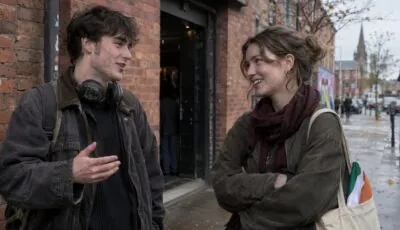
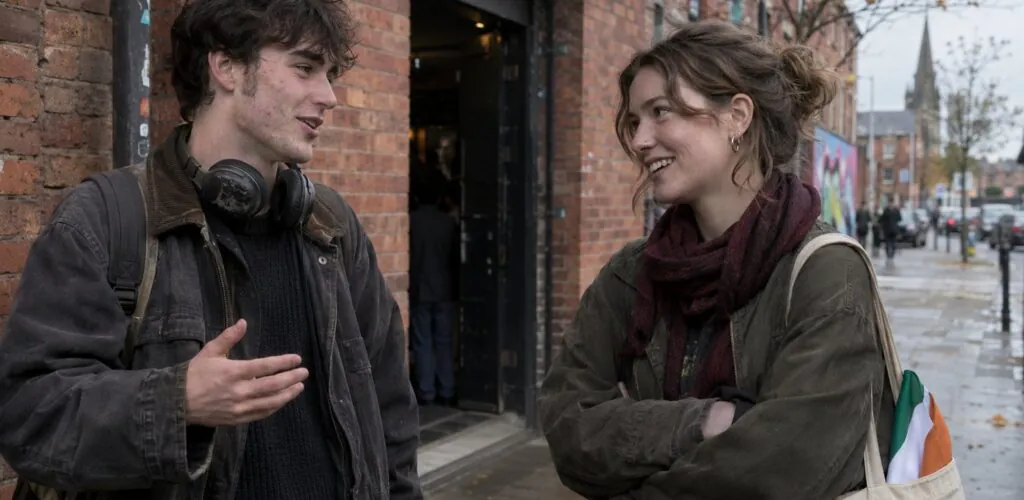
For some young people in Northern Ireland, identifying as Irish can therefore be both a way of living in Belfast, asserting a culture and imagining a different constitutional future.
And why not dream of a reunited island of Ireland?
Kneecap, an ancient language in contemporary culture
From rap to film, changing perceptions
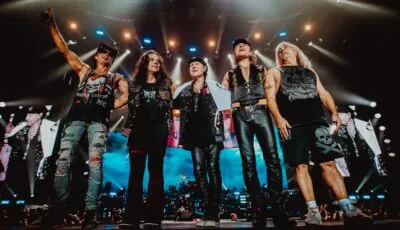
This dream of unity is nothing new. But it has been brought back into the spotlight by the rap group Kneecap. A Northern Irish group from Belfast and Derry, they rap in English as well as Irish, drawing young people’s attention to the importance of their Irish roots.
Mo Chara, Móglaí Bap and DJ Próvaí have given the Irish language a showcase far removed from the cliché of a language reserved for textbooks or rural landscapes.
A film dedicated to the group, also titled “Kneecap”, directed by Rich Peppiatt and released in 2024, has broadened that visibility. The three members appear as themselves, alongside Michael Fassbender, among others.
Here, cinema turns a band’s story into a narrative about the right to speak one’s own language. However, the necessary distance of a fictional work should be maintained: inspired by their origins, this film is neither an exhaustive documentary about Belfast nor a representative portrait of its young people.
For those discovering the Irish language, the surprise lies less in its age than in its capacity to embrace contemporary uses. A language can be used to pass things on, but also to joke, create or protest. The popularity of artists alone, however, cannot measure how many new speakers they inspire.
The dream of unity is not the same as an electoral result
Young people are more nationalist, but views vary
Academic research adds useful depth to this cultural story. In an analysis published in September 2025, researchers Katy Hayward and Ben Rosher observe, drawing on the 2024 Northern Ireland Life and Times survey, a contrast between younger adults who are more nationalist and older generations who are more unionist.
The study also invites us to distinguish between several questions: wanting reunification, believing it will happen and deciding how to vote do not necessarily produce the same answers. The survey examines adults’ social attitudes, including those of people who do not vote; it does not predict a referendum. Listening to the group is therefore not enough to ascribe a political opinion to its audience.
An aspiration governed by democratic consent
Reunification remains a political project, not an inevitable consequence of cultural renewal. As the House of Commons Library explains, the Belfast Agreement provides for change based on majority approval in both jurisdictions on the island. The UK framework provides for a referendum when the Secretary of State considers a majority in favour in Northern Ireland to be likely.
Those who wish to remain in the United Kingdom, those who identify as both British and Irish, and those who do not place this question at the centre of their lives are equally part of Northern Irish society. Telling the story of a generation that dreams of unity means allowing this plurality to remain visible.
Discovering a living culture in Belfast
A way in beyond the slogans
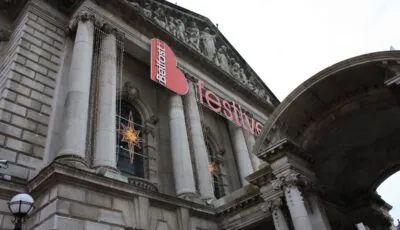
For travellers, this story can change the way they see the city. Rather than reducing west Belfast to its political symbols, they can also seek out the places where the language is spoken and passed on. On Falls Road, Cultúrlann McAdam Ó Fiaich offers an arts programme centred on Irish in a former Presbyterian church. The centre welcomes visitors and local people alike, with a bookshop and café-restaurant among its facilities.
Check its programme before you visit: discovering an exhibition, listening to music or leafing through books offers a way to approach this identity through its creative expression. Kneecap’s commitments are a powerful voice in this conversation; they do not encompass all its nuances, disagreements or other ways of feeling at home in Belfast.