
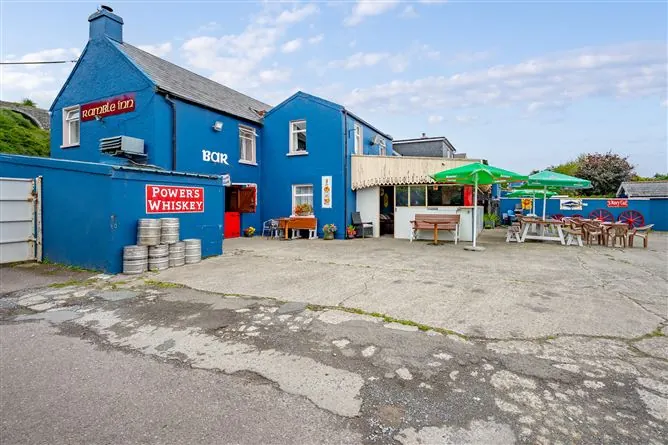
It was one of those Irish pubs whose history was not merely told by its walls. In Halfway, near Ballinhassig in County Cork, the Ramble Inn has just been sold to a local businessman for a sum close to its €1 million guide price. The transaction could mark the definitive disappearance of an establishment whose history stretches back more than three centuries.
The news, reported by the Irish Examiner on 10 September 2026, goes far beyond a straightforward property sale. The Ramble Inn was Halfway’s last pub. It was also home to a remarkable collection of vintage vehicles, machinery and artefacts, making it a distinctive stop on the N71 road towards west Cork.
A Cork pub with a history dating back to 1709
More than three centuries of history in Halfway
The Ramble Inn’s exceptional character lies first and foremost in its age. According to information published by the Irish Examiner, the title deeds associated with the bar date back to 1709. They refer to Thomas Barter, a member of a landowning family whose estates extended across this part of County Cork.
The premises passed through generations before being taken over by Alan and Mary Barry, who owned it for 44 years. Over the decades, the couple turned the Ramble Inn into far more than a place to have a pint: the pub became a meeting place for local people, as well as a well-known destination for enthusiasts of vintage machinery.
Alan Barry had a particularly Irish way of describing his establishment, calling it “the biggest confessional in the country” – a reminder of the social role rural pubs continue to play in many Irish communities.
The village’s last pub had closed in June
Halfway loses one of its main social hubs
The Ramble Inn closed its doors in June 2026, when its long-standing owners decided to end the business. The closure carried particular significance: since Colman’s Bar disappeared around 20 years earlier, the Ramble Inn had become Halfway’s only pub.
Its sale therefore reflects a wider shift in rural Ireland. A traditional pub is not simply a business: in villages where services are becoming scarcer, it can also serve as a meeting point, a place where local stories are passed on and, at times, a genuine community institution.
A remarkable museum of vintage machinery and vehicles
Vintage rallies held for several decades
The Ramble Inn had another distinctive feature: its two-acre site housed a substantial collection of vintage machinery, tractors, lorries and railway artefacts. Alan and Mary Barry also organised vintage vehicle gatherings in Ballinhassig for several decades.
A large part of the collection was dispersed at auction before the property was sold. Among its most notable pieces was a 1937 Mercedes-Benz 170V Cabriolet B, fully restored in the late 1980s. According to the Irish Examiner, the vehicle had once been registered to the office of Germany’s ambassador to Ireland during the Second World War.
The sale also included railway-related items and furniture, including a large piece in Canadian cherrywood made by the renowned Irish designer and cabinetmaker Joseph Walsh.
The Ramble Inn may never reopen
The site could be redeveloped
This is probably the most significant aspect of the sale. According to the available information, the new owner is not thought to intend to reopen the pub. Instead, the site of around two acres could be the subject of a redevelopment project.
A large part of the land lies within the Halfway development area set out in the Cork County Development Plan 2022–2028. The document notably provides for the encouragement of new housing in the village.
No final plans have been announced at this stage, however. It would therefore be premature to say that the historic Ramble Inn building will disappear. Nonetheless, the sale casts real uncertainty over the future of a pub that has been part of the local landscape for generations.
A chapter in the history of rural Irish pubs draws to a close
An everyday heritage more fragile than it appears
The possible loss of the Ramble Inn is a reminder that Ireland’s heritage is not limited to castles, abbeys and major monuments. Old pubs are also part of the country’s cultural landscape. Their decor, regulars and the stories accumulated over the decades form a memory that is far harder to preserve when an establishment closes for good.
For now, the building remains in place in Halfway. But following the closure of the bar, the dispersal of its vintage collection and now its sale, a story that began at the start of the 18th century may have reached its final chapter.
Main source: Irish Examiner, 10 September 2026.