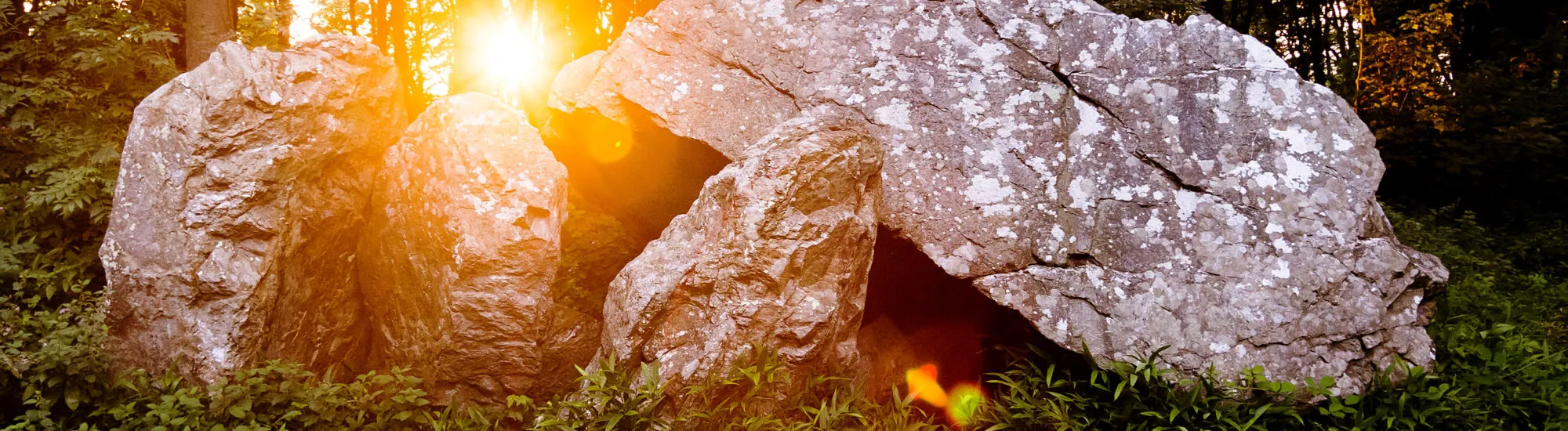
In the woodland overlooking Howth Castle, a slab more than five metres long rests at an angle on upright stones. This is Aideen’s Grave, a Neolithic tomb whose appearance has changed over the centuries. The stones tell the story of a collapsed burial chamber. Its name, meanwhile, comes from an Irish tale featuring Oscar, Oisín and the warriors of the Fianna.
At first glance, the capstone dominates the entire monument. Then look at the two tall stones that still support it. These uprights marked the entrance and give their name to this family of monuments, the portal tombs. Behind them was a single chamber, measuring around 2.60 metres long by 1.10 metres wide. The stone that closed the entrance has partly fallen inwards.
Ireland’s earliest portal tombs date from around 3800 BC. This provides a reference point for the funerary tradition to which the Howth dolmen belongs. The precise date of its construction remains uncertain. Its capstone measures approximately 5.20 metres long by 4.20 metres wide. Comparing this cover stone with the narrowness of the chamber gives an idea of the work required to move and position such a stone.
In local tradition, Aideen, also known as Étaín Fholthinn, is the wife of Oscar, son of Oisín and grandson of Fionn mac Cumhaill. When news reaches her of Oscar’s death at the Battle of Gabhra, she dies of grief. Oisín then has a tomb erected in her memory on the heights above Howth.
The tale belongs to the Fianna cycle and became attached to a monument several millennia older than itself. In the 19th century, the poet and antiquarian Samuel Ferguson drew on this tradition in The Cromlech on Howth. The poem links the memory of Aideen with the landscape of the peninsula, between the heights of Ben Éadair and the sea. The dolmen thus carries two histories: that of its funerary architecture, and that of the generations who gave it a name.
The monument appears among the rhododendrons. When they are in bloom, their colours brighten the undergrowth around the slab. For the rest of the year, the stones stand out chiefly because of their size and tilt. Take the time to view them from the side to make out the uprights and understand how the chamber opened.
The walk can be combined with a visit to the castle estate. If you continue towards Howth Harbour, you move from woodland to a very different landscape of quaysides and fishing boats. Together, the two stops offer a glimpse of the peninsula beyond its cliff path.
Want to extend your visit without having to rush around? Here are a few well-located places to stay near the must-see attractions.
Essential information to help you plan your visit, including key landmarks, access information, and booking options.
Howth Castle Demesne, accès par Howth Road, Howth, County Dublin, Republic of Ireland, Tourist sites in Ireland
53.379225, -6.082144
The estate does not publish opening hours specifically for the dolmen. Check the estate’s guidance before your visit.
Check the opening hours and admission requirements before you leave, especially during peak season or on Irish public holidays.
free