

South of Belfast, between the brick façades of Queen’s University and the lively streets of the university quarter, the Belfast Botanic Gardens offer a green escape in the heart of the city. The park covers 28 acres, or around 11 hectares, not 28 hectares as is sometimes claimed.
Its expansive lawns, mature trees and two Victorian glasshouses make it one of the locals’ favourite places for a stroll. Admission is free to the gardens, the Palm House and the Tropical Ravine: an excellent place to visit in Belfast, including when the weather takes a turn for the worse.
The Belfast Botanic Gardens were established in 1828 by the Belfast Botanic and Horticultural Society. At the time, botany captivated Europe’s elites. Explorers, merchants and collectors brought back plants from Asia, Africa, the Americas and the Southern Hemisphere, while technical advances finally made it possible to cultivate them at British and Irish latitudes.
The garden was initially funded by members’ subscriptions and remained largely reserved for subscribers. However, the public could visit on Sundays, one of the few rest days available to Belfast’s workers at the time.
In 1840, Queen Victoria granted the establishment the title of “Royal”. The gardens thus became the Royal Belfast Botanical Gardens.
Belfast Corporation, the predecessor of the present-day city council, eventually purchased the estate. It reopened in 1895 as a fully public park, under the name Botanic Gardens. It is now owned by Belfast City Council.
Belfast experienced spectacular growth in the 19th century. Linen mills, shipyards and engineering works profoundly transformed the city. The glasshouses at Botanic Gardens became a showcase for the scientific, industrial and architectural ambitions of this new metropolis.
The park still retains notable trees and plant collections inherited from that period. During the Second World War, part of its grounds was converted into allotments to contribute to the food effort.
Over time, the gardens also became an important cultural space. They occasionally host festivals, concerts and public events, while retaining their everyday role as a neighbourhood park.
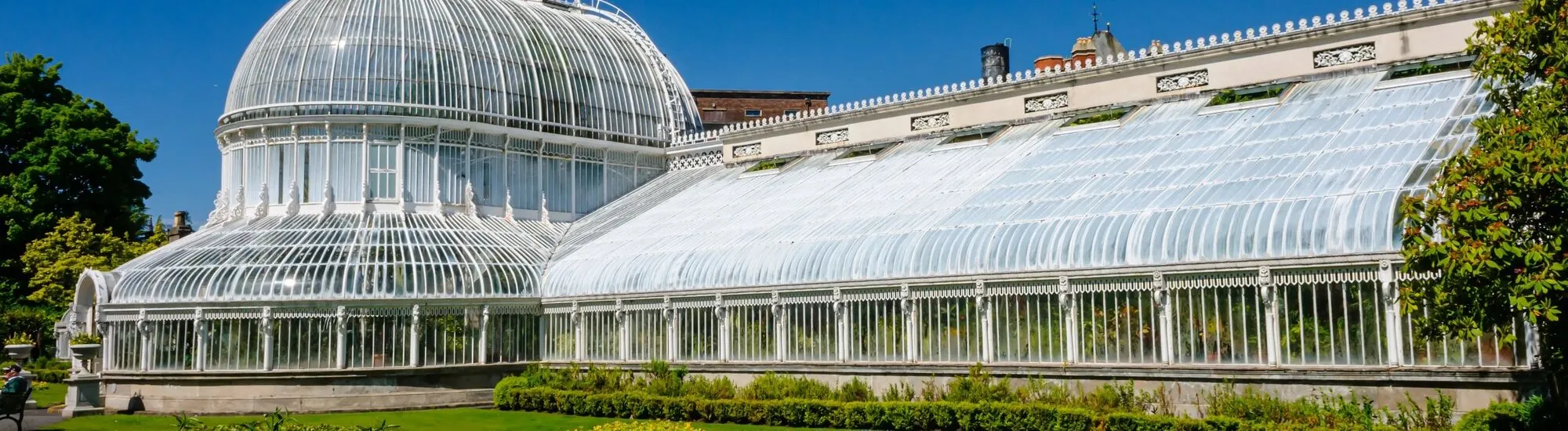
With its bright white structure, glazed wings and central dome, the Palm House is the most iconic landmark in Belfast Botanic Gardens.
Construction began in 1839, not 1939. The glasshouse was designed by the architect Charles Lanyon, who was also responsible for several major Belfast buildings, including Queen’s University’s famous Lanyon Building.
The two wings were made by the ironworker and engineer Richard Turner, a leading specialist in structures combining iron and glass. They were completed in 1840. The large central dome, intended to house palms and other tall plants, was added in 1852 by the Edinburgh firm Young.
The Palm House is therefore one of the world’s oldest examples of a glasshouse built from curved glass and iron. Its architecture belongs firmly to the Victorian era and predates Art Nouveau by several decades, so it would be inaccurate to associate its design with that artistic movement.
The glasshouse at Belfast Botanic Gardens is divided into three areas. One wing is devoted to tropical plants, while the other houses temperate plants and seasonal displays. Beneath the central dome, the available height allows palms and the largest species to spread their foliage.
Orchids, succulents, bird-of-paradise plants, ferns and plants from several continents create a setting that changes with the flowering seasons. Condensation beading on the glass and the humid warmth contrast sharply with Belfast’s often cool air.
The glasshouse remains relatively compact. Twenty to thirty minutes are enough to explore it, though botany and photography enthusiasts could easily spend longer there.
Less conspicuous from the park’s pathways, the Tropical Ravine offers a very different experience. The current building was conceived by Charles McKimm, the gardens’ first superintendent, and opened in 1889.
Rather than displaying plants on a single level, its designers made use of a natural hollow crossed by a watercourse. Visitors walk along an elevated gallery and look down on vegetation growing several metres below. This bird’s-eye view creates the impression of observing a miniature forest from the canopy.
In Victorian times, caves, mirrors, candles and a small waterfall further enhanced the theatrical character of the setting. The building was enlarged in 1900, then supplemented in 1902 by a heated pool for growing giant water lilies.
The current collection is notably inspired by a botanical inventory compiled in 1904. It includes ferns, orchids, bromeliads, cinnamon trees, banana plants and various species belonging to some of the planet’s oldest plant lineages.
Some cycads in the Tropical Ravine are more than 200 years old. These plants, which are sometimes threatened in their natural habitat, already existed in similar forms in the age of the dinosaurs.
The site is also associated with Victoria amazonica, the spectacular giant Amazonian water lily. The species was first cultivated in Ireland at Belfast Botanic Gardens in 1852 and continues to be planted there in some years.
Following a major restoration programme carried out between 2013 and 2018, the Tropical Ravine regained several elements of its Victorian architecture. At the same time, the building was modernised with a misting system, improved glazing, a lift and educational displays.
There is more to discover than the two glasshouses. The paths run through wide lawns, flower beds and rows of mature trees. The character of the park changes considerably with the seasons.
The rose garden becomes particularly appealing during the summer flowering season. The alpine garden, meanwhile, brings together plants suited to rocky ground and harsher environments. Sculptures, herbaceous borders and trees from different parts of the world punctuate the route.
The lawns are ideal for a break or a picnic. Disposable barbecues, however, are prohibited in Belfast’s municipal parks.
Belfast Botanic Gardens are surrounded by one of the city’s most vibrant neighbourhoods. Students, families, joggers and travellers mingle along the paths, giving the park an atmosphere that is more lively than solemn.
At certain times of year, concerts and events may be held on the lawns. These may affect access to certain parts of the site.
The Ulster Museum is located directly within the gardens. Admission is free, and its collections cover archaeology, the history of Ireland, natural sciences and fine art. Combining the glasshouses with the museum makes it easy to plan half a day of sightseeing, even when it rains.
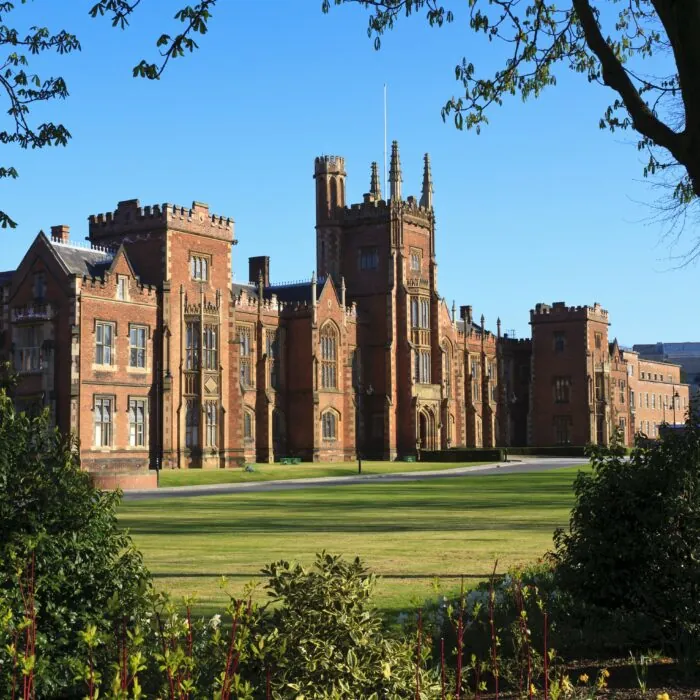
Queen’s University Belfast is also just a few steps away. Its main building, designed by Charles Lanyon, is worth seeing for its red-brick façade, reminiscent of the great British universities of the 19th century.
Nearby Botanic Avenue is home to numerous cafés, restaurants and shops. It is a good place for lunch before or after your walk.
Spring and early summer generally offer the most abundant blooms. The rose garden is particularly appealing during the summer, while autumn brings out the colours of the mature trees.
The Palm House and Tropical Ravine are interesting all year round. Their warm, sheltered atmosphere even makes them an excellent option on a cold or rainy day.
Allow around an hour for a quick walk including both glasshouses. A more comprehensive visit combined with the Ulster Museum can easily fill half a day.
Admission to Botanic Gardens, the Palm House and the Tropical Ravine is entirely free. No booking is required for a standard individual visit.
Guided tours of the Tropical Ravine are usually offered on Tuesdays and Thursdays at 2 pm, as well as on Saturdays at 11 am. It is advisable to contact the site in advance to check whether they are running and the conditions of access.
The park has several entrances on Botanic Avenue, University Road and Stranmillis Embankment. From Belfast city centre, it is around a 20- to 25-minute walk. Botanic railway station is less than ten minutes away on foot.
Metro routes 7 and 8 serve the area around the park. There is no public car park within the gardens, and parking on nearby streets is regulated.
The Tropical Ravine is accessible to wheelchair users and has a lift to the exhibition gallery. Accessible toilets and an induction loop are also available. However, some entrances to the building do not have automatic doors.
Access to the lower level of the ravine is limited and must be arranged in advance for certain activities. Visitors with particular requirements are invited to contact the team before their visit.
Essential information to help you plan your visit, including key landmarks, access information, and booking options.
College Park Ave, Botanic Ave, Queen's quarter, Queen's quarter
54.581132, -5.930521