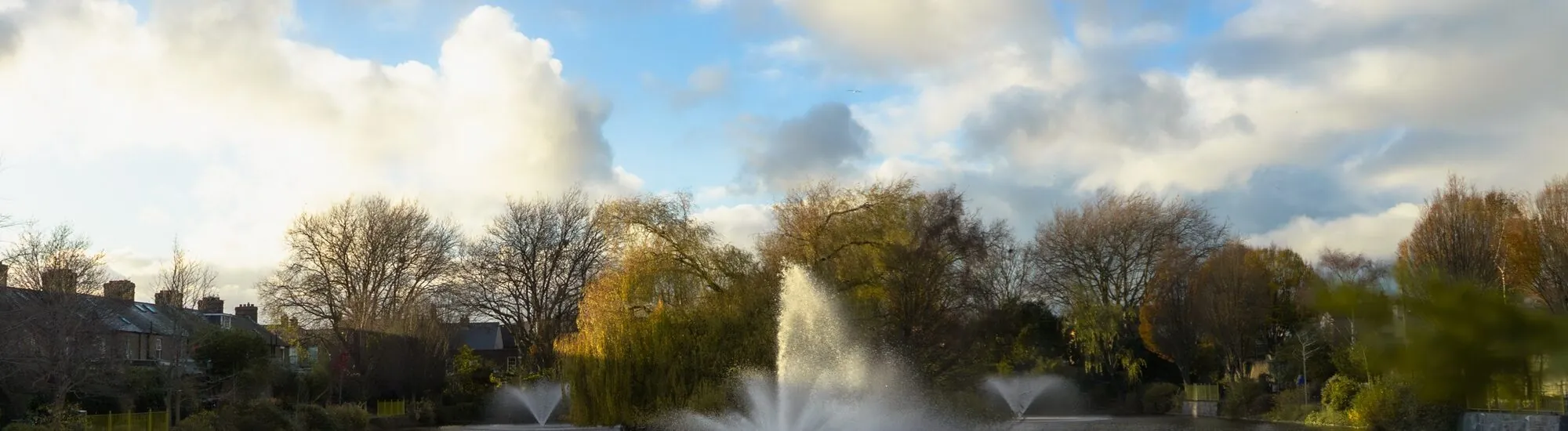
Here is one of Dublin’s best-kept secrets, sure to appeal to those who enjoy places often overlooked by tourists. Blessington Street Basin is a former reservoir in north Dublin, now offering a refreshing waterside walk. A path circles the basin, while a small planted island breaks up the reflection of the trees. Today, Blessington Street Basin feels like a neighbourhood garden. When Dublin brought the basin into service in 1810, however, it met a far more pressing need: supplying water to residents on the north side. Later, the reservoir also supplied two major distilleries. Its rectangular layout, walls and the caretaker’s house near the entrance still tell that story.
At the beginning of the 19th century, the city needed a way to store water before distributing it to homes. Blessington Street Basin entered service in 1810. Its water came from Lough Owel in County Westmeath and reached Dublin via the Royal Canal, according to the National Inventory of Architectural Heritage. Once in the reservoir, it could be distributed through the city’s water network. On the scale of Dublin, the basin was the final visible link in a journey that began far beyond its streets.
The garden’s shape remains that of the hydraulic structure. Its walls are built from local limestone, and the bottom was lined with a layer of marl clay to retain the water. Unlike a park pond dug to enhance a stroll, the basin was first and foremost intended to hold a volume of water useful to the city. Even today, the space it occupies within its enclosure explains why the paths follow the water’s edge. The garden has taken its shape from the former reservoir.
When Dublin turned to other sources for its water supply, the reservoir remained useful. It supplied, in particular, Jameson at Bow Street and Powers at John’s Lane, until the 1970s. The sources do not all place the transition at the same time: the heritage inventory describes almost exclusively industrial use from the 1860s onwards, while Visit Dublin states that the basin continued to supply homes until 1885. They agree on the role of the distilleries in its final decades of operation.
This connection adds another point of interest to a walk towards Smithfield. At the former Jameson distillery, visitors discover a production site. On Blessington Street, they can see part of the infrastructure that kept the industry running. Together, the two sites show how distilling was woven into the workings of the city, with its canals, water reserves and pipes.
At the main entrance, look at the gates aligned with the street and the small brick house to one side. It recalls the time when a caretaker lived near the reservoir. The basin’s inventory mentions a caretaker’s dwelling as early as 1811. The architectural record for the current house, recognisable by its gables and Neo-Tudor details, dates it to around 1890. This distinction explains why both dates appear in descriptions of the site.
The path along the water offers several views of the artificial island, laid out as a refuge for birds. Ducks and swans are part of life at the basin, although there is no guarantee of seeing them in the same spot from one visit to the next. Benches make it easy to enjoy the garden even if you have little time. To take in the reservoir’s layout, walk to the side opposite the entrance and look back: the long edges, island and gates form three layers that are less easy to make out on arrival.
The transformation into a garden can be seen near the entrance, on the plaque commemorating the works. It records that the site was refurbished in 1993 and 1994, then opened as a public space by President Mary Robinson on 4 November 1994. The structure that once supplied homes and distilleries became a place to walk, sit or watch birds.
From the top of O’Connell Street, allow around 15 minutes on foot. Head up towards Parnell Square, then follow Frederick Street North and Blessington Street to the gates. The park is easy to visit as a short stop. Closing times change with the season: if you are planning to visit late in the day, check the Dublin City Council page before setting off. The basin fits naturally into a walk through north Dublin, between Parnell Square and Phibsborough.
Essential information to help you plan your visit, including key landmarks, access information, and booking options.
Blessington Street, Phibsborough, Dublin, County Dublin, Republic of Ireland, Tourist sites in Ireland
53.35722, -6.26980
Opens at 10 am. Closing time varies according to the month and the clock change. Check Dublin City Council’s seasonal timetable before your visit.
Check the opening hours and admission requirements before you leave, especially during peak season or on Irish public holidays.
Free entry.