
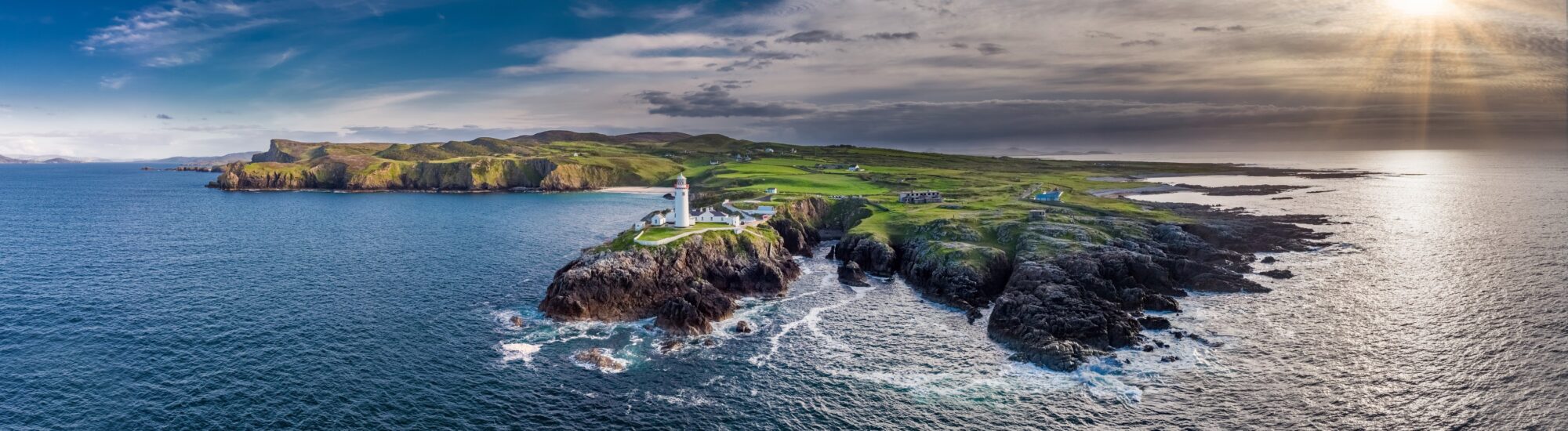
At the tip of the Fanad Peninsula, a white tower stands out against the Donegal moorland. The Atlantic stretches out before it; behind lie the more sheltered waters of Lough Swilly. When the wind rises, waves crash against the rocks and clouds seem to swallow the coast. It is in this dramatic landscape that Fanad Head Lighthouse stands watch, one of Ireland’s most iconic lighthouses.
Still operational, Fanad Head has guided ships for more than two centuries. Today, visitors can tour its tower, discover the former keepers’ accommodation and even stay overnight on site. It is a complete maritime experience in one of County Donegal’s wildest regions.
The construction of the lighthouse is closely linked to one of the most tragic shipwrecks to occur in the waters of Lough Swilly.
On the night of 4 December 1811, the Royal Navy frigate HMS Saldanha was attempting to reach the shelter of the lough as a violent storm swept the coast. The ship struck the rocks of Carraig Dhónaill, near Fanad Head, before running aground in the Ballymastocker Bay area.
More than 250 people died, including Captain William Pakenham. According to local tradition, the ship’s parrot, found some time later, was the only survivor.
After the disaster, Royal Navy Captain Hill wrote to the Ballast Board to request the construction of a lighthouse at the entrance to Lough Swilly. He believed that a light visible from offshore might have prevented the wreck.
The project was approved and work began in 1815, with an initial budget of £2,000. The lighthouse was designed by George Halpin Senior, an engineer responsible for numerous maritime works around the Irish coast.
Fanad Head’s light was first illuminated on 17 March 1817, St Patrick’s Day. Lamps fuelled by whale oil and parabolic reflectors then produced a red light towards the Atlantic and a white light towards Lough Swilly.
The first tower was not tall enough to be fully visible from the Atlantic. During the 1870s, maritime authorities therefore considered several ways to improve the range of the light.
A taller new tower was eventually built. It entered service on 1 September 1886 and makes up most of the lighthouse visible today.
The tower measures 22 metres from its base to its summit, excluding the lantern. The light stands 39 metres above sea level. Reaching it requires climbing 76 steps: 59 granite steps arranged in a spiral and 17 ladder-like steps.
The lighthouse’s operation evolved regularly. The old lamps were replaced, the optics modernised and the site gradually electrified. In 1975, the station switched to electric operation without a permanent night watch.
By 1978, only a principal keeper remained on site. When he retired on 30 September 1983, Fanad Head became a station overseen by a part-time keeper, with no permanent presence in the tower.
Contrary to what the former article stated, the lighthouse is therefore no longer occupied full-time by a keeper. The former accommodation has been restored and is now available to travellers.
Fanad Head is a fully operational lighthouse managed by the Commissioners of Irish Lights. Its primary role remains to safeguard navigation at the entrance to Lough Swilly and along Donegal’s northern coast.
The lighthouse emits a sequence of five white or red flashes every 20 seconds. The red sectors warn mariners of hazardous areas, including the reefs and rocks around the entrance to the lough.
The white light has a nominal range of 18 nautical miles, or around 33 kilometres. The red sectors are visible up to 14 nautical miles, around 26 kilometres. This range naturally depends on weather conditions and visibility.
The system operates automatically and the equipment is monitored remotely. Technicians nevertheless carry out maintenance on the optics, electrical installations and various navigation devices.
The guided tour takes visitors inside the tower and introduces the daily lives of the keepers who once lived on this isolated headland. The guides are from the area and cover both the history of the lighthouse and that of the Fanad Peninsula.
After discovering the former equipment and stories of shipwrecks, visitors climb the tower’s 76 steps. From the top, the view extends across the Atlantic, Lough Swilly, the Donegal coast and the hills of the peninsula.
The climb includes narrow steps and a final section more akin to a ladder. Children must be at least 1.20 metres tall to enter the tower. Those below this height may visit the exhibition spaces, but must remain at the foot of the tower with an adult.
Audio guides are available in French, English, Irish, German, Spanish and Italian.
The experience also includes several areas devoted to marine wildlife, former keepers and the shipwrecks of Lough Swilly. A virtual-reality reconstruction allows visitors, in particular, to relive the storm and the wreck of HMS Saldanha.
Booking a time slot before your visit is recommended. Tickets can be bought online until the day before. A limited number of places may still be available on the day, but this is not guaranteed.
Three former keepers’ cottages have been restored at the foot of the lighthouse: Dunree View, Inishtrahull View and Tory View. They can be booked year-round as self-catering houses.
The experience allows you to remain on the headland after visitors have left. Once night falls, the lighthouse beam regularly sweeps across the landscape, while the sounds of wind, waves and seabirds replace the bustle of the day.
Accommodation rates vary according to the property, dates and length of stay. Booking well in advance is strongly advised, particularly in summer and at weekends.
The accommodation accepts pets subject to the terms stated at the time of booking.
The lighthouse is only one stop among the landscapes of the Fanad Peninsula. Ballymastocker Bay beach, also known as Portsalon Beach, forms a long stretch of sand beside Lough Swilly.
Further north, narrow roads run through moorland, pasture and small villages, some of which lie in the Gaeltacht, the regions where Irish is still spoken in everyday life.
Mulroy Bay separates the Fanad Peninsula from the Rosguill Peninsula. Its sheltered waters contrast with the cliffs and waves of the Atlantic coast.
The area is also of interest for seabird watching. Dolphins, seals and sometimes whales may be spotted from the coast, though their presence cannot be guaranteed.
Essential information to help you plan your visit, including key landmarks, access information, and booking options.
55.276129, -7.632460
1h30
As opening times may change due to weather, technical operations or special events, it is essential to check the official Fanad Lighthouse website before travelling.
Check the opening hours and admission requirements before you leave, especially during peak season or on Irish public holidays.
The visit includes the outdoor areas, exhibitions and a guided climb of the tower for those who meet the access requirements. Children must be at least 1.20 metres tall to climb the tower.