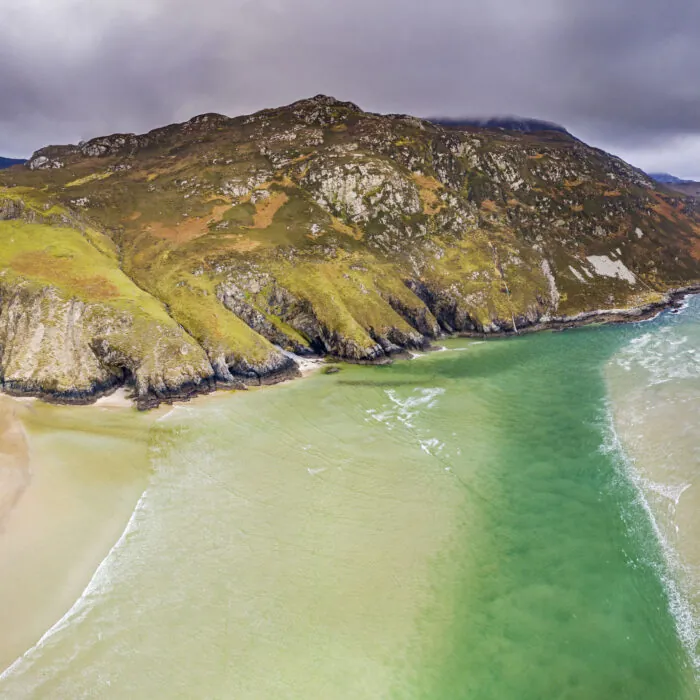


In south-west County Donegal, Glengesh Pass is one of those roads where the journey becomes a discovery in its own right. A few kilometres from Ardara, the road climbs in hairpin bends between broad grassy slopes before revealing a deep valley. The road’s curves, farmland and surrounding contours create a spectacular landscape, where the light can change within minutes.
The pass is mainly explored by car, with a stop at the viewpoint to take in the valley. Cyclists can also tackle it, though it requires sustained effort. It is worth distinguishing this scenic road from a developed hiking site, however: the presence of mountains does not guarantee waymarked trails accessible from the summit.
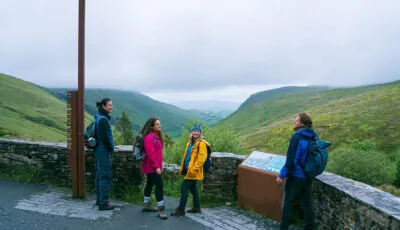
Glengesh Pass – © Big Style Media – Fáilte Ireland
Glengesh Pass lies on the R230, on the route linking Ardara with the Glencolmcille area. The N56 leads to Ardara, but it does not cross the pass.
Approaching from Ardara, the road follows the valley uphill before reaching the sharpest bends. As you go, the scale of the landscape gradually becomes clear: houses shrink to small landmarks, field boundaries trace the valley floor and the slopes frame the road.
The route can be travelled in either direction. From Ardara, you discover the valley on the ascent; approaching from the other side, the hairpin bends come into view as you descend. Above all, choose the direction that fits your itinerary, rather than making extra detours in search of a particular view.
The designated viewpoint is the essential stop. Once parked in an authorised space, take a few minutes to look across the whole valley rather than focusing only on the road.
The contrasts are what make the panorama so appealing: open slopes, enclosed fields, darker contours and the ribbon of road folding back on itself. Beneath a changeable sky, breaks in the cloud can light up one part of a hillside while the rest remains in shadow.
Allow around 20 to 30 minutes for the panoramic stop, or longer if you enjoy photography. This is a suggested duration for the stop itself, in addition to driving time from your previous destination.
The main challenges are the sharp bends, steep gradients and limited visibility around certain corners. Adjust your speed, keep left and anticipate the possibility of a car, cyclist or larger vehicle around the next bend.
There is no need to describe the road as being consistently in poor condition: its state can change. Focus instead on the conditions that day, including a wet road surface, fog or heavier traffic than expected.
On descents, use an appropriate gear to control your speed. If you are driving a hire car, familiarise yourself with the controls before tackling the pass. Steady, unhurried driving makes for a more relaxed journey.
The hairpin bends may tempt you to stop for countless photographs, but only pull over in places where parking is permitted. Do not stop on a bend, on a narrow stretch of road or in front of a farm entrance.
Drivers can enjoy the panorama once parked. If you are travelling with others, passengers can take in the scenery on the ascent, then everyone can enjoy the same freedom at the viewpoint.
If you are travelling in a motorhome or a large vehicle, plan your crossing with your vehicle’s size and your confidence on winding roads in mind. Do not assume that you will be able to turn around anywhere. If the route feels too challenging, choose one better suited to you before setting out.
By bike, Glengesh Pass is best suited to those able to manage a sustained climb and a descent on an open road. The bends and gradient demand as much attention as physical fitness.
Check your brakes, carry water and wear visible clothing. Wind can make progress more difficult and cool you down quickly during a stop. Plan a ride whose overall distance remains suited to your ability: reaching the pass is only one part of the route.
The viewpoint lets you discover the landscape without setting out on a hike. The road’s bends are not a developed walking route, however, and the surrounding land is not automatically accessible.
To explore the high ground, look for a documented route with authorised access, then check its grade and conditions. Do not set off at random across fields assuming that a path visible from the car park forms a waymarked loop.
If walking is your main aim, plan this activity separately. You can then combine a suitable hike in the area with a stop at Glengesh, without confusing the two experiences.
To appreciate the pass, visibility matters more than bright sunshine. A cloudy sky can offer beautiful light, while dense fog hides the valley and makes driving more difficult.
Check the weather before you set off and leave some flexibility in your schedule. If conditions deteriorate, slow down and do not insist on reaching another viewpoint at all costs. A waterproof jacket is still useful for your stop, even when the weather seems mild in Ardara.
Glengesh Pass combines naturally with a stop in Ardara and continuing your journey towards Glencolmcille. Allow time for the minor roads: distances may seem short on a map, but the bends and stops pleasantly slow your progress.
Avoid cramming the day with too many far-flung stops. The pass is best discovered without rushing, allowing time to get out of the car, take in the contours of the landscape and wait for a break in the clouds.
Want to extend your visit without having to rush around? Here are a few well-located places to stay near the must-see attractions.
Essential information to help you plan your visit, including key landmarks, access information, and booking options.
Leamagowra, Ardara, County Donegal, Republic of Ireland, Tourist sites in Ireland
54.720591, -8.484578