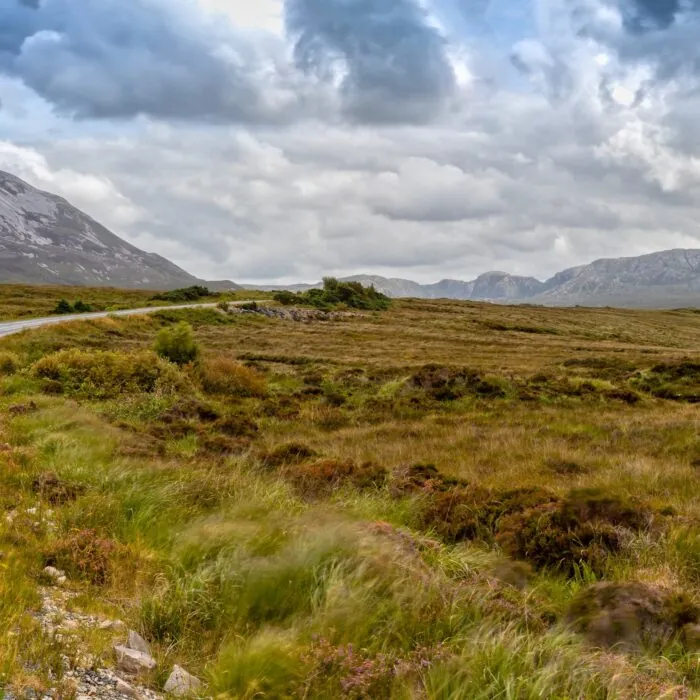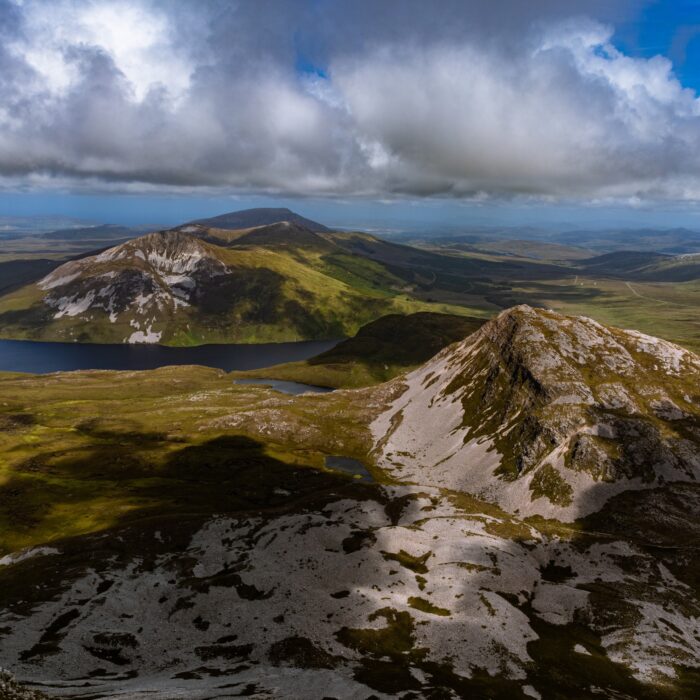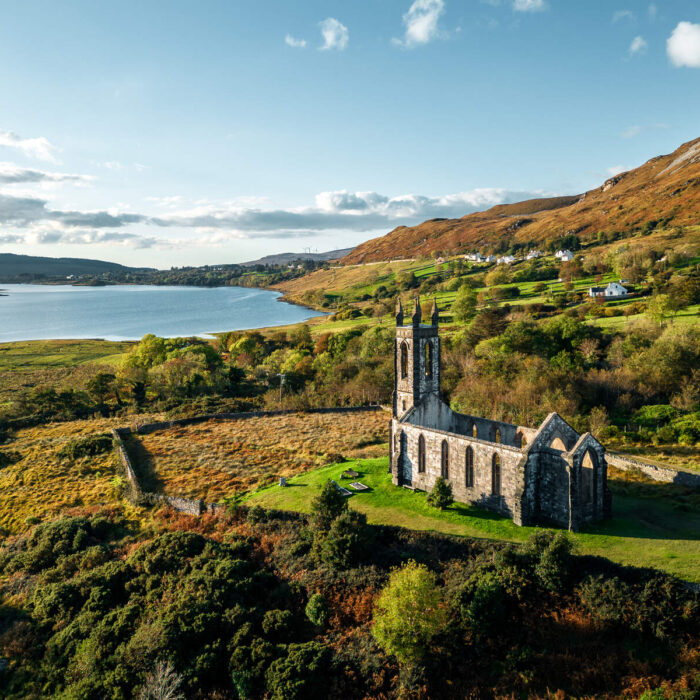


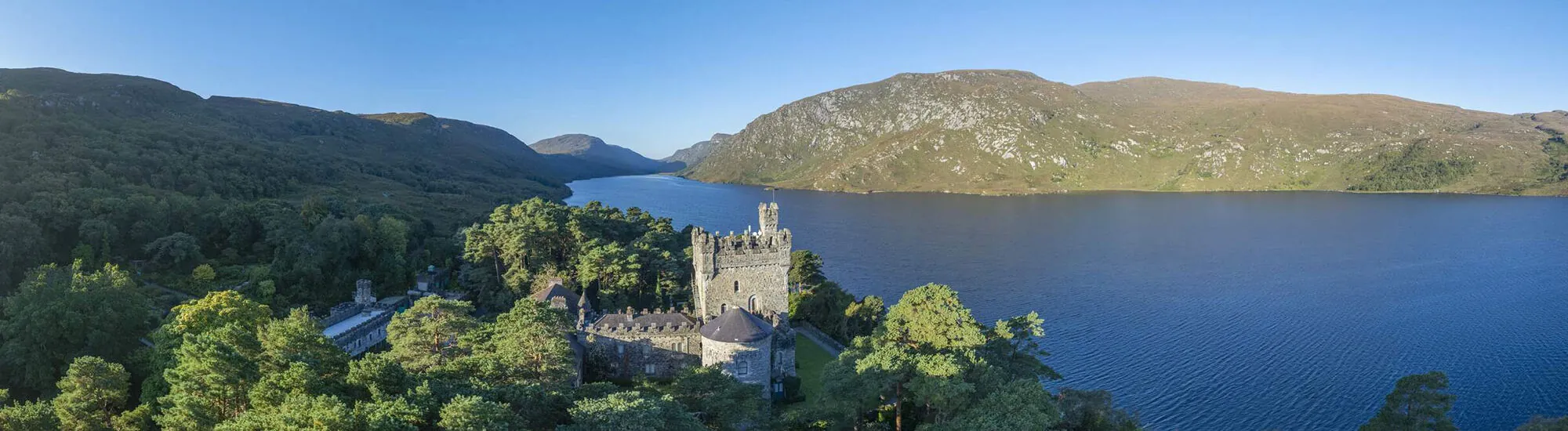
In a wild Donegal valley, Glenveagh Castle stands on the shores of Lough Veagh, facing the Derryveagh Mountains. Built of local granite between 1867 and 1873, this imposing Victorian residence appears to have been set down in the midst of a landscape that has remained untouched for centuries.
Now part of Glenveagh National Park, the castle is open to visitors for part of the year. Its apartments, gardens and mountain setting make it one of County Donegal’s most remarkable sites.
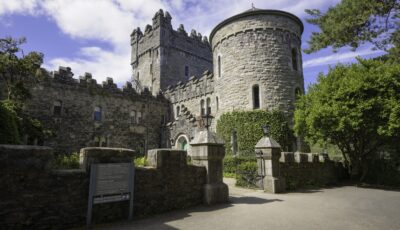
Glenveagh Castle in County Donegal – © trattieritratti
The estate’s history truly begins in 1857, when John George Adair, a wealthy Irish landowner born in County Laois, acquired several properties in the Glenveagh Valley. He wanted to transform this remote area into a vast private estate devoted to hunting and the appreciation of nature.
Construction of the castle began in the late 1860s. The plans were entrusted to the architect John Townsend Trench, who conceived a fortified residence inspired by Ireland’s ancient tower houses and the romantic retreats of the Highlands.
The main building takes the form of a powerful rectangular keep, surrounded by towers, battlements and several residential wings. Yet behind its medieval appearance lies a quintessentially Victorian country house, designed to welcome wealthy guests in the heart of a spectacular landscape.
John George Adair’s name remains inseparable from a traumatic episode in Donegal’s history. In April 1861, more than 200 people from around 40 families were evicted from their homes in the Derryveagh Valley.
These evictions took place after the Great Famine, not during it. Adair accused his tenants, in particular, of supporting those responsible for the death of one of his employees. He also wished to exert greater control over his estate and develop his livestock farming and hunting activities.
Accompanied by the police, the landowner’s agents demolished or made several houses uninhabitable. The families driven from the valley had to find shelter nearby or emigrate to Australia and other territories.
Known as the Derryveagh Evictions, this operation has left a lasting mark on local memory. It earned Adair a reputation as a ruthless landlord, one that remains very much present in Donegal’s stories. A free exhibition devoted to these events can be seen at the park’s Visitor Centre.
After John George Adair’s death in 1885, his wife Cornelia continued to develop Glenveagh. American by birth, she enriched the interiors, expanded the gardens and gradually transformed the estate into a fashionable residence.
The castle subsequently changed hands several times before being acquired in 1937 by Henry Plumer McIlhenny. This art collector from Philadelphia brought a new elegance to Glenveagh. He furnished its rooms with carefully selected furniture, textiles and works of art, while continuing to develop the gardens.
McIlhenny welcomed many figures from the worlds of art and culture to Glenveagh. The actress Greta Garbo is said to have stayed at the castle, as did Charlie Chaplin and several members of international high society.
In 1975, Henry McIlhenny sold a large part of the estate to the Irish State. He then gifted the castle, the gardens and much of their furnishings to the nation in 1983. Glenveagh National Park opened to the public in 1984, followed by the castle in 1986.
A visit allows you to enter the principal reception rooms and private apartments. Contrary to what its austere silhouette might suggest, the castle’s interior has a warm and refined atmosphere.
The drawing rooms still display some of the furnishings collected by Henry McIlhenny. Wood panelling, tapestries, bookcases, paintings and decorative objects offer a glimpse of life in this isolated residence during the 20th century.
In 2026, self-guided visits are available. Information is provided in several languages, as well as in Braille. Guided tours are less common and are mainly intended for specialist groups with advance bookings.
Numbers may be limited. It is not possible to book a time slot in advance for an individual self-guided visit: tickets are sold on site, subject to availability.
Glenveagh’s gardens create a striking contrast with the surrounding bogland and mountains. Their relatively sheltered microclimate has made it possible to acclimatise plants from very different regions.
Visitors can explore a walled garden, terraces, woodland areas and several flower-filled spaces arranged around the castle. Rhododendrons, ferns, exotic trees and colourful beds create a setting that changes with the seasons.
Access to the gardens is free and available all year round. Some areas may, however, be closed for conservation or safety reasons. Several sections also have steps, steep slopes and uneven surfaces.
The main car park and Visitor Centre are around 3.5 kilometres from the castle. Private vehicles are not generally permitted to travel as far as the building.
A path running alongside Lough Veagh leads to the castle on foot. This easy, mostly level walk takes around 40 to 50 minutes each way. The route offers beautiful views across the lake and mountains.
An electric shuttle also runs between the Visitor Centre and the castle throughout the day. The first departure for the castle is scheduled for 9.30 am, the last departure from the Visitor Centre at 4.30 pm, and the final return journey from the castle at 5.15 pm.
Shuttle tickets are sold at the Visitor Centre and at the castle reception. Dogs are not allowed on board, with the exception of assistance dogs.
Essential information to help you plan your visit, including key landmarks, access information, and booking options.
Gartan Mountain, Church Hill, Glenveagh National Park, Glenveagh National Park
55.036288, -7.968723
45 minutes
Glenveagh National Park is open free of charge all year round. Opening hours nevertheless vary according to the area and the season.
Visitor Centre: open daily from 9.15 am to 5.30 pm.
Glenveagh Castle: self-guided visits are available on Tuesdays, Wednesdays, Thursdays, Saturdays and Sundays. The castle is closed on Mondays and Fridays, except on certain bank holidays.
The castle interior is generally open from 9.45 am to 5.15 pm. Last admission is at 4.45 pm.
Shuttle: first departure for the castle at 9.30 am, last departure from the Visitor Centre at 4.30 pm, and final return journey from the castle at 5.15 pm.
The castle closes during Christmas week. Other closures may be decided at short notice. It is therefore recommended that you check opening hours on the official Glenveagh website before travelling.
Check the opening hours and admission requirements before you leave, especially during peak season or on Irish public holidays.
Entry to Glenveagh National Park, access to the Visitor Centre, parking and access to the gardens are free. Entry to the castle interior and the shuttle service are charged.
Self-guided castle visit:
Guided tour, by booking and subject to availability:
Return shuttle:
A single journey costs €3 per adult and €2 at the reduced rate. This option allows you, for example, to take the shuttle to the castle and then walk back along Lough Veagh.