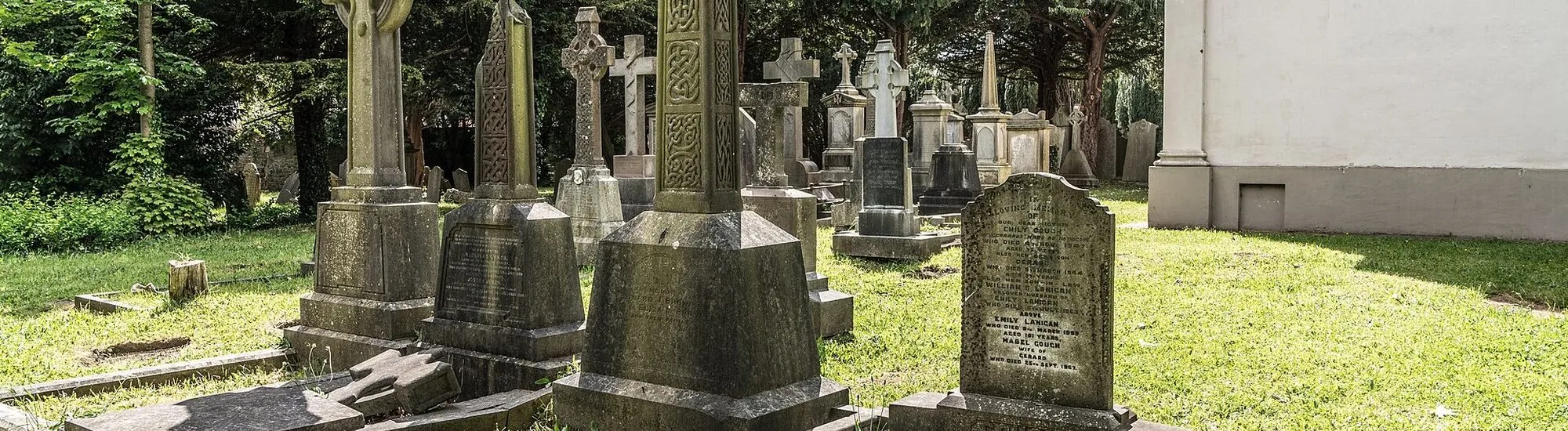
In Inchicore, near the Grand Canal, the high walls of Goldenbridge Cemetery enclose a small, tree-lined burial ground. A neoclassical chapel stands among the graves. Beneath the building, vaults were intended for guards and their dogs: at the time, the dead had to be protected from body snatchers. Goldenbridge also tells a less dramatic but more decisive story for Dublin families: the right to bury loved ones according to the rites of their choice.
At the beginning of the 19th century, Catholic families in Dublin did not always have a place where they could freely observe their funeral rites at the graveside. The Dublin Cemeteries Trust links the founding of Goldenbridge to this situation. Daniel O’Connell, a leading figure in Catholic Emancipation, and the Dublin Cemeteries Committee sought to provide a dignified burial space for people of all faiths, as well as those of none. According to the organisation that manages the site, the cemetery opened in 1828. The same committee later opened Glasnevin Cemetery in 1832.
You may also come across the date 1829, which appears in the National Inventory of Architectural Heritage, placing the cemetery’s establishment in the context of Catholic Emancipation. The Dublin Cemeteries Trust gives 1828 as its opening date. At Goldenbridge, the significance of this history becomes clear in the site itself: land laid out for burials, with its own walls, paths and chapel, separate from the parish churchyard model surrounding a church.
Richmond Barracks presents Goldenbridge as Ireland’s first garden cemetery. The site is modest in size, making it easy to appreciate its layout without covering long distances. Mature trees, paths running between the graves and walls separating the grounds from the surrounding neighbourhood give the cemetery an atmosphere quite distinct from the street outside. As you walk through it, rows of modest headstones give way to more elaborate monuments. This variety of forms and inscriptions is part of the site’s heritage interest.
The mortuary chapel, completed in 1835 according to the Dublin Cemeteries Trust, serves as a landmark. Its columned façade and pediment resemble a small temple. This carefully considered architecture also concealed security measures. The site manager explains that a staircase built into the walls allowed guards to climb onto the roof and keep watch over the surrounding area. The boundary walls had been completed before the first burials. They reassured families at a time when bodies could be exhumed and sold for anatomy teaching.
The vaults beneath the chapel were fitted out for the guards and their dogs, described by the Dublin Cemeteries Trust as Cuban bloodhounds. It is one of the episodes recounted on guided tours. The layout of the buildings makes more sense when you consider what the team had to watch: the entrances, the areas around the walls and recent graves. The presence of the guards also offers another way of reading the chapel. It was a place for quiet reflection, but also part of a system designed to protect the graves.
Those buried here include W. T. Cosgrave, who died in 1965 and chaired the Executive Council of the Irish Free State. His life connects the cemetery with the birth of the new state’s institutions. The guided tour also explores stories on a neighbourhood scale, including that of Eugene Lynch, who was killed in 1916 at the age of eight. A new headstone marks his grave. This stop is a reminder that the Easter Rising also affected Dublin residents who were not fighting.
Goldenbridge resumed offering new burials in 2017. Its paths are therefore still used by families who come to pay their respects. During your visit, stay on the paths wherever possible and give space to people gathered around a grave. The cemetery is discovered as much through its stories as through the place it continues to hold in neighbourhood life.
The guided tour starts at Richmond Barracks, near Bulfin Road. The organiser estimates an eight-minute walk to the cemetery entrance and a total duration of around one hour and 15 minutes. The route takes place outdoors, on grassy paths that can sometimes be uneven. Wear suitable footwear, and ask the team for advice before booking if you have particular mobility needs.
To reach the cemetery directly, the Dublin Cemeteries Trust states that Drimnagh stop on the Luas Red Line is less than 100 metres away. Check the site’s opening times for an independent visit and Richmond Barracks’ slots for the guided tour. If you are spending half a day in western Dublin, you can continue on to Kilmainham. The barracks, cemetery and nearby prison shed light on three different aspects of local history: military life, family memory and the history of imprisonment.
Want to extend your visit without having to rush around? Here are a few well-located places to stay near the must-see attractions.
Essential information to help you plan your visit, including key landmarks, access information, and booking options.
St Vincent Street West, Inchicore, Dublin, County Dublin, Republic of Ireland, Tourist sites in Ireland
53.336417, -6.316405
The Dublin Cemeteries Trust gives opening hours of 9.30 am to 3 pm daily for the gardens and burial grounds. For the guided tour, check Richmond Barracks’ available slots. Stated duration: around 1 hour 15 minutes.
Check the opening hours and admission requirements before you leave, especially during peak season or on Irish public holidays.
Guided tour: adults €10, concession €8, children aged 5 to 17 €6, according to Richmond Barracks. Times and booking.