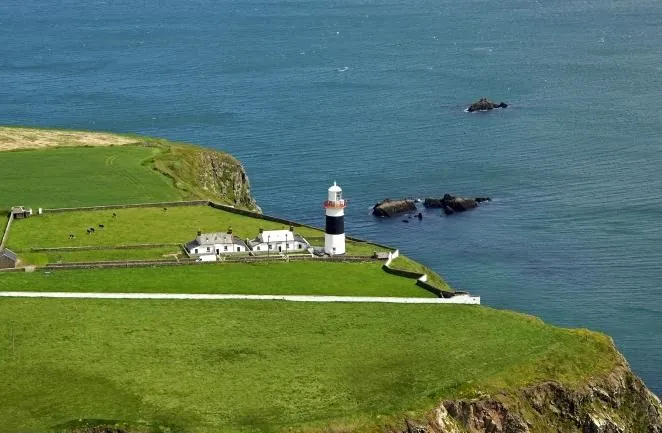
At the tip of a headland in County Waterford, a white tower banded in black stands out above the Celtic Sea. Mine Head Lighthouse has watched over this stretch of coast since 1851. Around it, fields, cliffs and the former keepers’ cottages form a maritime landscape that remains largely undeveloped for tourism. The lighthouse is intriguing for its setting: its tower stands 21 metres high, yet its light overlooks the sea from 87 metres above high-water level.
This striking silhouette is well worth exploring through its history. However, there is one essential limitation to bear in mind before planning a visit: Mine Head is an operational lighthouse, with no public visits advertised, and it is reached via a private road. It should not, therefore, be treated as an open monument with freely accessible parking and walking paths.
In the 19th century, improving the safety of the approaches to Youghal and Cork prompted lengthy debate. Merchants and shipowners called for a new light. Construction began on Capel Island, off Knockadoon Head, but the engineer George Halpin argued for another location: Ballymacart Head, now known as Mine Head.
The wreck of the steamship Sirius in January 1847 brought the issue back into focus. The vessel struck Smith’s Rock, near Ballycotton, in dense fog. The inquiry recommended two lighthouses to improve marking in this area. The Capel Island project was eventually abandoned in favour of Ballycotton and Mine Head. Both lights were lit on 1 June 1851. Their shared history is a reminder that these towers form part of a network: for sailors, each light complements the landmarks along the neighbouring coast.
Designed by George Halpin Senior, Mine Head has a circular tower that tapers towards the top. A gallery encircles the lantern, which is crowned by a metal dome. The masonry details and ancillary buildings deserve as much attention as the overall silhouette: the National Inventory of Architectural Heritage notably highlights the quality of the stonework and the preservation of the ensemble.
The keepers’ cottages are a reminder that the lighthouse was also a place to live. On this exposed headland, the residential and service buildings formed a small station organised around maintaining the light. Their presence gives the landscape a human scale: behind the tower seen by ships offshore, people had to live, work and ensure that the signal continued uninterrupted.
The black band against the white background also serves a purpose. The colours make a lighthouse identifiable by day, while its light pattern distinguishes it at night. It is a way of reading the coastline that turns these monuments into true landmarks.
Mine Head was electrified in 1964 and has operated without permanently stationed keepers since 1973. Its equipment was subsequently modernised. Automation did not mark the end of its role: the lighthouse remains an aid to navigation operated by the Commissioners of Irish Lights.
To understand its dimensions, it is important to distinguish between the height of the tower and that of the light. The 21 metres refer to the building; the 87 metres indicate the elevation of the light above high-water level. It is the headland’s terrain that gives the lighthouse such a commanding position. Its technical specifications are published by Irish Lights, the body responsible for its operation.
Mine Head is located in Monagoush, in the Old Parish area — An Sean Phobal in Irish — south of Dungarvan. Along with Ring, Old Parish forms part of the Waterford Gaeltacht, a region where the Irish language retains a place in local life. The lighthouse is therefore in the western part of the county, not near Tramore.
From Dungarvan, a car makes it easier to explore the surrounding area. However, make a clear distinction between reaching Old Parish via public roads and accessing the lighthouse station. The lighthouse coordinates pinpoint the building; they do not indicate a public car park or the start of an authorised walk.
No regular public visits to the tower are advertised. The Old Parish community website states that the lighthouse is not open to the public. You should therefore not plan to climb to the lantern, visit the keepers’ cottages or enter the grounds.
For any exterior approach, do not regard a route shown on a walking app as permission to pass. Before using a private road, obtain the agreement of the relevant owners or managers. An open gate does not constitute permission. Without confirmed access, do not attempt to reach the lighthouse by crossing fields or seeking a route along the cliffs.
There is no sufficiently established visitor route here to promise a walking time, parking at the destination or access suitable for pushchairs and wheelchairs. This is vital information if you are travelling with family or have limited time.
If you have permission to approach, choose calm weather and good visibility. A telephoto lens or binoculars will allow you to observe the tower from a distance, without trying to reach the cliff edge. The contrast between the pale buildings, the black band and the coastal landscape is what makes the subject so compelling; there is no need to frame your shot above a sheer drop.
Wear shoes with good grip and a windproof jacket. Keep well away from changes in slope, especially on wet grass, and turn back in strong gusts. On narrow roads, do not park in front of a farm entrance or in a space needed for vehicles to pass each other. Finally, do not bring a picnic expecting visitor facilities at the lighthouse: this is not a site developed for visitors.
Mine Head will appeal above all to lighthouse and maritime heritage enthusiasts willing to check access conditions before travelling. For a day out in County Waterford, keep Dungarvan and the landscapes of Old Parish on your itinerary, without making your entire outing dependent on access to the headland.
If your main aim is to enter a tower and discover how it works, choose a lighthouse that explicitly offers visits instead. Mine Head offers a different encounter with the coast: that of a facility still at work, whose beauty should not obscure either its purpose or its access restrictions.
Essential information to help you plan your visit, including key landmarks, access information, and booking options.
Monagoush, Old Parish (An Sean Phobal)
51.9926, -7.5870833
Lighthouse not open to public visits. No regular visitor opening hours are advertised. The tower and its grounds should not be considered accessible 24 hours a day. Any potential approach via the private road requires prior agreement; if access is granted, favour daylight hours and calm weather.
Check the opening hours and admission requirements before you leave, especially during peak season or on Irish public holidays.
No ticketing or regular public visits are advertised. No admission charge applies to a tourist service open to the public. This does not constitute permission to access the site: the approach road is private and the station is not freely accessible.